The Departed

Departed1

Movie review by Greg Carlson

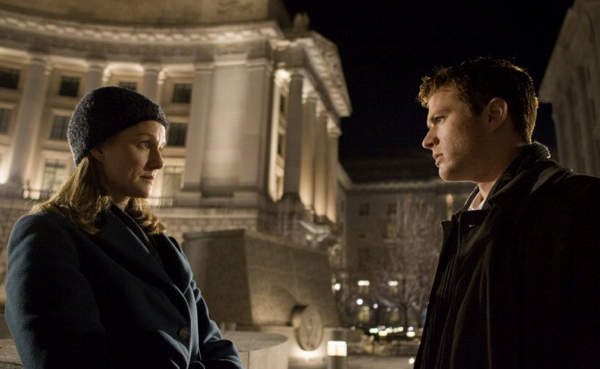
Trust Martin Scorsese to deliver the goods even when the picture he’s serving on a silver platter is a remake of a Hong Kong mole movie with a tantalizingly preposterous premise. Massive suspension of disbelief is required to buy a set-up in which a mobster grooms an underling to infiltrate the police department even as an undercover cop manages to breach the same mobster’s own inner circle. Think about it too much and the whole thing collapses like a house of cards, but buckle up for the ride and “The Departed” is likely to stick to your ribs a whole lot longer than “The Aviator” and “Gangs of New York.”

With this welcome abandonment of overlong, fussy period pieces, critics have strained their keyboards trying to come up with ways to bear-hug Scorsese, the potentate of contemporary American gangster cinema, the first two “Godfather” movies notwithstanding. While “The Departed” is no “GoodFellas,” it is one of the veteran filmmaker’s strongest theatrical features in years, in no small part due to a rollicking screenplay by William Monahan, who serves up heaps of delicious dialogue to counterbalance the snaky turns of the convoluted plotting.

While Scorsese’s trademark craftsmanship, abetted by longtime collaborators like DP Michael Ballhaus and editor Thelma Schoonmaker, works like crazy glue, an armful of colorful star turns further stacks the deck. Leonardo DiCaprio, making his third feature with Scorsese, is at last well-suited for the role in which he is cast. Matt Damon is comfortable on the familiar turf of the movie’s Boston setting, and he’s got the authentic-sounding accent to prove it. The flashiest role, however, belongs to Jack Nicholson, whose deviant thug Frank Costello marks another standout character in the great performer’s impressive arsenal. Costello’s voracious appetite for sex and violence laces the film with a lethal combination of humor and menace. Squeamish viewers should be warned: “The Departed” has more head shots than a modeling agency file cabinet.

Filled with quicksilver exchanges, Monahan’s script trades in beautifully crafted put-downs and wonderfully vulgar insults. Nicholson, Alec Baldwin, and especially Mark Wahlberg, who nimbly steals all the scenes in which he appears, are the chief beneficiaries of Monahan’s gift of gab. The script ripples with hilarious, foul-mouthed taunts, often delivered so rapidly that great lines are buried by even better ones. Occasionally, Scorsese is unable to corral Nicholson, but honestly, who cares? Nicholson’s Costello is such a juicy role, you can practically see the electrical charges whenever he appears on the screen.

For Scorsese fanatics keeping score, “The Departed” is not without noticeable flaws. Linking the two double-agents through a love triangle with Vera Farmiga’s shrink is a strategy that doesn’t pay off (and didn’t exist in the original “Infernal Affairs”). Also, at two and a half hours, “The Departed” nearly overstays its welcome. The story threads need so much attention that elements of character, especially the relationship between Costello and Damon’s Colin Sullivan, are merely implied when they should be fleshier. Even so, “The Departed” only strikes a few sour notes. The vast majority of Scorsese’s latest composition provides the cinematic equivalent of soaring arias and dazzling guitar solos.


The Heart of the Game

Heartofthegame1

Movie review by Greg Carlson

An entertaining if not always polished sports documentary along the lines of “Hoop Dreams,” “The Heart of the Game” presents the sometimes curious story of the Roosevelt High School Roughriders girls basketball team in Seattle, Washington. Peopled largely by white, middle and upper middle class students, Roosevelt saw its hardwood fortunes turn around with the arrival of University of Washington accounting teacher Bill Resler, a neophyte coach whose daughters had once attended Roosevelt. Director Ward Serrill frames the first part of the film around the unorthodox Resler, who immediately does away with any offensive strategy in favor of a relentless full-court press.

Resler miraculously turns the Roughriders into one of the most explosive teams in the state, and with each season, he introduces a new theme to his teenage gym rats. With evocative monikers like “Pack of Wolves” and “Tropical Storm,” these themes are as amusing to the audience as they are to Resler’s players. Something about them, however, resonates with the girls, who gleefully shout “Draw Blood!” during time-out huddles. Resler’s oddball strategies pay off, and attendance at games soars. Amazingly, Serrill followed the ups and downs of the team for seven years, which provides a real sense of continuity as the various story threads emerge and evolve.

Strangely, Serrill only highlights a few of the Roughriders as individuals, a frustrating tactic that no doubt disappointed some of the girls who fade into the background. Despite a gripping – but all too brief – glimpse at one player’s sexual victimization, “The Heart of the Game” shifts its attention during its second half to Darnellia Russell, a phenomenal basketball player whose decision to attend Roosevelt, and play on a team with mostly affluent white players, provides Serrill with the opportunity to comment as much on race as he does on gender. Russell’s off-court struggles, including a frustrating eligibility fight that ends up before a judge, make for engrossing viewing.

Serrill strains to make Russell the central story of his film, but many observers will be left wondering why more time was not spent examining the intense cross-town rivalry between the Roughriders and the Garfield High School Bulldogs, coached by two-time All-American and former Harlem Globetrotter Joyce Walker. Perhaps Serrill did not have the same kind of access to Walker as he did to Resler. Whatever the reason, it’s too bad, since Walker is every bit as intense and interesting as Resler.

Although the movie doesn’t seem to be aimed at teenagers, younger viewers might find plenty of interest in the film. Its PG-13 rating likely covers a handful of profanities, although it is far from shocking that in the locker room, high school girls express themselves as colorfully as their male counterparts. Underneath the falsely projected overconfidence that masks a strong dose of teenage insecurity, the Roughriders appear to learn a great deal from Resler. One of the movie’s strengths is the almost complete absence of parents; Resler instructs the girls of the team to form an inner circle to deal with conflicts. That he insists on his own exclusion is powerful stuff.

Jackass Number Two

Jackassnumbertwo1

Movie review by Greg Carlson

Following a handful of half-hearted attempts to penetrate Hollywood as a comic actor, Johnny Knoxville returns to form as the leader of one of the most obnoxious and fearless crews of louts to appear on the big screen. Belonging to a strange genre almost completely its own, “Jackass Number Two” combines staged stuntman spectacle with an almost handmade, do-it-yourself documentary aesthetic. Composed, like its ridiculously profitable predecessor, of random clips of Knoxville and friends performing monumentally offensive and stupid tricks, gags, and practical jokes, the movie is guaranteed to appeal to its massive teenage male constituency.

Often risking life and limb – one wonders how many pages of releases and waivers and insurance forms are signed prior to production – Team Jackass alternates between “Wild Kingdom”-style animal encounters and the sort of ambush street theatre of “Candid Camera.” When not doing one of those two things, the boys tend to cook up non-stop opportunities to expel or ingest various bodily fluids, sometimes expelling and then ingesting. Audiences without any tolerance for an invention known as the “Fart Mask” are not likely to wander into “Jackass Number Two” accidentally, but even so, it might be worth a word of warning.

In so many ways, the “Jackass” franchise is utterly critic-proof, which makes the sequel’s largely positive print reception all the more surprising. While comparing the nature of “Jackass” to Luis Bunuel, who is thanked in the credits, is a stretch, there is something to be said for the anarchic spirit Knoxville and company bring to the proceedings. Yes, the image of a razor slicing open an eye in “Un Chien Andalou” continues to startle decades later, but seeing a real leech attach itself to Steve-O’s eyeball can also trigger a visceral reaction. Weak-hearted viewers might feel compelled to look away any number of times, and the screening attended by this critic resulted in at least one occasion when a person briefly excused herself for some fresh air.

For some “Jackass” connoisseurs, the sequel might be missing something. It turns out that coming up with new ways to potentially injure oneself takes a great deal of imagination, and some of the movie’s bits feel reheated. Guest star John Waters, in a blink-and-you’ll-miss-him cameo, is completely underused; of all people, he might have been able to say something witty and intelligent about all the debasement and debauchery. Instead, he merely introduces a “magic trick” in which Wee Man is smothered by an obese woman’s belly flop.

The movie’s best segments, however, demonstrate a great deal of inventiveness. A four-way teeter-totter placed at the center of a rodeo ring takes on a Tex Avery-esque quality once an angry bull is released. Another rodeo-themed scene uses a suspended fire hose as a stand-in for a bucking bronco. The movie’s most elaborate and complex set-up involves the application of a beard made entirely of cast members’ pubic hair, a cab ride to the airport involving a phony terrorist, and a dirty double-cross in which an undercover Jay Chandrasekhar pulls a gun on the unsuspecting Ehren McGhehey. It’s a clever scene, and will keep devotees happy until the next “Jackass” film makes its way to the multiplex.


The Black Dahlia

Blackdahlia1

Movie review by Greg Carlson

A rather odious piece of genre-worshiping cheese, Brian De Palma’s adaptation of James Ellroy’s novel “The Black Dahlia” is a tremendous disappointment and a near-complete misfire. De Palma, who hasn’t made a truly electrifying movie in a very long time, is the sort of director who insists that every possible shade of gray be excised from his narratives lest his audience miss the thunderous point. Complete with a “Scooby-Doo”-like denouement in which a roomful of wagging tongues explains everything in detail (accompanied by the director’s helpful flashbacks no less), “The Black Dahlia” is a mystery thriller with no thrills and no mystery.

Using the notorious, grisly, and unsolved 1947 Los Angeles murder case of Elizabeth Short as its jumping off point, “The Black Dahlia” constructs a bizarre labyrinth of suspects and clues as it circles around the lurid story of a young woman with alleged ties to prostitution and pornography (links that were discredited in the actual case, but proved far too juicy to leave out of the fictionalized version). It is too bad the titular character doesn’t function as more than the catalyst for the storylines of the cops ostensibly trying to solve her murder, since the only time the movie sparks is when the audience catches glimpses of Short in uneasily voyeuristic reels of going-nowhere-fast screen tests (Mia Kirshner plays Short, De Palma provides the voice of the off-screen director).

Not coincidentally, screenwriter Josh Friedman apes the central triangle of Ellroy’s superior “L.A. Confidential” right down to the defining character traits, substituting Aaron Eckhart for Russell Crowe, Scarlett Johansson for Kim Basinger, and Josh Hartnett for Guy Pearce. Unfortunately, the new movie has none of the subtlety, depth, and intelligence demonstrated in Curtis Hanson’s Academy Award nominee for Best Picture. The chances that “Black Dahlia” will receive any major nominations come Oscar time are exactly zero.

Competing with the ghost of the victim, Scarlett Johansson looks out of place as the woman caught between the so-called “supercops” who watch over her. Like every character in the movie, Johansson’s Kay Lake harbors secrets, but by the time they are revealed, nobody sitting in front of the flickering screen will care. Hilary Swank, trying out a new type of character as well as a Hepburn-tinged accent, fares a bit better as Madeleine Linscott, a twisted rich girl at the center of a creepily dysfunctional family.

One’s enjoyment of the movie might hinge on whether or not you accept Josh Hartnett as a hard-boiled film noir detective. Frankly, nobody is going to claim that the young actor is in the same league as Humphrey Bogart, and the clunky voiceover narration – filled with woozy, period-esque similes and metaphors – has the tendency to inspire more laughter than it does respect. The movie breaks a sweat trying to suggest that dirty, cynical Los Angeles is collectively responsible for Short’s death, but the failure of “The Black Dahlia” lies squarely with De Palma. A good movie about this material might be made one day, but De Palma’s version is not it.


Hollywoodland

Hollywoodland1

Movie review by Greg Carlson

Structured like “Citizen Kane” meets “Rashomon, ” “Hollywoodland” speculates on the death of actor George Reeves, who played the Man of Steel on television from 1952 to 1958 (following an appearance in the low-budget quickie “Superman and the Mole-Men”). For generations of grade-school kids, Reeves’ demise has been the subject of speculative urban legends, from the notion that mental instability convinced the actor that he could fly like the character he portrayed to the equally unlikely claim that he believed bullets would bounce off his body. “Hollywoodland” suggests several scenarios – ranging from accidental murder to calculated hit – but the one that makes the most sense is the official version: a depressed Reeves took his own life.

“Hollywoodland” hedges its bets by tracking both George Reeves (Ben Affleck) and a private investigator named Louis Simo (Adrien Brody), who is trying to piece together the facts of what appears to be a conspiracy. Sewn together like a crazy quilt, first-time screenwriter Paul Bernbaum’s script spends a great deal more time than it should contemplating the emotional troubles of the Simo character, when the Reeves storylines are infinitely more compelling and worthwhile. A rickety subplot involving Simo’s estranged wife and son doesn’t do the movie’s pacing any favors either.

Whenever the film takes up with Reeves, it sputters to life. Affleck makes a strong impression as the frustrated TV star, whose relationship with Toni Mannix (Diane Lane), the married wife of a thuggish studio executive (Bob Hoskins), provides the central focus of the flashbacks. As suggested in “Hollywoodland,” Reeves resents being a “kept man,” as the wealthy Mannix – engaged in a very open marriage – buys Reeves lavish gifts, including a rather nice house. As Reeves begins to think that his inability to find film roles has as much to do with Toni’s wishes as it does with his inseparable identification with the Superman role, “Hollywoodland” invents a number of fictitious flashpoints, the most intriguing of which is a test-screening of “From Here to Eternity” that results in Reeves being left on the cutting room floor because the audience can’t stop cracking wise (digital magic places Affleck in the same frame as Burt Lancaster, which will intrigue many film buffs).

Another of the too-good-to-be-true anecdotes revolves around a child who pulls a loaded handgun on Reeves during a public Superman appearance. While stories of surly brats testing the actor’s “powers” have become a well-oiled aspect of the Reeves legend, the veracity of the scene remains suspect. Even so, it makes for a cinematic moment – a point not lost on M. Night Shyamalan, who used the idea in “Unbreakable.” In or out of the blue tights and red cape, Affleck brings a weary dignity to Reeves, showing us a man who tried to accept his fate with as much cheer and good humor as he could muster.

First time feature director Allen Coulter (a veteran of a number of HBO series, including “The Sopranos” and “Six Feet Under”) approaches the material in a workmanlike fashion, and the result occasionally feels as suited to cable television as it does to theatrical distribution. The supporting roles are filled by terrific performers (Jeffrey DeMunn, as Reeves’ agent is a standout). Smartly, the movie mostly avoids milking the far-fetched possibilities surrounding the man who gave birth to the “Superman curse,” settling instead on the human elements of a broken tinseltown dream.

Wordplay

Wordplay1

Movie review by Greg Carlson

A consistently charming glimpse into the world of crossword puzzles, their creators, and the folks – both regular and famous – who solve them, “Wordplay” is a delightful documentary in the same vein as “Spellbound.” Even though its brainy subject matter might at first glance seem like a solitary activity not exactly suited for a gripping visual treatment, filmmaker Patrick Creadon (serving as his own director of photography) employs plenty of eye-catching strategies to involve the audience members (some viewers at the screening attended by this critic occasionally felt compelled to shout out answers at the screen).

Cutting between an interesting mixture of celebrity crossword addicts, including New York Yankees pitcher Mike Mussina, the Indigo Girls, documentary filmmaker Ken Burns, Jon Stewart, and Bill Clinton, as well as a handful of the fastest competitive solvers who participate in the annual American Crossword Puzzle Tournament, Creadon examines a variety of perspectives on the nature of what to many might seem like a waste of time. “Wordplay” focuses exclusively on the puzzles of the New York Times, arguing firmly that its offerings are the undisputed gold standard of crosswords. Puzzle creator Merl Reagle, a regular contributor to the Times puzzle feature, offers a humorous history of the development of the modern crossword puzzle, sharing all sorts of fascinating tidbits about the de facto rules that go into creating a great puzzle (one example: no clues about bodily function allowed).

Reagan’s confederate is Will Shortz, the veteran crossword editor of the New York Times. Shortz comes across as an affable, down-to-earth fellow brimming with curiosity and driven by an obsession with accuracy and a love for the possibilities of language. Shortz, who created his own major in college revolving around language puzzles (enigmatology!), runs the American Crossword Puzzle Tournament, and the contestants profiled in “Wordplay” represent a goofy assortment of wonderfully nerdy characters.

Former champion Ellen Ripstein, who also enjoys twirling a baton, perpetual third-place winner Al Sanders, gifted youngster Tyler Hinman, and word wizard Trip Payne are some of the key players who converge on the 28th annual tournament. Following several rounds, in which the puzzlers fill in squares with seemingly impossible speed, the top three finishers work the final puzzle on oversized boards as the audience watches their every move. To bring us to that moment, Creadon patterns “Wordplay” almost exactly like “Spelbound,” as we wonder who will walk away the champ.

If “Wordplay” reveals any major flaws, they reside in the guarded reticence of Shortz, whose career is presented devoid of intellectual struggle or conflict. It is hard to fault the movie for espousing a positive tone – it is, after all, about something that millions of people do for fun. “Wordplay” is also very funny, waxing about whether solvers do the puzzle with a pencil or with a pen, for example. To Creadon’s credit, the movie doesn’t come off as elitist or snobbish. Sure, the top solvers belong to a pretty exclusive group, but Creadon reminds us that anyone who enjoys language can take pleasure in the grid, whether it takes five minutes or twenty-five minutes to finish.

Invincible

Invincible1

Movie review by Greg Carlson

The appealing “Invincible” notches another accomplishment in the Disney sports movie playbook. Another pure formula re-write of the underdog-to-hero myth, the movie is a sure-fire crowd pleaser, its release ideally timed for launch just ahead of the upcoming NFL season. For the pro sports league and the Mouse House, the movie is also a match made in heaven; fortunately for the cinemagoer, “Invincible” is also less pretentious than many of its celluloid kin. Massaging the unbelievable but true tale of Vince Papale, a working class bartender who miraculously made the roster of the 1976 Philadelphia Eagles through an open tryout offered by new coach Dick Vermeil, filmmaker Ericson Core and his team make all the right moves.

Infused with a penchant for tacky period detail, from the wallpaper to the wigs, “Invincible” immediately sets its thematic sights on the parallel between Philadelphia’s mid-70s blue collar woes and the losing ways of its once-proud Eagles. Director Core, a veteran cinematographer who served as his own director of photography on “Invincible,” captures the gritty deflation with an expert eye. Core has in Mark Wahlberg a terrific choice as Papale, as the performer’s ability to combine innocence with sadness (as evidenced in some of his best performances, in films like “Boogie Nights” and “I Heart Huckabees”) perfectly suits the tone of the movie.

Complementing Wahlberg is Greg Kinnear as Vermeil, freshly hired from his Rose Bowl victory with the UCLA Bruins. Brad Gann’s screenplay parallels the uphill battles of the two men, charting their self-doubt as they attempt to transform themselves from outsiders to accepted members of the team. One wonders to what extent the hostility of the other players was exaggerated for dramatic effect, but Core generally does a more than serviceable job of keeping invented, over the top, confrontations out of the frame.

The oft-repeated information that Papale was, at thirty years of age, considered something of a dinosaur, will remind viewers of “The Rookie.” It also enhances one of the film’s chief attractions: the subjective placement of the audience member in the place of awestruck Papale. Particularly impressive are the adrenaline-fueled trips through the tunnels of massive stadiums to the brightly-lit gridiron. Core offers just enough shots of Vince’s point-of-view to treat the viewer to the sensation of being in the big game. Even though the movie dials down the level of bone-crushing hits when compared to other football flicks, the restaging of plays always feels authentic (clips of the real Papale in action are included at the conclusion of the film).

“Invincible” includes a less effective subplot tracing Papale’s budding relationship with fellow bartender Janet, an almost too-perfect woman (Elizabeth Banks, playing a tough, funny, and sensitive beauty with a head crammed full of football statistics). Banks manages to make the most of a slim role, and to be fair, the script barely tries to invent any reason why Vince and Janet shouldn’t be together. The other performers, including Michael Rispoli, Kevin Conway, and Kirk Acevedo ably fulfill the Philly roughneck stereotype. It is too early to tell whether “Invincible” will join “Rudy” as one of the quintessential football movies, but like Papale himself, it certainly has a shot.


Sketches of Frank Gehry

Sketchesoffrankgehry1

Movie review by Greg Carlson

In “Sketches of Frank Gehry,” director Sidney Pollack (making his first documentary feature, which will be shown as an episode of the PBS series “American Masters”) explains his connection to the monumental architect: both men work in fields driven explicitly by the commercial demands of the marketplace, but both men think of themselves primarily as artists. The tension between these poles means that frustration and compromise occasionally trump the flights of self-indulgent fancy that would otherwise render their final products impossible. Like the doodles Gehry scribbles out on paper to chart the beginning of each of his projects, Pollack’s movie is a fairly easygoing introduction to Gehry that places admiration above anything else.

The “anything else” that does briefly make it into the movie is manifested in the form of professor and critic Hal Foster, the only major Gehry detractor given screen time. Foster makes several thought-provoking claims, but for each one Pollack is ready with praise from the likes of Dennis Hopper (who lives in a Gehry-designed house), Ed Ruscha, or Michael Eisner. Eisner, along with fellow power-brokers Michael Ovitz and Barry Diller, remind viewers of Gehry’s connection to show-business types, an arguably lowbrow element of his work that might dismay the scoffers and the snobs. If Pollack makes any major missteps, it is in the rather high pretentiousness quotient of the giant egos paraded from start to finish.

Gehry himself addresses the ego issue, but spends a great deal more time coyly cultivating the “aw shucks” self-effacement of a more humble man than the one capable of designing structures like the Walt Disney Concert Hall and the Vitra Furniture Museum. A meaty appearance by Milton Wexler, Gehry’s therapist for more than three decades, nimbly accounts for a slightly more accurate take on the monumental confidence and ambition of the movie’s titular subject.

Arguably best known for the spectacular Bilbao Guggenheim, Gehry’s magnificent post-1989 work reminds one of whimsical multi-paneled spaceships. The fluid alien landscapes of his buildings’ exoskeletons reflect light in shimmering, cascading waves, making the metallic plating appear to move as if it were alive. The legendary, late Philip Johnson nicely describes the importance of this component of Gehry’s style in one of the movie’s better interviews. Pollack also devotes a significant portion of the movie to explaining how computer programs allowed Gehry, with the support of his team of collaborators, to achieve previously unheard of options,

Pollack chooses to insert himself into the movie’s proceedings, following Gehry with a digital video camera. Their interactions give the movie a casual, conversational tone that beats the majority of the pompous talking heads (among them an over-the-top Julian Schnabel, sipping sprits in shades and a bath robe) that the director intersperses with his own one-on-one time with Gehry. Despite the movie’s mostly gritty, grainy look, the many images of Gehry’s buildings – inside and out – offer viewers a glimpse of the master’s breathtaking uses of space and materials. Whether one is an architecture enthusiast or is merely interested in seeing how a creative mind ticks, “Sketches of Frank Gehry” is well worth the effort.


Step Up

Stepup1

Movie review by Greg Carlson

A thoroughly predictable and utterly generic teen dance movie, “Step Up” trots out a familiar and unremarkable set of moves. Creakily mounting the “unlikely partners” scenario that has fueled previous titles like “Dirty Dancing” and “The Cutting Edge,” “Step Up” doesn’t manage to improve on “Save the Last Dance,” with which it shares a writer. Young audience members probably won’t mind that “Step Up” often plays like a pale imitation of “Fame,” either, seeing as how a movie made in 1980 is ancient history. Choreographer turned director Anne Fletcher proves better at arranging numbers than she does at creating convincing drama.

Bland mannequin Channing Tatum, who was nearly as dull in “She’s the Man” earlier this year, plays moody bad boy Tyler Gage, an angry kid from the wrong side of the tracks who divides his time between arguing with his ill-tempered foster dad and stealing cars with his pals. Following a heavy-handed altercation with a violent thug that practically has the word foreshadowing emblazoned on it, Tyler breaks and enters the Maryland School for the Arts, netting himself a hefty community service sentence when he’s caught by a security guard. Mopping floors and emptying trash cans at the school gets old fast, so it’s a good thing a lead male dancer’s ankle injury coincides with Tyler’s arrival.

Nora Clark (Jenna Dewan), the uninjured half of the dance partnership, is desperate to continue working on her routine for the upcoming Senior Showcase, so it doesn’t take an advanced degree in psychology to figure out that Tyler will – ugh – “step up” and fill in for her hobbled collaborator. In fact, Tyler’s willingness to dance with Nora is merely the first of the film’s titular metaphors, as a parade of clichéd subplots provides life lessons involving personal growth and responsibility. By the time the credits roll, Tyler will have learned to “step up” in multiple ways.

“Step Up” introduces so many secondary storylines that the dancing seems to disappear for long stretches. Worse yet, despite the promise that Tyler’s fluid street style will inject some needed zest into Nora’s traditional routine, nothing much comes of the hip hop influence that first introduces us to the Tyler character. It is a de facto requirement that dance movies end with a splashy production number that shows off the skill of the nascent lovers, and “Step Up” does indeed have such a scene. What is surprising, however, is that so little time is used for dancing set-pieces leading up to the finale.

When the movie turns its attention to the class differences that conspire to keep Tyler and Nora apart, it seems to run out of gas. Virtually nothing is done to explain the bond between Tyler and his best friend Mac (Damaine Radcliff), who is quick to blame Nora for his buddy’s waning interest in hotwiring autos destined for the chop shop. Not everyone is skeptical of performing arts high schools. In one too-good-to-be-true moment, professional criminal Omar (Heavy D) – the proprietor of the chop shop – attests to the value of an arts education. “Step Up” is filled with similar head-scratching scenes and turnabouts, from distant parents who seem to change overnight to frosty administrators who can be instantly won over by some smooth turns on the dance floor.

Talladega Nights: The Ballad of Ricky Bobby

Talladeganights1

Movie review by Greg Carlson

As a follow-up to the Adam McKay/Will Ferrell collaboration “Anchorman: The Legend of Ron Burgundy,” ‘’Talladega Nights: The Ballad of Ricky Bobby” is business as usual – and business is good for the comic team. The world of NASCAR replaces nightly news as the backdrop, and with its red-state appeal and brash patriotic swagger, the racing circuit seems like easy pickings for slapstick and ridicule. “Talladega Nights” provides many opportunities to rib good-ol’-boy culture, but McKay and Ferrell can be credited with allowing many of their characters room to breathe as people, not mere stereotypes. Yes, Ricky Bobby has two first names, but Ferrell continues his uncanny ability to believably embody foolish men with larger vocabularies and more imagination than their brains should allow.

With a structure that mirrors “Anchorman,” “Talladega Nights” sets up its central oaf for a well-deserved fall from grace. Following a zippy first half that documents the rise to stardom of dim-bulb Ricky, the film introduces French Formula One ace Jean Girard (Sacha Baron Cohen, playing with an accent so outrageous, it nearly transcends the template established by Peter Sellers in the “Pink Panther” series). The openly gay Girard’s confidence enrages Ricky’s pit crew, but when the Gallic speed demon proves impossible to beat, the wheels come off – literally – for Ricky.

Imagining that he has lost the use of his legs, Ricky spirals into the same well of self-pity that saw Ron Burgundy regretting his choice of milk on a hot day. Visits from crew chief Lucius (Michael Clarke Duncan) and best friend and driving teammate Cal (John C. Reilly) get him back to his feet, but crippling fear behind the wheel keeps Ricky from any victory laps. As Cal, Reilly proves his versatility yet again. Both funny and pathetic, he perfectly captures the blend of jealousy and awe that comes with being Ricky Bobby’s sidekick.

Even when a weird turn in the plot reconfigures the dynamics of the “shake and bake” bond shared by Ricky and Cal, Reilly holds on tight to his character’s understated loyalty. Despite the flashier rivalry that exists between Ricky and Girard, the deepest relationship depicted in the movie is the passionate male bond between childhood pals Ricky and Cal. Ferrell and Reilly have a field day with the homoerotic possibilities of their partnership, and most of the film’s funniest scenes show the two of them interacting on a nearly psychic level. The credit roll outtakes are not to be missed in this capacity, as a flood of hilarious ad-libs demonstrates just how hard it must have been to choose the takes that ended up in the final version.

For all of its joys, “Talladega Nights” feels a bit bloated. Despite great supporting performances from Gary Cole and Jane Lynch as Ricky’s parents, some of the subplot revolving around the tumultuous relationship between Ricky and his idle, shiftless pop could have been trimmed. The movie offers enough laughs, however, to guarantee that the audience won’t mind. Ferrell, who should almost certainly continue to write his own material if it means more movies like this one and fewer like “Bewitched,” knows exactly how to wring laughs out of humility.