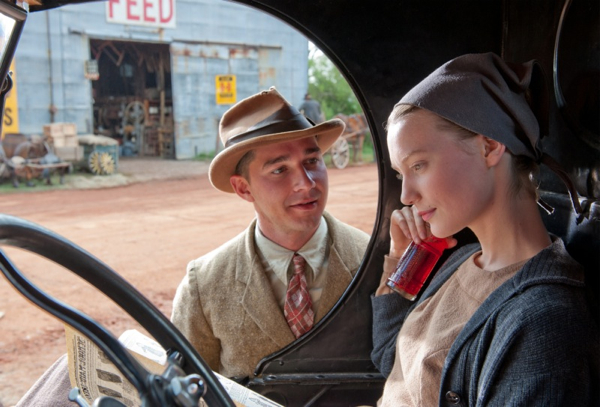
Casa de mi padre

Casademipadre1

Movie review by Greg Carlson

Mexploitation throwback “Casa de mi padre” may not be as satisfying as its surreal pedigree promises, but the Spanish language comedy featuring Will Ferrell as the dim bulb son of a rancher played by the late, great Pedro Armendariz Jr. (to whom the film is dedicated) is recommended viewing for anyone interested in vintage look, z-grade telenovela tributes. As Armando Alvarez, Ferrell delivers his dialogue straight, and press notes made hay with news of the actor’s one-month dialect crash course. Ferrell’s unshakable commitment to character has long been one of his assets, and he carves out a very recognizable persona as an eager-to-please second son yearning to be loved like his older brother.

“Casa de mi padre” echoes the low-fi techniques lovingly reproduced by Quentin Tarantino, Robert Rodriguez, Edgar Wright, Eli Roth, and Rob Zombie in 2007’s “Grindhouse,” including rough splices and print damage. Director Matt Piedmont applies the low-budget, poor production value aesthetic with a wide brush, from ongoing gags involving the liberal placement of mannequins as background “extras” to mismatched continuity within scenes that cut between location photography and studio sets. The silliness extends to the regular appearance of a spirit guide big cat fabricated by the Jim Henson Creature Shop, a handful of musical interludes and an after-the-credits endorsement from a game Dan “Grizzly Adams” Haggerty.

The plot of the movie lifts several of the most recognizable elements of Elia Kazan’s adaptation of “East of Eden,” as well as some of the equally triangular melodramatic whiffs of King Vidor’s “Duel in the Sun.” The filmmakers are certainly affectionate toward their retro inspirations, lavishing the same kind of reverence and attention to period detail “Pootie Tang,” Undercover Brother,” and “Black Dynamite” paid to Blaxploitation.  As the beloved first-born Alvarez scion, Diego Luna demonstrates his inner Tony Montana, engaging fellow “Y tu mama tambien” compadre Gael Garcia Bernal in a contest of flamboyant displays of swaggering machismo.

The movie’s firearm and squib count grossly outpaces the ribaldry, and “Casa de mi padre” skips much of the genre’s sleaze. Predictably, however, the opportunities for women within this world are defined by sexuality. Padre Alvarez employs a battery of scantily clad housemaids, but like any number of the film’s visuals, no payoff or reason is offered to explain their attire. Ferrell and co-star Genesis Rodriguez, who plays Armando’s irresistible, soon-to-be sister-in-law, engage in a ridiculous sex scene that fetishizes the male and female derriere to the brink of lunacy.

Current news items covering the brutality of the illegal drug trade in Mexico are a far cry from the bizarre comic treatment of the same themes in “Casa.” Even so, the movie’s lukewarm social commentary, embedded primarily in the officious, racist DEA agent played by Nick Offerman, reminds viewers that stereotypes can be a two-way street (an explanation of the supply and demand economics of cocaine hilariously sees American buyers as “shit-eating crazy monster babies”). The critique is a throwaway, and the agenda of “Casa de mi padre” is more appropriately concerned with Armando squinting into the sunset with “the eyes of a small chicken” while he tries in vain to roll a cigarette.

The Cabin in the Woods

Cabininthewoods1

Movie review by Greg Carlson

WARNING: The following review reveals plot information. Read only if you have seen “The Cabin in the Woods.”

While major metropolitan critics were asked in preview screenings to avoid any significant revelations contained within the entertaining metafiction titled “The Cabin in the Woods,” any meaningful discussion of the movie would be worthless without the ability to address what amounts to the entire operational conceit of the horror-comedy. In other words, read no more if you plan to see the film. Cooked up by co-screenwriters Joss Whedon (who also produced) and Drew Goddard (who also directed), “The Cabin in the Woods” was shot in 2009 and caught up in MGM’s Chapter 11 problems. Time on the shelf has done little to diminish the movie’s catchy exuberance.

Five coeds pack swimsuits and climb into an RV in anticipation of a weekend frolic at the location of the title, unwittingly cruising into an elaborate trap marking them as human sacrifices. Their every move is monitored and manipulated by the eyes of a massive underground operation led by a pair of eggheads (deadpanning Richard Jenkins and Bradley Whitford) in white, short-sleeved shirts. En route to the remote destination, a stop at a cobwebbed gas station involves an ominous exchange between the travelers and the creepy, tobacco-chewing attendant Mordecai (Tim De Zarn), but needless to say, the kids ignore the harbinger as if they had never seen a horror movie.

Grafting the puppetmaster premise of “The Truman Show” and the less-known “Special Service” episode of the 1980s “Twilight Zone” to the self-referential, filmic Droste effects generated by Wes Craven’s “Scream” (“Cabin” includes a variation on the “rule” proscribing splitting up when in danger) and Sam Raimi’s Ash saga, especially “Evil Dead II,” “The Cabin in the Woods” favors humor over fright, even though the filmmakers jolt the audience with several shocks before an outrageous late-arriving turn where all hell breaks loose. Along the way, the filmmakers identify their own predilections for all manner of cinematic scare tactics, thoughtfully distinguishing between the plain old zombie and the “zombie redneck torture family.”

The vast number of allusions to horror conventions would take multiple viewings to tally, and Whedon and Goddard gleefully pile up references to H.P Lovecraft, EC Comics, lakeside psycho killer series, John Landis and Michael Jackson’s “Thriller,” Japanese ghost stories, and the “anything goes” spirit of Nobuhiko Ohbayashi’s “Hausu.” The film would have been even better had the elevators containing our collective worst nightmares included cameo appearances by additional iconic inspirations such as the key Universal Studios monsters portrayed by Lon Chaney, Bela Lugosi, and Boris Karloff, as well as more recent slashers like Michael Myers, Jason Voorhees and Freddy Krueger.

Sigourney Weaver, whose Ellen Ripley is one of the quintessential “final girls” identified by Carol Clover – despite the lack of any preoccupation with the character’s virginity in “Alien” – pads the “voices of authority” category on her resume, adding “The Cabin in the Woods” to a list that includes “Avatar,” “WALL-E,” and “Paul.” The surprise of seeing Weaver is compromised by her duller narrative function as the denouement “explainer” who nearly blurts “If not for you meddling kids…” Kristen Connolly’s Dana, whose unisex name is another homage to one tradition of final girl protagonists, may be prevented from fulfilling all the criteria associated with the concept of the last survivor standing, but she may earn a spot next to some of the genre’s most tenacious veterans.

American Reunion

Americanreunion1

Movie review by Greg Carlson

The latest if not the last entry in the teensploitation franchise known for its ribald antics and carnal humiliations, “American Reunion” is the fourth theatrically released movie in the series and the eighth overall. Missing the tenth anniversary by a couple years, the script clumsily but self-mockingly explains away the unlikelihood of a thirteenth class reunion with some expository dialogue as protagonist Jim (Jason Biggs) meets up with his core group of friends to relive the memories of 1999 and presumably generate a few new ones. Jon Hurwitz and Hayden Schlossberg, of “Harold & Kumar” fame, assume screenplay and directorial duties, but never quite capture the – dare we say, nuances – of Paul and Chris Weitz’s filmmaking and Adam Herz’s writing.

For admirers of the original film willing to overlook almost everything in the terrible sequels, “American Reunion” tries with no small amount of desperation to capitalize on the seemingly incongruous blend of familial warmth and penis jokes popularized though not originated in Judd Apatow’s movies. Both Apatow and the “American Pie” films owe a debt to John Hughes, not to mention “American Graffiti,” “Fast Times at Ridgemont High,” and “Dazed and Confused.” The original film’s male-centered quest to dispense with virginity aligns “American Pie” with a long list of sex-as-rite-of-passage tales, including “Porky’s,” “The Last American Virgin,” and the lesser known “Hot Moves.”

Every principal member of the original cast returns, although Natasha Lyonne’s Jessica appears in a fleeting cameo. Only the most devoted fans would remember that of Jim’s best friends, Chris Klein’s Oz did not attend “American Wedding,” and neither did Lyonne, Mena Suvari, Tara Reid, or Shannon Elizabeth. Several minor characters, including John/MILF Guy #2 (John Cho) and Chuck “The Sherminator” Sherman (Chris Owen) are also on hand. We learn that Jim’s mother has died, but her passing seems to have been written essentially to facilitate a boozy encounter between Noah (Eugene Levy) and Stifler’s mom (Jennifer Coolidge).

The lustful chain of outrageous calamities bedeviling Jim over the years (pastry masturbation, superglue mistaken for lubricant, shaved pubic hair vented directly to wedding cake) forges a new link in neighbor Kara (Ali Cobrin), the girl-next-door that Jim used to babysit. Now eighteen and eager to lose her own virginity, Kara targets our married hero, straining his imagination as well as his fidelity to Michelle (Alyson Hannigan). Naturally, Jim’s understanding father is on hand to awkwardly share advice with his son, and even though we’ve been there so many times before, the nicely timed scenes between Biggs and Levy are among the movie’s high points.

On several occasions, “American Reunion” acknowledges the difficulties of growing up and moving on, from Jim and Michelle’s transition into parenthood to Stifler’s (Seann William Scott) angry realization that high school may have been the best time of his life. At the expense of other more promising stories, “Reunion” spends altogether too much energy on the boorish Stifler, the perpetual fifth wheel who emerged from secondary status to huge popularity, ala Arthur Fonzarelli. Scott’s character is much better in small doses, and even though a surprising turnabout reverses his previous failures, some small pleasure is derived watching “the Stif-meister” labor fruitlessly to reconstruct his former glories.

Jeff, Who Lives at Home

Jeffwholivesathome1

Movie review by Greg Carlson

In the opening scene of Jay and Mark Duplass’ “Jeff, Who Lives at Home” title manchild Jason Segel humorously expounds on his dedication to M. Night Shyamalan’s “Signs.” In breathless wonderment, Jeff outlines into his handheld recorder a philosophy dependent on barely-there synchronicities and a universe where even the most farfetched coincidences could be the markers of profound portent. Given the history of the filmmakers, the viewer cannot be sure whether and to what extent Jeff is sympathetic and meant to be taken seriously. Is he an ambitionless pothead whose embrace of a ridiculous Mel Gibson film suggests to sophisticates that he is not deserving of respect? That the monologue is delivered on the toilet initially points to yes, but the rest of the movie appears to argue on behalf of Jeff as a decent, worthy person.

Jeff’s easygoing lifestyle is mirrored by the movie’s uncomplicated plot, in which Jeff and his insensitive brother Pat (Ed Helms) reconnect while conducting an incompetent surveillance job on Pat’s frustrated and possibly adulterous wife Linda (Judy Greer). Meanwhile, Jeff’s mother Sharon (Susan Sarandon) attempts to figure out the identity of the entirely too obvious secret admirer at the office where she works. The character-driven orientation favored by the filmmakers allows the accomplished cast to riff on the subtleties and tics of personality that are needed to fill in the gaps between the slapstick shenanigans that echo so many dozens of TV sitcom scripts.

Tagged as practitioners of the so-called mumblecore aesthetic of do-it-yourself moviemaking and the low stakes, irony-dependent “white people problems” that almost inevitable accompany the plotlines of said films, the Duplass brothers began the transition away from outsider status with “Cyrus” in 2010. “Jeff, Who Lives at Home” is less engaging and accomplished than “Cyrus,” even though both movies share the premise of lead adult characters who still live with their mothers. As usual, the women in the movie carry the burden of responsibility while the males embody lavish quixotic pursuits of delusional fancy – minus the chivalry. Pat’s ill-conceived purchase of a Porsche becomes an operational symbol of his self-centeredness and his inability to listen to Linda.

The Duplass’ jittery photography embraces the unmotivated zoom in what feels like deliberate defiance of technical sophistication, and the distraction, as Andrew Schenker adroitly noted, “gets more tired with each film.” The movie’s episodic structure suggests a series of short films, some better than others. The section in which Jeff gets mugged following a pickup basketball game won’t do much to help the negative perception of mumblecore’s attitudes regarding race, but the sequence unfolds like a Raymond Carver short story and is significantly more interesting than the foolish chapter in which Jeff eavesdrops on Linda at a bistro.

There is little doubt that the climax of “Jeff, Who Lives at Home” resorts to the feel-good banalities that tidily conclude so many mainstream Hollywood comedies, and the movie’s journey is significantly better than its ultimate, huggy destination. The contrivances surrounding the culmination of Jeff’s quest to discern the cosmic purpose of his “Signs”-inspired ideology take place during a traffic jam that is too shapeless to align with either Hal Needham’s “The Cannonball Run” or Jen-Luc Godard’s “Week End.” All the characters conveniently end up in the same place at the same time, and make validating, split-second decisions guaranteed to divide audience goodwill.


The Hunger Games

Hungergames1

Movie review by Greg Carlson

Suzanne Collins’ mighty young adult turned crossover publishing phenomenon “The Hunger Games” arrives in theatres as the franchise heir apparent to book series-to-screen juggernauts like “Harry Potter” and “Twilight.” With a ready-made fan base eager to see heroic Katniss Everdeen come alive in the person of Jennifer Lawrence, “The Hunger Games” will almost certainly make a very big star out of its talented lead. Lawrence’s Oscar-nominated work in “Winter’s Bone” runs in thematic parallel to the flinty “girl on fire,” a resourceful, intelligent, and welcome female leader in a world dominated by male action heroes.

Classifiably critic-proof, the release of “The Hunger Games” movie has already launched a library of interpretation, from critiques of clueless, racist Twitter users flabbergasted that certain characters (Rue in particular) are not played by white actors to iron-willed defenses of Koshun Takami’s “Battle Royale” as the unsung – and, until recently, largely unacknowledged – origin of Collins’ core story elements. Collins denied familiarity with “Battle Royale” in a detailed “New York Times” profile by Susan Dominus, shrewdly identifying the ancient Greek myth of Theseus and the Minotaur as her inspiration, but as Irene Peter quipped, “ignorance is no excuse, it’s the real thing.”

Certainly, dystopian fiction featuring life and death consequences did not originate with Takami’s novel, and “The Hunger Games” owes additional debts to Orwell’s “1984,” Jackson’s “The Lottery,” and Connell’s “The Most Dangerous Game,” to name just three items on a growing list of suggested influences. But whether one reads the novel as a protest of economic disparity between rich and poor, an expose of societal dependency on lowest-common-denominator reality television, an exploration of the horrors of war, or simply as an allegorical corollary to the real and imagined struggles of adolescence, “The Hunger Games” is elastic enough to withstand a variety of wide-ranging interpretations.

The production design, special effects, and costumes place “The Hunger Games” somewhere between “Twilight” and “Harry Potter” on the scale of visual value. The computer generated images of the galloping quadrupeds known as mutts outpace the werewolves of Forks, Washington, but the garish fright wigs and pancake makeup favored by the faux-aristocratic denizens of the imperial headquarters are deliberately redolent of foppish French Revolution-era aristocrats, and the enterprise often feels surprisingly cheap. With the ironic exception of the scenes in which Stanley Tucci’s Caesar Flickerman interviews the ill-fated tributes on television, many of the Capitol sets resemble something from made-for-TV movies.

Stylistically, “The Hunger Games” falters in its nausea-inducing handheld camerawork, a poor choice that offers no deep insight into the omnipresent media coverage demanded by the bloodthirsty Big Brothers of the Capitol – other than to serve as a weak reminder that nearly everything we see is presumably being captured for broadcast. Additionally, the demands of the film’s PG-13 rating drain the blood from Collins’ visceral descriptions of death in the arena. In place of the stark immediacy of the text, Ross dances around the horrors of children killing children, cutting away or staying in close to avoid showing any detail that might run afoul of the MPAA (the depiction of the tracker jacker attack is particularly flimsy and ineffective). One supposes there is some kind of insincerity suggested by the movie’s compromise position, but the broken state of the movie ratings system offers no alternative for a massive, mainstream release.


A Separation

Separation1

Movie review by Greg Carlson

Riveting, humane, and vibrantly alive with closely observed detail, Asghar Farhadi’s “A Separation” showcases dimensions of contemporary Iran that few Americans could imagine while at the same time remaining steadfastly universal. Tumbling headlong through a series of increasingly contentious legal dilemmas, Farhadi’s restless, urgent storytelling – captured in crowded frames by cinematographer Mahmoud Kalari – bounces between domestic and municipal locations as a painful and complex examination of marriage, parenthood, caregiving, class, gender, and adolescence consolidates into the kind of masterful cinematic storytelling crafted by the great Italian neorealist filmmakers of the 1940s.

The first Iranian motion picture to win the Academy Award for Best Foreign Language Film and the Golden Bear for Best Film at the Berlin International Film Festival,  “A Separation” deposits the viewer in the middle of a searing standoff between middle class Tehran spouses Nader (Peyman Moaadi) and Simin (Leila Hatami), at odds over Simin’s desire to move the family out of the country to provide better opportunities for their child Termeh (Sarina Farhadi, the filmmaker’s daughter). Nader refuses to leave his aging father, whose struggle with Alzheimer’s disease makes constant supervision a necessity, and the bitter standoff only signals more rough times ahead.

Simin moves in with her parents, and Nader hires the pregnant Razieh (Sareh Bayat), who illegally hides the employment from her husband Hodjat (Shahab Hosseini), as a housekeeper and caretaker. Misunderstandings and poor choices lead to tragic results, and Nader and Razieh find themselves entangled in an escalating series of accusations that place their loved ones under tremendous stress. Farhadi filters a great deal of the film’s point of view through the perspective of Termeh, whose childhood disappears bit by bit every time she is called upon to make grown-up decisions.

Delivered with the precision plotting of a procedural, “A Separation” unveils an agenda less concerned with uncovering a single truth than with recognizing the shades of gray that complicate strict interpretations of the law. As we watch Simin struggle with the obstinate, unmovable Nader, Farhadi observes parallel husband/wife discord between Razieh and Hodjat, whose own young daughter provides an additional visual echo between the two families. While the class divide between the sets of couples implies different types and sources of friction, Farhadi constructs a unified, parallel study of gender-dependent predicaments.

“A Separation” resists black-and-white reductionism, and Farhadi’s shrewd objectivity makes room for disparate readings. More conservative viewers, and one presumes some of the Iranian power brokers who originally endorsed the movie’s Oscar candidacy, might readily identify the film’s wrenching events as a blistering critique of divorce. Others will certainly see the story as a reminder that restrictive conditions for women exacerbate problems in a church-and-state linked society. Brilliantly, Farhadi retains all the familiar, recognizable messiness of life without overtly passing judgment on the individuals who populate his movie. This ambiguity, reminiscent of Yimou Zhang’s 1990s work with Li Gong (another instance in which tension between artist and regime was publicized in the West), has made for interesting news items in the wake of Farhadi’s awards season successes: Ethan Sacks reported in the “New York Daily News” on March 12, 2012 that Iranian government officials had canceled a planned celebration of “A Separation.”

John Carter

Johncarter1

Movie review by Greg Carlson

Everything good that director Andrew Stanton brought to the lauded “WALL-E” in 2008 is completely absent in the dreadful “John Carter,” a frustrating, soulless sarcophagus of a movie that feels even longer than its already bloated 132-minute length. Released one century after Edgar Rice Burroughs’ primary source material “A Princess of Mars” began its serial debut in the pulpy “The All-Story,” “John Carter” was nearly made into an animated feature pitched by legendary artist Bob Clampett in the 1930s (a brief glimpse of Clampett’s test footage can be found on YouTube). The “John Carter” we get unspools like the doughy offspring of George Lucas’ “The Phantom Menace,” and never escapes the affectation of a copy of a copy of a copy.

Civil War-era Virginian John Carter (Taylor Kitsch), presumably hunting for gold in Arizona, stumbles upon the means to teleport himself to Mars, and there encounters a convoluted political struggle pitting several factions and species against one another. Allegiances shift with little explanation, and Carter – along with the viewer – hurtles himself headlong into the fracas without stopping to ask any substantive questions. Inexplicably, Stanton pauses for flashback scenes in which Carter recalls the loss of his family on Earth, the shots bearing an eerie resemblance to similar components in “Cowboys & Aliens.”

So much of what resembles story development in “John Carter” rolls by without any differentiation in emotional urgency that every single scene blends together in a kind of cinematic white noise. Carter’s humanness allows him to negotiate the gravitational fields of Mars like a miraculous flea, but the computer-enhanced weightlessness only calls to mind the same ridiculous gag in Ang Lee’s stupefying “Hulk.” The four-armed mantis-esque alien race known as Tharks (voiced by talents like Willem Dafoe, Samantha Morton, and Thomas Haden Church) aren’t as pretty as James Cameron’s Na’vi, despite the similarities in their height and impossibly svelte waistlines.

Laughable dialogue is belched in every scene, and while several dozen lines contend for most embarrassing status, Lynn Collins probably won’t be adding “We may have been born worlds apart, but I know you, John Carter” to her audition reel. Mark Strong plays main heavy Matai Shang, a shape-shifting immortal whose reasons for doing just about anything are as hazy as the Martian horizon. Strong, whose villainous skill suggests a modern-day Basil Rathbone, can make even the most mechanical dialogue menacingly convincing, and he is certainly stuck with some of the script’s foulest sentences.

Despite much aping of “Avatar,” “John Carter” opts out of an interspecies romance between Carter and the Thark warrior Sola (Morton), whose storyline consists principally of a lukewarm recognition of father-daughter bonds in a culture otherwise unable or unwilling to recognize paternity. Instead, Carter’s less interesting love interest is Collins’ Dejah Thoris, the plucky princess whose experiments with some convoluted energy source called the Ninth Ray might be the key to the Red Planet’s survival. Both Kitsch and Collins are appropriately comely and sculpted, but despite the obvious design debt to Frank Frazetta’s paintings and illustrations – the visual standard by which any adaptation of “John Carter” will be measured – the flesh and blood incarnations can’t summon the same kind of wonderment captured in Frazetta’s brushstrokes.

Wanderlust

Wanderlust1

Movie review by Greg Carlson

Comic journeys in which out-of-touch yuppies follow their bliss are many in number, and often trace their roots to Hy Averback’s 1968 “I Love You, Alice B. Toklas!,” a groovy Peter Sellers vehicle penned by Paul Mazursky and Larry Tucker in which an uptight lawyer falls under the spell of a prototype Manic Pixie Dream Girl. In “Wanderlust,” David Wain and Ken Marino update the rough contours of the scenario as a commentary on the current economic climate’s anti-corporate occupation attitude. Unlike Sellers’ soon-to-be-wed square, Paul Rudd’s character is already married, but both “Toklas” and “Wanderlust” play with the fantasies of free love before reinforcing the values of commitment and the middle path.

Rudd and Jennifer Aniston are George and Linda, a couple unable to make the payments on their West Village “microloft” when HBO passes on Linda’s foul penguins with testicular cancer doc and George gets the boot from his suit and tie operation. Accepting defeat, the protagonists pack their bags and head for the humiliation of the Atlanta McMansion owned by George’s portable toilet mogul brother Rick (co-writer Ken Marino), a brilliantly coarse jackass. Unable to cope with Rick’s alpha male autocracy, George and Linda decide to return to the Elysium Bed and Breakfast where they stayed en route to Rick’s monstrosity.

The dwellers at Elysium, an “intentional community” that operates like the halcyon ideal of a world where Charles Manson never happened, happily share everything from chores to possessions to each other’s bodies, and “Wanderlust” makes hay with George’s discomfort when his car is abused and his personal privacy invaded (the end credit outtakes from the toilet scene featuring Jordan Peele are hysterical). Malin Akerman’s cheerfully sunny sexual availability (“Think about being inside me”) pushes George to the limit of self-control. When Linda insists that George take advantage of Eva’s offer, his mirror monologue as he practices painfully awkward seduction talk develops into a tour de force display of fearless humiliation. Rudd deserves some kind of award for it.

Wain’s accomplished supporting cast includes veteran Alan Alda as the aging commune founder, Joe Lo Truglio (who appeared at the Fargo Film Festival in “High Road” and live on stage during the closing night improvisation show “Celebrity) as a nudist winemaker/aspiring writer whose earnest dreams of success are as outsize as his manhood, and Justin Theroux in what may be his best screen work to date. Theroux’s confident, patronizing alpha act is perfect, and a goofy scene in which he scorches Rudd’s hopeless acoustic guitar attempt on the Spin Doctors’ “Two Princes” in a music circle is one of many funny sketches in which he excels.

Accompanying tropes of the genre provide fodder for gags, with the “intoxication ensues” device a centerpiece echoing the memorable pot brownie feast that sends Sellers into psychedelic overdrive. Aniston tripping her ass off doesn’t quite measure up to the “Toklas” standard, but Wain fools around with some loopy visual effects that approximate what the character sees in her altered state. Generally, Aniston is outpaced by the improvisational veterans surrounding her (the Wain-Michael Ian Black-Michael Showalter triumvirate appear in a terrific cameo), but “Wanderlust” affably suggests that we still might be able to find a few more laughs sending up the era that the film’s target audience never experienced firsthand.

Rich Sommer Interview

Richsommer1

Interview by Greg Carlson

Actor Rich Sommer is best known for playing Harry Crane on “Mad Men,” but his extensive performing credits include appearances on “The Office,” “Curb Your Enthusiasm,” “CSI,” “Law & Order,” “Without a Trace,” “Ugly Betty,” “Nikita,” and “Burn Notice.” He made his feature film debut in “The Devil Wears Prada.”

This week Sommer returns to Fargo-Moorhead, where he graduated from Concordia College, as a special guest of the Fargo Film Festival. Along with Matt Walsh, Sommer will be headlining “Celebrity,” the closing night event of the film festival on Saturday, March 10.


Greg Carlson: I read that you made haunted houses as a kid. What was your best ever Halloween costume?

Rich Sommer: My mom usually made our costumes. They were pretty great. I think the family favorite is when I was a magician, and my brother was a rabbit popping out of a hat. She also made a Kermit costume that was a hit. She is crafty. Now she makes costumes for our kids. It’s a nice nostalgia buzz.


GC: Did you perform as a kid?

RS: Kind of. I was Johnny Tremain in the Newberry Elementary School production of “Johnny Tremain” when I was six. Otherwise, just school and church plays. I didn’t take any of it too seriously.


GC: What movie do you know by heart?

RS: “Dumb & Dumber.”


GC: Your ardent followers know you love board games. Which is your favorite?

RS: Die Macher, which no one reading this has ever heard of.


GC: Did you read comic books growing up?

RS: A little bit, but not with any consistency. There was an issue of Batman where he runs into this vampire girl and her parents are dead and it was terrifying.


GC: Your Fargo-Moorhead fans would love to hear an interesting anecdote or memory from your time at Concordia.

RS: There are too many to mention. Walks to Mick’s Office from campus, performing in a tiny room at Noah’s Coffee with my improv group, that tiny Statue of Liberty across the bridge. It’s all rolling around in there.


GC: You met your wife in Cleveland in graduate school. How were you introduced to one another? Was it love at first sight?

RS: We were two of an eight-member class. I thought she was a knockout, but we didn’t hit it off right away. It wasn’t until about halfway through our time in Cleveland that we even acknowledged any interest in one another.


GC: The actor’s life means maintaining some wild hours. What are some of the things you do to balance career with being a father and husband?

RS: The nice thing is that mine is not a nine-to-five job. I usually work two or so days a week at “Mad Men,” and am around the rest of the time. When I’m traveling, it’s harder. Lots of FaceTime and phone calls. I miss them a lot.


GC: Can you tell us a little bit about Matt Walsh and Celebrity? What can we expect to see on stage Saturday night at the Fargo Film Festival?

RS: Matt Walsh is one of the founders of the Upright Citizens Brigade, an improv group and school with theaters in New York and Los Angeles. He is one of my idols, basically. He asked me a while ago if I would host a new stage show he had come up with called “Celebrity.” It’s a stage version of a popular party game. What can you expect Saturday? We have no idea. We are doing an approximation of our show, which is already an approximation of a real show. So expect a couple guys grasping for straws. And it might even be funny.


GC: What will you be doing for the March 25 premiere of the fifth season of “Mad Men”?

RS: I’ll be with my wife’s family in Minnesota. I can’t wait.

The Power of Two

Poweroftwo1

Interview by Greg Carlson

“The Power of Two,” the honorable mention recipient in the documentary feature category of the 2012 Fargo Film Festival, will be screened on Wednesday, March 7 at 10:30 a.m. (followed by a lunch panel) and 7 p.m.

Twins Ana and Isa Stenzel, along with producer Andrew Byrnes and director Marc Smolowitz, will be in Fargo for the events. Greg Carlson talked to the team about their experiences making the film.


GC: The book project was an undertaking by itself. At what point did the idea for a feature length documentary really germinate and move from thought into action?

Andrew Byrnes: Marc came up with the idea to make a documentary inspired by Isa and Ana’s memoir shortly before the twins were set to tour Japan in fall 2009 to support the publication of the Japanese version of their book. I knew Marc as an Academy Award-nominated documentarian through mutual philanthropic work in San Francisco. I approached him to inquire whether he knew of anyone in Japan who could film a few of Ana and Isa’s speeches during their 26 day, 10 city tour.

They had been rehearsing night and day to deliver in Japanese 19 speeches about cystic fibrosis and organ transplantation, which is rare and controversial in Japan. Marc was intrigued and asked to read their memoir.  He quickly contacted us and said that he wanted to be the one to film the twins in Japan, and that not only would the story make a powerful documentary but could be the center of a global call to action around organ donation and cystic fibrosis awareness. Less than three months later we were in Japan for the first shoot of the film!


GC: Ana and Isa have always been together and Andrew entered the picture years ago. How did Marc become involved?

Marc Smolowitz: I fell in love with Ana and Isa as writers and as characters when I read their co-authored memoir. I see Ana and Isa as both ordinary and extraordinary women, which reminds us that we often see such humbling and familiar contrasts in our own lives. They are entirely approachable yet somehow also bigger than life. Ultimately, it is their twin bond that resonates on-screen with immense power — the kind that transcends boundaries of culture, race and nation.

I look forward to sharing Ana and Isa’s stories of survival with the world. I am quite sure that audiences will embrace them with the same openness and excitement that they themselves bring to every day. For me, it truly has been a highlight of my life and career to make this film. I have learned so much about what it means to be an advocate for something bigger than myself.


GC: The production spent significant time on the road to collect all the necessary footage. How many miles did you log? How did you balance the demands of the shoot with personal and professional lives?

AB: We logged lots of miles!  We shot over 240 hours of footage in 27 cities in three countries.  In terms of “balance” (quotes intentional), the project really became my baby, consuming lots of my waking hours outside of work.  Because we were not just making a film but also building an offline and online community around the film and related causes, our task was particularly large.  Thankfully we had a great team who understood the mission and worked really hard to accomplish our goals of completing the film and making a difference.

Isa Stenzel-Byrnes: I remained free from a paid job to make time for film shoots and production efforts. That being said, I certainly slacked off on some other projects as the film dominated our 2010! (Most of 2009 focused on the Japan tour and learning Japanese). Although Ana and I are “subjects” and Marc was the filmmaker, Ana and I remained very involved with efforts to coordinate community film shoots, raise funds, and recruit reputable interview subjects. So, the time demands were intense and it truly was a team effort.

Ana Stenzel: I don’t have an exact number of miles that we logged except to estimate that it was in the thousands, and we surely built up our frequent flier miles! Balancing our personal and professional lives was not easy. I am fortunate to have a very understanding boss and arranged for most of my travel on weekends.

My husband has been very supportive as I leave him frequently and spend more time on the computer than with him. In between film shoots, I was able to still take care of my health (a top priority) and spend time with family and friends. Fortunately, our lives post-transplant have afforded us great amounts of energy so that we can pack in a lot in 24 hours.

MS: The collaboration with Ana, Isa and Andrew was a remarkable experience, and everyone worked incredibly hard over the course of the 22 months it took to make the movie. The post-production phase was particularly intense, with myself, two editors, a music producer and music editor working with many others upward of 100/hours per week to get the film finished. As a filmmaker, I was so fortunate to have so many people at the top of their game on my creative team.

We were all heavily invested in making a successful film that would have a powerful impact on audiences. Everyone felt a strong connection to Ana and Isa’s story, and the other stories featured in the movie. Everyone who worked on the film pushed themselves to deliver their best work. I was incredibly proud of the productive way in which we all worked together. Long hours, for the love of the craft. Truly an inspiration for everyone involved.


GC: As you sorted through footage and assembled what would become the final version, what was the hardest scene to cut out?

MS: There were many scenes that were built that I loved that did not make it into the movie, and I hope they will find their way into DVD extras down the road. There is one scene that did not make it into the movie that was one of the first scenes we edited, and it was literally in the timeline in different places until about 36-48 hours before picture lock. It featured the twins at San Francisco Great Strides, an annual fundraising walk to raise money for CF. The scene featured an additional story line about a friend of Ana and Isa named Charlie Stockley, who had CF and died waiting for a transplant.

As we edited the movie, it became clear that this scene was more like a mini-documentary of its own that took viewers out of the movie. As much as I loved this scene, for the good of the movie, I made a very difficult to remove it. It was one of the toughest decisions I had to make while in post-production. I did not make it lightly, but in the end, I know I made the right decision. I think every filmmaker has a scene like this that he or she has to choose to get rid of in the context of a feature length film.


GC: Whether viewing alone or with an audience, which moment in the film provides you with the greatest thrill or sense of accomplishment?

ISB: My favorite scene in the movie is the opening, with the swimming at the National Kidney Foundation U.S. Transplant Games. It epitomizes the gift of transplant and the theme of the film: pure freedom, normalcy and health offered by transplantation. It also has nothing to do with sickness or my patient identity.

AB: As a producer, I am all about production value and giving something extraordinary and unexpected to the audience.  So I love the particularly cinematic moments, especially the scene of the twins blowing bubbles on a bridge in Virginia to honor their organ donors. Also, I adore the soundtrack, which our music supervisor Nicole Dionne so brilliantly weaved throughout the story.  Every time I see the film I’m still blown away by the music.

AS: I am most humbled when I see my donor family in the film. They are incredibly gracious people who literally saved my life – without them, none of this would be possible. I am so proud of their courage of being public with their story despite their emotional pain. I am proud to know such quality human beings, who gave to others unconditionally at the moment of personal tragedy and despair.

Personally, I am most proud when the film opens with the inscription stating the film is inspired by a memoir written by Anabel & Isabel Stenzel. We wrote the book ourselves, with little input from others so there is true ownership there. Without the book, the film would not have happened. We continue to receive positive feedback from readers, many of whom are touched by CF and find hope and guidance in our writing. Touching people’s lives and easing the burden of CF for others in our own small way is the most gratifying part of this journey.

MS: There is a scene in Japan where the twins are on a boat ride in Japan, reflecting on the relationship they have with their donors and how organ transplantation transcends boundaries of race. The scene comes out of a beautiful shot of balloons being released into the sky at the Green Ribbon Running Festival in Tokyo, and then it literally soars onward, taking the viewer on a kind of cinematic journey that allows time for reflection, introspection and rest.

For me, I wanted to pepper the film with these sorts of entirely cinematic movements, not something you often encounter in a documentary. In a film with many characters, many interviews, many intense screens, and many emotional moments, it was so important to allow audiences the time to literally BREATHE and appreciate their own breath. The entire film is edited like this, but this specific boat ride scene is for me when that approach works as a powerful coming together of theatricality and documentary.


GC: Can you describe the most memorable or surprising viewer response to the movie?

ISB: In Portland, a young woman with CF approached me, in tears and unable to collect herself. She finally shared how Ana and I were her “heroes” because she needed to believe things would be okay for her, and she needed to know there were others like her, struggling with the same disease.

AS: Through the power of outreach and the media, people from all walks of our lives have somehow heard of the film and come to see it. At our Washington DC premiere, a woman approached us, stating she was our babysitter when we were 5 years old! Clearly we didn’t remember her, but she read about a film about twins with CF in the paper and remembered us! That was a small, small world!

Another wonderful response I received from the film was from 2 separate people with cystic fibrosis who saw the film and were so moved by it. They both stated that they started to take better care of themselves and be more compliant with their medical regimen because of the film. To know that our story motivated our comrades to fight this challenging disease was truly gratifying.

MS: For me, it was very powerful to show the film in Tokyo at the Tokyo International Film Festival and have it so well received by Japanese audiences. At one of the Tokyo festival screenings, 3 people from the Japan section of the film were also in the audience – Mrs. Nakazawa, a mother/advocate who lost her baby while trying to go to the USA for him to receive a transplant; Mr. Tanaka, a donor father who lost his daughter and said yes to donation; and Taro Kono, a Japanese politician who led the charge to change the transplant law in Japan.

Having all three of them there was very powerful for me, and the fact that they all loved the movie and cheered for its success was the strongest validation I could ever ask for. It was so important for me to make a film that the Japanese could receive well, and in the case of these three people — who opted in to be interviewed and share their stories – delivering on their trust was paramount for me. That night in Tokyo, it all came together beautifully in every way.