Twilight

Twilight

Movie review by Greg Carlson

It is no secret that most youth-oriented film franchises are created for and marketed to teen boys, so the idea of a wildly popular series aimed at girls of the same age makes “Twilight” a little easier to swallow than its tepid construction might otherwise merit. Based on the inaugural volume in Stephenie Meyer’s publishing juggernaut, director Catherine Hardwicke’s movie version captures only the tiniest spark of the best filmmaking qualities she displayed in “Thirteen” and “Lords of Dogtown.” An overhaul, or perhaps more to the point, revamp (pun intended), of the lore and legend of bloodsuckers from Stoker’s Count Dracula to Rice’s Lestat, “Twilight” juggles several expectations while remaining true to the genre’s seductive and sensual foundations.

Like Joel Schumacher’s 1987 “The Lost Boys,” “Twilight” jettisons most of the unsavory aspects of vampirism in favor of teenage angst and cool. When Bella Swan (Kristen Stewart) leaves sunny Arizona to live with her police chief dad in perpetually drizzly Forks, Washington, she falls hard for pale Edward Cullen (Robert Pattinson), a member of a clan of nosferatu pledged not to drink human blood. Edward might think of himself as a “bad guy,” but his actions prove the opposite, especially when he draws on his superhuman strength and speed to save Bella from serious injury in a car wreck.

Meyer’s conceptual masterstroke, which translates efficiently to the big screen, is Edward’s internal struggle to refrain from sinking his fangs into Bella’s pretty neck. Working perfectly as an allegorical corollary to the teen abstinence movement, Edward’s pledge to protect Bella and remain in control of his desires is the engine that drives the movie’s blend of perpetual longing and honorable chastity. Stewart and Pattinson have the chemistry to pull it off, and several of the movie’s strongest scenes allow the lovers to explore their romantic feelings without going “all the way.”

The courtship of Bella and Edward unfolds leisurely during the first half of the movie, and Hardwicke reasserts the aptitude for the rhythms and patterns of teen communication that she demonstrated in her previous features. “Twilight” takes a major nosedive, however, with the introduction of a silly trio of nomadic vampires who encroach on Cullen family turf. The script fails to explore the motivations of the movie’s true antagonists, and viewers are left with flat, wooden villains unable to generate any intrigue or interest. An insensible ballet studio showdown with one of the evil revenants meant as the movie’s dramatic climax comes across as a futile and dreadfully dull story-topper.

“Twilight” tacks on a shameless denouement that all but trumpets the inevitable sequel. As the credits roll, the tragically hip will cringe at the inclusion of Radiohead’s “15 Step,” out of place alongside the more pedestrian sounds of Linkin Park, Mute Math and Paramore. The younger viewers will not locate any disparity in the choice of tunes, two of which are performed by star Pattinson. Instead, they will be comparing notes on the latest actor to achieve virtually instant heartthrob status and imagining what it would be like to be held in his arms, high above the ground in the branches of a towering tree.

Quantum of Solace

Quantumofsolace1

Movie review by Greg Carlson

“Quantum of Solace” is several notches below “Casino Royale,” but Daniel Craig continues to demonstrate that his James Bond is arguably the best.  Directed by Marc Forster, whose eclectic choices behind the camera can be hit or miss, “Quantum of Solace” manages a noteworthy pair of Bond statistics: it is the shortest movie in the series to date, running more than a half hour tighter than its predecessor, and it is also the first of the Bond films to pick up immediately where the previous story left off.  Beyond those two facts, there is little to distinguish “Quantum of Solace,” which is encumbered by hellacious, disorienting editing during its many action sequences as well as an awful, thudding score by David Arnold.

While nowhere near the bottom of the heap in the Bond archive – it is handily better than any of the Brosnan and Dalton entries – “Quantum of Solace” won’t be placed near the top by many franchise fans either.  Forster spends too much time staging action at the expense of the downtime needed to explore the revitalized Bond, who is still learning the ropes and figuring out the angles of the 00 license.  It is still novel, if not fascinating, to see a Bond portrayal that suggests a rookie as opposed to a veteran, but one gets the feeling that by the next outing, that particular aspect of the storyline will be shelved.

The movie Bond’s voracious sexual appetite for exotic partners has been scrutinized by pop culture academics for years (recall the discussions of the post-HIV epidemic Bond in the reviews of an earlier decade’s “reboot”), but the agent’s persuasive way with the opposite sex has been a sacred cow, as certain as the sunrise.  No rules demand that Bond have intercourse with every significant female whose path he crosses, and “Quantum of Solace” is particularly lean on eroticism.  Bond’s relationship with fellow revenge-seeker Camille (Olga Kurylenko) is chaste, but the screenplay does squeeze in a dalliance with Gemma Arterton’s Strawberry Fields, whose fate is revealed in a clever visual nod to “Goldfinger.”

Considering the popularity of the “Bourne” series, one can easily understand why a Cold War relic like the Bond suite would brush the dust from itself in imitation.  Some longtime followers will cringe at the latest Bond’s similarities to Bourne, but if the Craig era continues to explore a darker Bond of the “blunt instrument” variety described by Fleming (and Judi Dench’s M in “Casino Royale”), it makes sense to linger a bit when the man chokes the life out of an attacker.  A less cartoonish Bond universe, which seems to be Craig’s cup of tea, beats the silly gadgetry and inane wordplay that some admirers cling to like a security blanket.

If one accepts the premise that there can be a Bond for every generation, then making the character a bit richer and deeper risks nothing; after all, if that tactic does not work, the series can find a new lead and start all over again (again).  “Casino Royale,” in allowing Bond to develop feelings for Vesper Lynd (who is very much missed in “Quantum of Solace”), recalled “On Her Majesty’s Secret Service,” a cult favorite.  In the new film, we are told that Bond acts out of grief, but the screenplay avoids any kind of psychological exploration of the operative’s motives.  The inclusion of that sort of content could really shake up the rigid Bond universe.

Role Models

Rolemodels1

Movie review by Greg Carlson

It is a safe bet that many of the published reviews of “Role Models” will reference its similarity to the movies of current comedy juggernaut Judd Apatow. Apatow has perfected the art of the “bromance” as well as the blending of warm-hearted positivism and crass vulgarity. Movies like “Knocked Up” and “The 40 Year Old Virgin” have set a course for a kind of contemporary American humor that will be identified as its own particular subset of the comedy genre in years to come. David Wain, a brilliant comic mind in his own right, is the director and co-writer of “Role Models,” but the movie lacks much of the skewed worldview that defines funnier efforts like “Stella” and “Wainy Days.”

Actor Paul Rudd, who has collaborated with Wain on several projects, is joined by Seann William Scott, still effectively mining the oversexed party animal persona he originated as Steve Stifler in the “American Pie” series. The two of them are supposed to be best pals, although one immediately gets the feeling that Rudd’s bitter, angry, and sarcastic Danny doesn’t feel the same level of fraternity as Scott’s Wheeler. As pitchmen for an overpriced energy drink, Danny and Wheeler travel to schools in a tricked-out minotaur-themed monster truck. On one especially bad day in a chain of bad days, Danny’s rage leaves the buddies on the wrong side of the law.

Wain never seems very far away from fellow members of cult comedy troupe The State, and finds many laughs in the story of a pair of man-children whose arrested development catches up with them in the shape of court-ordered community service in a mentorship program called Sturdy Wings. Thanks in no small part to the effortless timing and charm of Rudd (another of the film’s credited writers), “Role Models” sustains its featherweight premise for more than half of the total running time. Filmmakers who emulate Apatow in the pursuit of his level of box office success, however, rarely have his uncanny ability to make the warm, fuzzy, lessons-learned part of the story work, and the last section of “Role Models” feels half-hearted, as if Wain might have preferred a less happy ending.

Once Danny and Wheeler meet their “littles” at Sturdy Wings, the movie divides its time between the nerd-heavy world of live action role-playing inhabited by cape-wearing Augie (Christopher Mintz-Plasse), who is paired with Danny, and the sewer-mouthed antics of pint-sized Ronnie (Bobb’e J. Thompson), who alternates between antagonizing Wheeler and picking up the man’s girl-watching techniques. Both of the kids are good, although audience members familiar with Mintz-Plasse’s turn as McLovin in “Superbad” might not buy him as a seemingly younger, less worldly version of the high school geek.

The remainder of the cast, including terrific supporting players like Ken Marino (another of the movie’s writers), Ken Jeong and Jo Lo Truglio, is excellent, but it is Jane Lynch who steals the movie as Sturdy Wings founder and former cokehead Gayle Sweeny. Lynch is brilliant as the off-kilter, high-strung motivator, and the way in which she caroms wildly from protective and nurturing to thoroughly age-inappropriate provides the film with its most memorable moments. Blurting out intimate information with shockingly unfiltered self-disclosure, the veteran Lynch proves once again that she deserves her own lead role in one of these types of comedies.

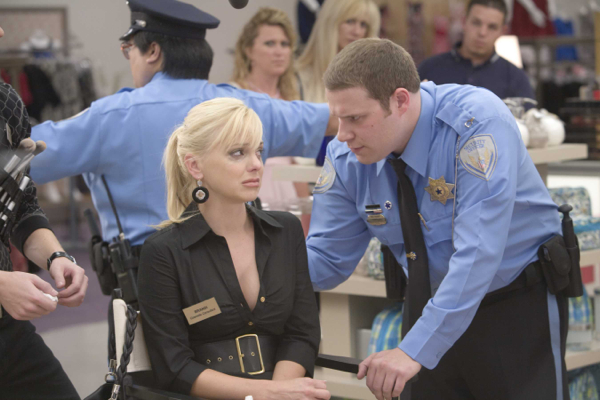
Zack and Miri Make a Porno

Zackandmiri1

Movie review by Greg Carlson

Like Fellini’s “8 1/2,” writer-director Kevin Smith’s “Zack and Miri Make a Porno” fictionalizes the filmmaker’s own career aspirations through the gauze covered lens of sideways self-mythologizing. Mirroring Smith’s breakout debut “Clerks,” “Zack and Miri” is based on the premise that a group of pals can kiss minimum wage slavery goodbye simply by stitching together a raunchy flick that can be sold back to like-minded true believers. Smith’s latest reaffirms the director’s position as Hollywood’s ultimate underachiever. Neither the presence of Judd Apatow regulars nor the spiffy technical work can hide the fact that Smith has never been much of a visual storyteller. Instead, his greatest gift remains his ear for blue dialogue, which wallpapers nearly every square inch of “Zack and Miri Make a Porno.”

Some Smith supporters might fawn over what passes for the movie’s heart, in this case the time-honored premise that two childhood playmates, despite the platonic boundaries of their longtime friendship, are really meant to be together as happily-ever-after lovers. In Smith’s world, these protagonists (not to mention the rest of the cast), curse like longshoremen, and their idea of Mickey Rooney/Judy Garland “let’s put on a show” entrepreneurship is to slap together an X-rated quickie just to be able to pay the water and electric bills.

Given the large number of “Zack and Miri” cast members who have appeared in recent Apatow-produced or directed comedies, Smith has taken some lumps for rehashing, reheating, and perhaps attempting to cash in on Apatow’s market. To be fair, Smith has long favored the blend of potty-mouthed vulgarity and romantic traditionalism packaged so expertly by Apatow, but one cannot help feeling that “Zack and Miri” suffers in comparison to “Knocked Up” and “The 40 Year Old Virgin.” A few Smith stalwarts, including Jason Mewes and Jeff Anderson, are on hand, although Mewes is nowhere near as much fun in the role of porn wannabe Lester as he is when playing his signature role of marijuana-addled Jay.

“Zack and Miri Make a Porno” never approaches the cleverness of “Chasing Amy” (still Smith’s best work), but it does transcend fairly low expectations in a couple of scenes, including a pre-Thanksgiving high school reunion and the brief tease of a “Star Wars”-inspired porn parody. The former, which captures a certain degree of the desperation felt by people in their late 20s faced with the prospect of explaining their lack of success to former classmates, stunt-casts Justin Long as Brandon Routh’s lover. The latter disappears almost as quickly as it arrives, as if Smith began to worry that a Dianoga dildo might raise the ire of George Lucas.

As the title pair, Seth Rogen and Elizabeth Banks work up a sweat trying to act their way around the blandness of their characters as conceived by Smith. The homogeneity of the director’s creations – nearly all Smith’s mouthpieces think and speak alike – is the movie’s central deficiency. With the exception of Craig Robinson, the other members of Zack and Miri’s unlikely family of pornographers are flat and unformed as recognizable human beings. We learn nothing, for example, about Traci Lords’ Bubbles beyond her signature sexual talent. Had the movie been as funny as it is earnest, one might have overlooked these flaws.

The Duchess

Duchess1

Movie review by Greg Carlson

Keira Knightley fans anxious to see the talented performer in another sumptuous period melodrama will not be as disappointed as 18th century history buffs by “The Duchess,” a beautiful but largely inert costume ball helmed by Saul Dibb.  Recounting the remarkable life of Georgiana Spencer Cavendish, who became the wife of William Cavendish, the fifth Duke of Devonshire, “The Duchess” makes up in production and costume design what it lacks in compelling narrative.  What could have been a captivating tale of the intellectual maneuvering and gamesmanship needed for a woman to survive the oppression of a crushingly sexist era ends up a fairly average example of the genre.

As discussed by Amanda Foreman in her book “Georgiana, Duchess of Devonshire,” upon which the movie’s script is based, the young Duchess successfully navigated the challenging social and political worlds of the late 1700s while trapped and constrained in an unhappy match.  The film is far less successful in balancing those two themes than was Georgiana, and most of the time the viewer’s attention is directed to the enormous pressure on the heroine to produce a male heir.  The movie includes the horrific reality of marital rape, but avoids dealing in any complex manner with the particulars of the Duke and Duchess’ interpersonal day-to-day, beyond the suggestion that the man was cold, distant, and more interested in his dogs than his spouse.

While Dibb does manage to squeeze in a fair number of scenes based on anecdotal record, including a brief dramatization of Richard Brinsley Sheridan’s play “The School for Scandal,” the movie spends most of its duration focused on the title character’s marital discord and unfulfilled promise.  The audience is reminded numerous times of Georgiana’s popularity with the public, but the film accomplishes very little in the way of explaining the convictions behind the young woman’s Whig Party beliefs.  One extravagant dinner scene offers the tiniest glimpse of Georgiana’s rhetorical gifts, but too often the political takes a back seat to affairs of the heart, including the steamy, doomed flirtation between Georgiana and childhood friend Charles Grey (Dominic Cooper), who would become Prime Minister.

Arguably the most compelling angle of Georgiana’s story is the open ménage a trois completed by the Duke’s romantic entanglement with the Duchess’ friend and confidante Lady Elizabeth Foster (Hayley Atwell), who lived openly as the Duke’s mistress for a number of years.  Even though the three shared a home, the movie neglects to explore the psychological impact of her husband’s affair on the Duchess in any depth, and blithely skips from Georgiana’s sympathy with her close friend to bitter jealousy without stopping to consider much of anything in between.

Knightley is as good as usual, but her dominance of the frame takes away screen time from several superb actors in supporting roles.  While Ralph Fiennes is in fine form as the Duke, both Charlotte Rampling as Georgiana’s mother and Simon McBurney as Charles James Fox are never quite given the juicy scenes they deserve.  The audience is left to imagine that the best parts of their conversations with Georgiana happened either just before or just after the scenes that were left in the film.


Quarantine

Quarantine1

Movie review by Greg Carlson

A derivative, vertigo-inducing horror cheapie based on the 2007 Spanish movie “REC,” “Quarantine” starts with promise but soon unravels into a haphazard hodgepodge of gimmicks.  Exclusively employing handheld, shaky photography meant to appear as if shot from the point of view of a character in the movie, “Quarantine” belongs to the same category of quasi-cinema verite shockers as “The Blair Witch Project” and “Cloverfield.”  Viewers prone to motion sickness will want to steer clear of the movie, which lurches and wheels from start to finish like a dinghy in a squall.

Director John Erick Dowdle, who co-wrote the screenplay with sibling Drew Dowdle, spends the first section of “Quarantine” establishing a relationship between TV reporter Angela Vidal (Jennifer Carpenter) and firefighters Jake (Jay Hernandez) and Fletch (Johnathon Schaech) during their usually uneventful overnight shift.  In hindsight, the fire station sequence is mostly time-filler, as it turns out Dowdle is not as interested in developing Angela or the other characters as first appears.  Accompanied by cameraman Scott (Steve Harris), whose lens provides the entirety of the film’s imagery, Angela tags along with the firemen on an emergency call to a downtown Los Angeles apartment complex.

Shortly after the crew’s arrival on the scene, an elderly resident attacks one of the first responders, and the panicked residents are gathered by police officers in the building’s main floor lobby.  The situation turns from bad to worse once the Center for Disease Control seals off the entire structure, trapping the protagonists inside with an unknown threat.  Dowdle cleverly builds tension in the first half of the movie by presenting the events of the story in real time and keeping both the audience and the characters in the dark about the nature of the calamity.  Unfortunately, the feelings of suspense and dread are soon replaced by the far less interesting techniques of shock and ambush.

As viewers learn more and more about the rabies-like disease that has infected some of the renters, the movie’s intrigue evaporates and the filmmakers expect a great deal more suspension of disbelief than the story can sustain.  Shooter Scott continues to roll tape long after any sane person hoping for self-preservation would shut off the camera.  The CDC agents surrounding the building are presented as silent storm troopers, offering no words of explanation or comfort from behind their anonymous hazmat suits.  A veterinarian played by Greg Germann offers his theory for the outbreak, but the actual summary, which unspools in the final reel, turns out to be a half-baked post-9/11 terror tale.

The most disappointing dimension of “Quarantine” is the erosion of Angela’s resourcefulness and confidence when people literally begin foaming at the mouth.  Once the ghouls emerge from the shadows to do gruesome harm, the young woman’s assertiveness melts away as she transforms into another sobbing, imperiled victim so common to the genre.  The climax, which tries to ape the night vision adrenaline of “The Silence of the Lambs,” falls short, and the dubious inclusion of its scenes for the movie’s trailer and poster thoroughly extinguishes any hope for needles-and-pins surprise.

Body of Lies

Bodyoflies1

Movie review by Greg Carlson

A familiar, by-the-numbers political thriller content to play by the rules of its own slightly skewed logic, “Body of Lies” comes packaged with several players from Hollywood’s elite but does not add up to much. Directed by Ridley Scott and starring Leonardo DiCaprio and Russell Crowe, the movie trumpets its own self-seriousness in addressing America’s preoccupation with shadowy Islamic fundamentalists who seek to terrorize the West. Joining a pack of recent films on the subject, including “The Kingdom” and “Rendition,” “Body of Lies” aspires to the level of intelligence and intrigue provided by “Syriana,” but never comes close to matching that movie’s quality. The very best thing about “Body of Lies” is the quotation from W.H. Auden’s poem “September 1, 1939” that appears at the beginning. How could the movie that follows be as eloquent?

Written by William Monahan and based on the novel by David Ignatius, “Body of Lies” oversimplifies the relationship between CIA operatives in the field and the geographically isolated commanders who give orders from the safety of Langley, Virginia. Time and again, Scott cuts between DiCaprio’s Roger Ferris, imperiled in the streets of various locations throughout the Middle East, and Crowe’s Ed Hoffman, who calmly makes life and death decisions via cell phone while he pads around in his bathrobe at home or takes his kids to school. While there might be something to the argument that America’s failure to make real progress in the so-called “War on Terror” has to do with arrogance and elitism, Crowe’s version of the blunt manager borders on caricature.

The contrast between the characters played by the principal performers is so great, Crowe comes across as more of a supporting actor than a full-fledged lead. Meanwhile, DiCaprio throws himself into his part with gusto, and Scott puts him through his paces in a physically demanding role. DiCaprio’s Ferris is a rising agency star who – unlike his boss – understands the importance of face-to-face intelligence gathering. Fluent in Arabic and comfortable bouncing around Jordan, Syria, Iraq, and other locales, Ferris establishes a valuable relationship with Hani Salaam (Mark Strong), the head of Jordan’s General Intelligence Department.

“Body of Lies” asks the audience to accept a variety of far-fetched situations, and one of the least believable subplots revolves around a tentative romance that blossoms between Ferris and an Iranian nurse (Golshifteh Farahani). It is difficult to swallow the premise that a seasoned professional like Ferris would risk attracting negative attention by initiating a public courtship, especially when he is in the middle of cooking up an intricate plot designed to draw out an elusive terror mastermind. Convention apparently requires some kind of love interest, however, even if the result fails to cohere.

One wonders whether Hollywood ever manages to come close to the way in which covert operations are carried out in the real world. “Body of Lies” perpetuates the notion that Unmanned Aerial Vehicles transmit high-definition images back to giant banks of monitors, while tactical decisions are made quickly and effectively thousands of miles from the action. The reality must be far messier than that, but the concept provides Scott with an opportunity to orchestrate action sequences whenever the dialogue gets too dull. Unfortunately, after awhile even the action becomes routine, making “Body of Lies” a rather disappointing current events picture.


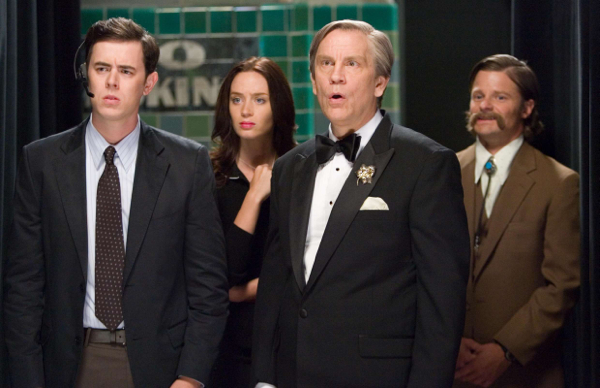
Nick and Norah’s Infinite Playlist

Nickandnorah1

Movie review by Greg Carlson

Adapted from the popular novel of the same title by Rachel Cohn and David Levithan, “Nick and Norah’s Infinite Playlist” is much better than the typical teen movie, floating above some of the genre’s usual limitations while falling prey to just a few of the others. Sadly, the characters bear no spiritual relation to the effortlessness and élan of William Powell and Myrna Loy’s more well known Nick and Nora, but the Charles family detectives were as grown up as Michael Cera’s Nick O’Leary and Kat Dennings’ Norah Silverberg are adolescent. Director Peter Sollett (“Raising Victor Vargas”) makes the most of the storyline’s “American Graffiti”-esque odyssey, and the movie’s leads are clever and appealing.

Unfolding during the course of a magical NYC evening, “Nick and Norah’s Infinite Playlist” establishes its musical pedigree with animated credits trumpeting some of the flavors-of-the-moment who grace the film’s soundtrack. Devendra Banhart and Bishop Allen provide tunes and appear onscreen. Band of Horses, Vampire Weekend, Tapes ‘n Tapes and the Real Tuesday Weld join many other artists with varying degrees of Pitchfork Media acceptability. Most of the music is well chosen, and only time will tell whether the soundtrack will take on the kind of cult status enjoyed by the groupings of songs in “Fast Times at Ridgemont High” or “Ferris Bueller’s Day Off.”

Movies that incorporate rock music or rock musicians as part of the plot more often than not come off as utterly phony, and it is difficult to buy the cast’s enthusiasm for tracking down a secret gig by the elusive and too-cool-for-mere-mortals Where’s Fluffy, a fictional group beloved by the film’s in-the-know hipsters. While Where’s Fluffy remains unheard for the duration of the film, Nick’s band the Jerk-Offs does play, and there is something endearing about Cera as the only straight boy in the group. Cera repeats the geeky earnestness he perfected during the run of “Arrested Development” and then later in “Juno” and “Superbad,” but he is so good at it, most viewers won’t mind.

Along with Cera, Dennings is the main attraction, and both performers manage to flesh out somewhat thinly written characters. The supporting players, almost across the board, scarcely register as recognizable human beings, reduced instead to the stereotypes of the bitchy, selfish princess, the drug and alcohol-fueled party girl, and the extroverted homosexual pal. Possibly to maintain some level of Big Apple credibility, “Nick and Norah’s Infinite Playlist” acknowledges, at least in passing, a rainbow of signifiers and identifiers for the variety of mostly privileged kids who pass through the scenes.

Despite an amplified orgasm that takes place at the storied Electric Lady recording studio, Sollett maintains a chaste romanticism throughout the film. The characters talk frankly about sex, but the film keeps its distance from the raunchiness that defined teen movies in the wake of “American Pie.” Some gross-out material, including a disgusting running gag about a piece of well-traveled chewing gum, feels a little forced. The good news is that the boy and girl falling for each other stuff, for all its familiarity, is warm, sweet, fun and wonderfully awkward.


Miracle at St. Anna

Miracleatstanna1

Movie review by Greg Carlson

A largely frustrating, mostly disappointing adaptation of James McBride’s novel, “Miracle at St. Anna” bears the hallmarks, and then some, of many a Spike Lee joint.  Despite the seasoned filmmaker’s audacious personal stamp, the movie plays like an overwrought made-for-television miniseries, piling numerous subplots on top of one another with little regard for audience sympathy.  This author wrote recently that Joel and Ethan Coen sometimes make movies in which they demonstrate contempt for their characters.  In Spike Lee’s case, it is the viewer who appears to be on the receiving end of the moviemaker’s scorn and derision.

The old writing adage “show don’t tell” is not a lesson Lee has learned.  He shows plenty, but he also has the tremendously annoying habit of spoiling many beautiful moments by adding some dialogue that points out the obvious.  At his very best, in movies like “Do the Right Thing,” Lee tempers his loquaciousness with a talent for sensational compositions and strong pacing.  “Miracle at St. Anna” occasionally seems like it was directed by someone else entirely, and the battle sequences in particular unfold with little sense of narrative space and time.

Lee seems unwilling to commit the film to a single tone, and lurches wildly from vicious violence to heavy-handed social commentary to the odd and out of place provinces of magical realism.  The latter is expressed in some dimensions of the unlikely relationship that blossoms between PFC Sam Train (Omar Benson Miller), a mountainous, superstitious, and deeply religious manchild, and Angelo (Matteo Sciabordi), a young Italian boy whose life is saved by Train.  Angelo refers to Train as the “Chocolate Giant,” and the protective bond that forms will remind some viewers of “Life Is Beautiful,” and not in a good way.

It is possible that the inconsistency of tone owes something to the unwieldy number of diversions and red herrings that bob up in scene after scene.  Instead of drawing the central quartet of soldiers as fully dimensional characters, the script dwells on a group of Italian villagers with varying political allegiances, a handful of partisans led by a guerilla known as the Great Butterfly, some Nazis looking to reclaim one of their own missing fighters, and a romantic rivalry over a pretty villager.  Additionally, Lee frames the movie with a murder mystery involving the pilfered head of a priceless statue.

There is definitely a great movie in the story of the Buffalo Soldiers of the 92nd Infantry Division, a segregated unit that was the only outfit of African Americans to see European combat during World War II.  “Miracle at St. Anna” is not that movie.  The role of African American soldiers, who faced racism on a regular basis from white officers, gets buried amidst all the other story threads, even though as a theme, it is the most promising component of the movie.  One of the most intriguing juxtapositions in the film occurs early, as members of the 92nd attempt a river crossing while a German truck broadcasts dispiriting messages from Axis Sally (Alexandra Maria Lara), a seductively voiced English speaker who reminds the men that they are fighting for a country that does not care about them.  If Lee had opted to pursue that idea to the exclusion of most of the movie’s others, “Miracle at St. Anna” might have succeeded.


Vicky Cristina Barcelona

Vickycristinabarcelona1

Movie review by Greg Carlson

A tasty dessert prepared with just the right combination of sweet and tart, Woody Allen’s “Vicky Cristina Barcelona” is one of the year’s most enjoyable movie experiences. Buoyed by delightful performances from an ensemble of gorgeous creatures made all the more beautiful by the alluring Spanish surroundings, “Vicky Cristina Barcelona,” like Allen’s finest films, considers romantic love from a multitude of angles. Funny, charming, and clever, the movie reinforces the director’s longstanding worldview: Allen privileges the epicure’s delight, even though he knows most of us will err on the side of convention and caution.

Seasoned enough to pull off the inclusion of voiceover narration in which the audience is introduced to two young American women spending the summer in Barcelona, Allen sets up his title characters as diametric opposites in temperament and taste, despite their enduring friendship. Vicky (Rebecca Hall), whose sharp dialogue will remind Allen aficionados of the director’s own enduring comic voice, is a skeptic who depends on the comforts of predictability and routine. Cristina (Scarlett Johansson) is impetuous, restless, and slightly reckless when it comes to relationships. As the movie explains more than once, Cristina is not sure exactly what she wants, but she knows what she doesn’t want.

Shortly after arriving in Spain, the friends make the acquaintance of Javier Bardem’s sensual artist Juan Antonio, who introduces himself by suggesting the three of them share a weekend of sex together. The women, like the viewers, are initially shocked, and press for some clarification. In one of the best lines in the film, Juan Antonio defends his bold proposition by explaining that “Life is short, dull, and full of pain.” While this particular sentiment might not be enough to placate hardened cynics, Allen presents it with such straightforward simplicity that many audience members burst out laughing at the blunt, unfiltered audacity of the idea. Juan Antonio, a hedonistic painter who initially seems like nothing more than a macho, Latin lothario stereotype, turns out to be much more complex than meets the eye, and Bardem is perfect in the role.

What follows includes a series of turnabouts, reversals, and surprises, and “Vicky Cristina Barcelona” would have been a good movie merely to follow the couplings to their conclusions. Allen has more ambitious things in mind, however, and lights a fuse with the introduction of Juan Antonio’s ex-wife Maria Elena (Penelope Cruz). Cruz’s sudden appearance changes the entire dynamic of the movie’s relationships, and the performer demonstrates tremendous flair, delivering her lines in a rapid-fire blend of Spanish and English that leaves all interlocutors begging for mercy.

For decades, Allen has dissected affairs of the heart with deft comic timing and no small amount of heartache and longing for an ideal that doesn’t exist outside of our own fantasies. “Vicky Cristina Barcelona” proves a nice addition to that tradition, and might just inspire some moviegoers to rent some of Allen’s classic work to see what the fuss was about thirty plus years ago, when the filmmaker was the toast of both cineastes and a public out for a good time at the movies.