Movie review by Greg Carlson
Based on a short story called “The Wicker Husband” by Ursula Wills, quirky Sundance feature “Wicker” arrives in theaters at the leading edge of a pack of award-season hopefuls. Written for the screen and directed by Eleanor Wilson and Alex Huston Fischer, the movie doesn’t appear to be generating enough critical or viewer interest to land any major nominations, but the darkly romantic fairy tale is well worth seeking out for fans of literate storytelling and accomplished acting. Built around a central performance from the always brilliant Olivia Colman, the film counts on strong support from Peter Dinklage, Alexander Skarsgård, and Elizabeth Debicki. Themes of romance, self-respect, and jealousy are explored within the larger context of class, gender expectations, and the limitations and flaws of the patriarchy.
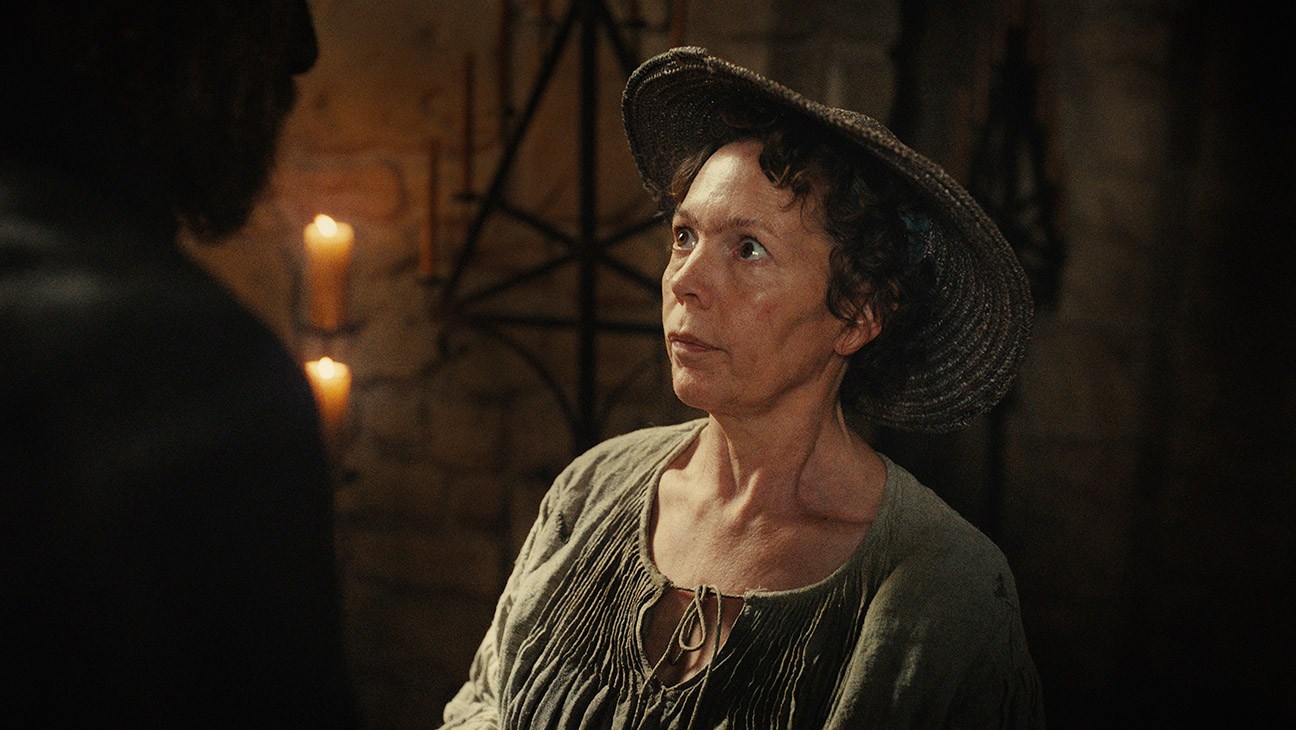
Characters are identified by their trades, and none of the villagers are more unfairly maligned than Colman’s Fisherwoman, whose pungent aroma draws cruel marketplace insults from her peers. The Fisherwoman, however, takes the slander in stride. Tired of being alone and longing for companionship, she seeks the services of the Basket Weaver (Dinklage). Her requested husband (Skarsgård) is intricately assembled and animated in the course of a month. Not long after a bed-destroying wedding night, the Fisherwoman’s green-eyed neighbors begin to express their covetousness. Nobody other than the mysterious Basket Weaver, however, applauds the union.
“Wicker” marketing has capitalized on the film’s purported horniness, but outside the initial flush of carnal passion, sex is absolutely secondary to the exploration of how comparison is the real thief of joy. The filmmakers make crystal clear the lack of maturity and self-confidence of the village menfolk, who gather at the tavern to gossip and speculate about the new arrival. The women, led by Debicki as the bitter Tailor’s Wife, arguably fare even worse. Valued only for their ability to produce offspring and help run family businesses, none of the wives are equal partners in life and marriage. It’s painfully obvious why the Fisherwoman’s newfound happiness with an attentive and doting soulmate should cause such a stir.
Wilson and Fischer throw a few curveballs that keep viewers invested in what will happen next (one of which is a brief and humorous cameo featuring Richard E. Grant as a rather suspect physician). The best of those choices comes when the Fisherwoman allows the tiniest fraction of doubt about her spouse’s faithfulness to cloud her trust. The brief misunderstanding that follows sets up a third act revelation that exposes the worst in nearly all the Fisherwoman’s acquaintances. This structural ploy, which returns the Basket Weaver to a prominent role at front and center, somewhat diminishes the extent to which we get to see a wholly satisfying reconciliation between the Fisherwoman and the Wicker Husband.
Some of the movie’s fable-like commentary comes down with a heavy hand. Fortunately, the jabs – like the use of a ceremonial collar as opposed to a wedding ring – are more often than not funny enough to compensate for the oversimplifications. Transcending the scripted dialogue, Colman and company also do plenty of heavy lifting in this respect. Surely, “Wicker” could use much more of the weirdness suggested by its magical title figure, whose visual and sound design elements are rendered with the right blend of intriguing grotesquery and physical allure.