Grizzly Man

Grizzlyman1

Movie review by Greg Carlson

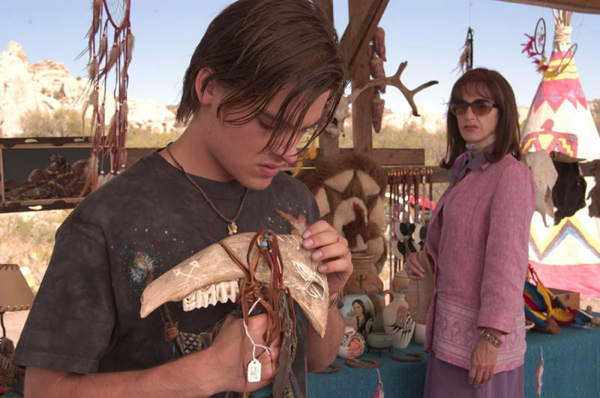
Admirers of veteran filmmaker Werner Herzog’s impressive body of work will not want to miss “Grizzly Man,” an engrossing documentary that blends Herzog’s ferocious hunger for knowledge with a hair-raising tale of one man’s fatal relationship with the wild bears in Alaska’s Katmai National Park. Like so many of Herzog’s oddities, outcasts, and misguided iconoclasts, subject Timothy Treadwell embarks on a seemingly mad and certainly reckless journey of self-discovery that requires participation in unthinkably perilous behavior as a measure of one’s mettle. “Grizzly Man” reveals immediately that Treadwell and girlfriend Amie Huguenard were killed and eaten by a bear (or bears) in October of 2003, and Herzog uses the incident as a jumping-off point for a discussion of, among other things, the desire for celebrity and the commodification of nature for personal gain.

“Grizzly Man” is composed largely of Treadwell’s own video footage, which he began compiling in 1999. Shot in the style of a Discovery Channel or Animal Planet series in which a “Crocodile Hunter” host lays it on thick while presumably teaching viewers something about the wild, Treadwell’s clips tell us a great deal more about Treadwell than the animals he claims he is there to protect. Several times, Treadwell loses his thread and launches into profanity-laced, paranoid rants in which he casts himself as a lone champion of the bears. Herzog occasionally comments in voiceover, but Treadwell does not need any help in terms of making himself sound like a raving, delusional, and terribly naive fool.

With his sandy, Prince Valiant locks and his surfer dude attitude, Treadwell seems much younger than his real age (he was born in 1957), and his playful, child-like demeanor contributes to a sense of arrested development. He calls the bears by pet names like Mr. Chocolate and Sergeant Brown, and tells the animals over and over how much he loves them. Several times, Treadwell breaks down in tears on camera as he struggles to explain just how closely he identifies with these creatures (in one absolutely hilarious moment, Treadwell chokes up over what he thinks is a dead bee). While Herzog manipulates the chronology of some of the footage, Treadwell emerges as a deeply troubled person whose inability to connect with human society fascinates the director.

Treadwell’s close encounters with the 800-pound behemoths are often breathtaking, and Herzog clearly admires his subject’s devotion to single-minded documentation. Several times, Treadwell finds himself nose to nose with a bear, and his determined tactics to interact peacefully with the animals are chilling to see. Treadwell became so accustomed to turning on his video camera whenever a bear wandered by, an audio recording of his own death was captured on tape (the lens cap was not removed). Herzog uses this harrowing piece of information to stage the film’s most compelling moment – rather than share the gruesome sounds with the audience, Herzog chooses to withhold them, and unheard attack ripples through the viewer’s imagination.

Herzog’s voice, clear and unflinching in its directness, provides the ideal counterpoint to Treadwell’s spacey “secret world of the bear.” The director often disagrees with Treadwell, and several of Herzog’s comments – such as the idea that when he looks at the world he sees only “chaos, hostility, and murder” or that nature itself is totally “indifferent” – resonate with a bleak sense of humor. While Treadwell practically foams at the mouth trying to attribute individual personalities to the many bears he encounters, Herzog cuts to the quick, suggesting that the bear merely regards Treadwell with a “half-bored interest in food.” Herzog himself is anything but bored by Treadwell, however, and viewers of “Grizzly Man” are beneficiaries of the great filmmaker’s curiosity.

A History of Violence

Historyofviolence1

Movie review by Greg Carlson

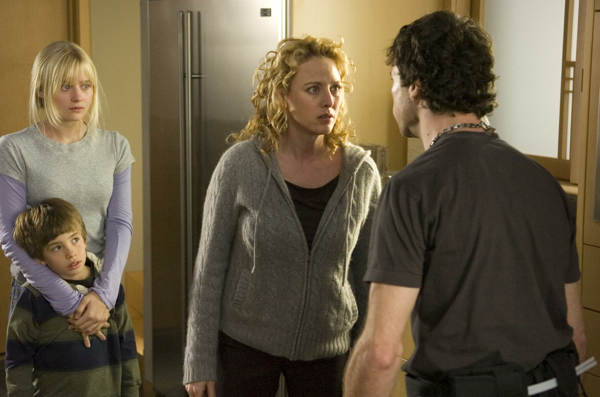
On the surface, David Cronenberg’s “A History of Violence” plays out like a conventional thriller steeped in the tradition of the American Western. Cronenberg – despite the charges that his filmmaking is often cold, detached, and clinical – has always been fascinated by the significant measure of awful things people do to each other and to themselves, so it will come as no surprise to fans of the director that “A History of Violence” offers more than initially meets the eye. Far less weird than many of the director’s signature films, “A History of Violence” still packs quite a punch, particularly with its often dizzying treatment of the title subject.

Set largely in the small town utopia of Millbrook, Indiana, “A History of Violence” introduces the Stall family: patriarch Tom (Viggo Mortenson), his beautiful wife Edie (Maria Bello), and their children Jack (Ashton Holmes) and Sarah (Heidi Hayes). Cronenberg wastes no time in psychologically linking the Stalls to something wicked in the air – Sarah’s nightmare-induced scream follows a prologue in which two cold-blooded killers hit the road following grisly multiple murders. Cronenberg’s careful, deliberate pacing of the film’s early scenes establishes the queasy realization that the bad men are destined to cross paths with Tom.

Once the roaming assassins appear at the diner Tom manages, Cronenberg stages the tense confrontation with an almost otherworldly combination of action, fear, adrenaline, and humor. The director has indicated in press for the film that one might indeed interpret the movie’s flashes of violence as absurdly funny, and part of this realization stems from the filmmaker’s decision to portray the violent moments without much of the ornamented, slow-motion stylization that accompanies so much of the mayhem audiences are accustomed to seeing on the screen. This is not to suggest that Cronenberg fails to fetishize the violence (the film has far too many gruesome aftermath close-ups to support that idea), but rather that care has been taken to involve the viewer in the consequences of the lethal outbursts that pepper the film.

Once Tom has been anointed a local celebrity for his curiously skillful actions at the diner, “A History of Violence” moves into high gear. Media attention on Tom’s heroics presumably brings about a visit from a trio of big city tough guys, led by disfigured Carl Fogarty (Ed Harris). Fogarty insists that he knows Tom, and Cronenberg relishes the blurring of past and present, as well as the real and the imagined. Tom’s very identity is called into question, and “A History of Violence” engages directly with the question of how Tom’s ability to commit ferocious acts of brutality and aggression test the loyalty and imagination of his wife and son.

In other words, Cronenberg is arguably more interested in what roles the Stall family will begin to assume following the suggestion that Tom is not who he says he is. In this context, “A History of Violence” earns high praise – particularly for the performance of Bello, whose own reaction to Tom’s identity crisis walks a tightrope fraught with anxiety, revulsion, and – surprisingly to herself – deep attraction. By the time Cronenberg arrives at the iconic illustration of domesticity that provides the film’s coda, as many questions have been raised as have been answered. One thing is known, however: “A History of Violence” is a forceful and sharp piece of filmmaking.


Roll Bounce

Rollbounce1

Movie review by Greg Carlson

A charming and good-natured comedy suitable for nearly all ages, “Roll Bounce” employs the familiar competition/contest formula as the framework for a nostalgic look back at the late 1970s and the popular pastime of indoor roller-skating. Anyone old enough to remember having a blast on quad-wheeled, lace-up skates will smile at the impeccable production design of “Roll Bounce’s” glitzy Sweetwater rink, a bustling bazaar of coin-op video and pinball games, spinning disco balls, smooth-talking disc jockeys, and ridiculously talented skaters. Jam-packed with well-chosen period tunes, “Roll Bounce” never quite catches fire, but it is an enjoyable way to spend an afternoon.

Starring Bow Wow as Xavier “X” Smith, a Chicago teenager mourning the death of his mother, “Roll Bounce” introduces a number of memorable characters in support of the lead performer. Chi McBride plays X’s dad Curtis, a stern but loving patriarch struggling to hide his own fear and sorrow from his two children. X’s close-knit group of friends contribute to the film’s ever-present spirit of camaraderie, but it is new neighbor Tori (Jurnee Smollett), a novice skater saddled with a set of unwelcome braces, who forges a warm bond with the moody X. Despite the boys’ relentless ridiculing of her orthodontic accoutrement, Tori gives as good as she gets, and her scrappy personality makes her right at home among her new pals.

Screenwriter Norman Vance Jr. and director Malcolm D. Lee focus the majority of their attention on the family drama of X and Curtis coming to terms with their loss, but the movie never completely neglects the skating, which is always photographed and edited with pulse-quickening verve. Much of the action on the rink is dominated by X’s rival Sweetness (Wesley Jonathan), a self-confident amalgam of Prince and James Brown, whose liquid moves have dominated the annual skating contest for several years in a row. Despite his glaring two-dimensionality, Sweetness is something to see on roller skates.

“Roll Bounce” also squeezes in a tentative love interest for X, an old acquaintance named Naomi (the tremendously charismatic Meagan Good), who initially seems more than willing to give X a chance, but grows increasingly impatient with his awkward inability to manage even a couples’ skate. “Roll Bounce” falters with this storyline, never taking the time to develop Naomi’s character – which is a shame, given the welcome presence of Good. Interestingly, Tori encourages X to pursue Naomi, and the filmmakers must be commended for eschewing the predictability of a rivalry for X’s affections.

At times, “Roll Bounce” might remind viewers of episodic television, which is not necessarily a bad thing. The movie often resembles the pilot of a series, with its multiple storylines and parade of eccentric bit-players (including comical turns by Mike Epps and Charlie Murphy as sanitation workers, and Nick Cannon and Wayne Brady as roller rink employees). Additionally, the period vibe of childhood – from the sights and sounds of the Atari 2600 to the neighborhood water balloon fights – blends perfectly with the exciting skating sequences, several of which are breathtaking highlights of the movie.


Lord of War

Lordofwar1

Movie review by Greg Carlson

An often gripping tale of a successful, self-made, illegal arms dealer, “Lord of War” doesn’t always hit its target, but its unique subject matter makes it worth a look. Writer-director Andrew Niccol, who wrote “The Truman Show” and directed “Gattaca” and “Simone,” brings his knack for off-center concepts to a timely (and timeless) political conundrum: the grotesque abundance of small arms and the ease with which they are placed in the hands of the world’s poorest and most disenfranchised people. “Lord of War” employs a bleak sense of humor to mask some of its horror, but in the end, nobody will feel much like laughing.

Nicolas Cage plays Yuri Orlov, the son of hardworking Ukrainian immigrants in Little Odessa, where Yuri grows up with brother Vitaly (Jared Leto) in the shadow of mob violence. In a darkly comic epiphany, Yuri realizes that going into the gun business is like going into the restaurant business: people are compelled to kill one another in the same way they are compelled to eat. With little more than his significant self-confidence and skill with languages, Yuri transforms himself into the world’s premier firearms dealer, selling weaponry to any war-torn region that will meet his reasonable prices.

Yuri manages to convince himself – and likely a few of the audience members – that his occupation merely represents the realities of free market economics. What his buyers do with the munitions once they leave Yuri’s possession is entirely beyond his control. It’s a chilling display of cognitive dissonance, particularly when Niccol depicts executions, murder, and mayhem carried out by children scarcely large enough to shoulder Yuri’s reliable Kalashnikovs. Only dogged Interpol agent Jack Valentine (Ethan Hawke) believes that shutting down Yuri’s operation will extend some lives – if only for a day or two.

As a result of Niccol’s convoluted moralizing, “Lord of War” fails to deliver a knockout punch – the impressive special effects often fetishize and glorify the violence Niccol intends to deride. Additionally, Yuri’s voiceover narration reveals the protagonist to be wholly vacant on the inside as well as the outside. Niccol wants to show us that Yuri is almost completely numb to the chaos he so willingly abets, but the character’s amorality renders any sense of audience affinity nearly impossible. Vitaly, whose cocaine addiction helps him deal with his brother’s ugly profession, struggles to become Yuri’s conscience, but the strain is greater than either of them can bear.

For the most part, “Lord of War” unfolds with the same cynical detachment embraced by Yuri, and Niccol manages to address some issues more effectively than others. Underwritten is Bridget Moynahan’s role as Yuri’s wife, a woman who chooses to look the other way as long as the money keeps rolling in. A hair-raising relationship between Yuri and self-appointed Liberian president Andre Baptiste (Eamonn Walker) suggests that both men are possibly psychotic – Baptiste for his willingness to kill at the slightest provocation and Yuri for his willingness to do business in Baptiste’s dangerous company. “Lord of War” produces too much queasiness to be totally satisfying, but its ability to provoke thought should attract anyone interested in global politics.


Red Eye

Redeye1

Movie review by Greg Carlson

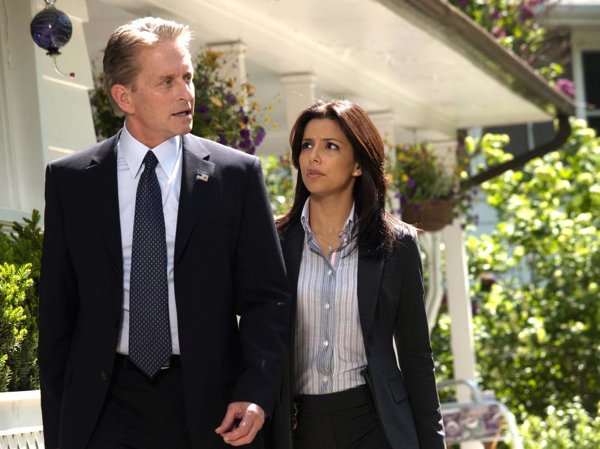
In “Red Eye,” beloved genre director Wes Craven deftly handles a ridiculously illogical screenplay that reaches for the single-mindedness of Hitchcock thrillers like “Rope” and “Lifeboat.” Brief in both duration and intellect, “Red Eye” keeps expectations low as it races through its mostly predictable contents and coasts on the charm of its attractive leads Rachel McAdams and Cillian Murphy. Set almost entirely on an overnight Dallas to Miami flight, the film will only please viewers tantalized by high-concept, single location pressure cookers such as “Phone Booth” and “Panic Room.” “Red Eye” surely deserves points for its conciseness, but the overall effect is muted by a familiar climax enlivened chiefly by Craven’s always impressive ability to handle spine-tingling suspense.

McAdams plays resourceful Lux Atlantic front desk manager Lisa Reisert, a multi-tasker who can handle any emergency that comes her way. This is fortunate indeed, for Lisa ends up seated next to dashing charmer Jackson Rippner (Murphy), whose moniker alone should trigger alarm bells. Once the plane takes wing, Rippner delivers some alarming news: if Lisa refuses to use her authority to move the deputy director of Homeland Security into a different suite back at the hotel, the baddies will murder her father. Craven brushes aside the implausibility of the request (a seaside room, the thinking goes, offers the would-be assassins a clearer shot at the VIP) and starts to tighten the screws.

Craven manages to wring plenty of thrills out of the thin screenplay, but the tight-quartered setting ultimately proves to be as much of a liability as a conceptual strength. Unfortunately, the script introduces several passengers (the unaccompanied minor, the kindly senior citizen, the irate and impatient jerk, etc.) without developing the possibilities of their participation in the unfolding drama. Instead, each of the background players simply provides a fleeting moment that bumps the plot forward. The idea is that Lisa must dig down deep and rely only on herself and her wits, but “Red Eye” might have been more interesting had it developed a few of the peripheral characters.

Despite the always welcome presence of Brian Cox, who plays Lisa’s imperiled father, even the people close to Lisa fade into the background. The arguable exception is Lisa’s plucky underling Cynthia (Jayma Mays), who always seems on the verge of melting into a puddle when confronted with challenging hotel business. Mays, in a delightful performance, takes the plight of the harried, service industry people-pleaser to giddy ends, and Craven relishes the opportunity to play her limited screen time for laughs.

By the time the plane touches down, a few of “Red Eye’s” bolts have rattled loose. Lisa’s sprint through the airport with Rippner at her heels is so unlikely one wonders if the entire design is some tongue in cheek criticism of post 9/11 security conditions. Even more preposterous is the staging of the final cat-and-mouse showdown, at the home of Lisa’s pop (fortunately for her, the old man has kept her room – including her field hockey stick – just as it was when she was growing up). The saving grace of the movie’s by-the-numbers climax is Craven’s skill at shooting the scary hide and seek between Lisa and Rippner, and the director creeps through hallways and behind doors with chilling effectiveness. Perhaps next time the veteran will have better material.

Me and You and Everyone We Know

Meandyouandeveryoneweknow1

Movie review by Greg Carlson

Multi-talented visual and performing artist Miranda July delivers an incredibly sure-handed feature film debut with “Me and You and Everyone We Know,” easily one of the year’s most insightful and challenging movies. Having already collected prizes at major film festivals, July’s film is a triumph of ensemble performing, especially noteworthy for the remarkable portrayals offered by young children. “Me and You and Everyone We Know” belongs to that category of offbeat, one-of-a-kind tales that inspire fervent cult followings but little mainstream box office success. Ironically, the hardcore supporters like it this way, as the movie can comfortably remain a secret treasure shared via enthusiastic word of mouth, without the risk of becoming too popular.

Set in the technologically dominated suburban present, “Me and You and Everyone We Know” resembles in many ways the work of Todd Solondz, but bursts with a warmth and humanism often missing from films like “Happiness” and “Storytelling.” While Solondz often highlights the grim and the cynical, July embraces a refreshing hopefulness that only occasionally skirts the edges of too-cute preciousness. Both directors depict frank sexual situations involving children, and both directors are capable of triggering feelings of queasiness as a result of these situations. While “Me and You and Everyone We Know” contains scenes that might unnerve parents of pre-teen and teenage kids, July refuses to judge the actions of her characters, and the result is a scary but bracing look at the ways in which young people navigate the treacherous waters of sexual curiosity and initiation.

Skittish viewers will wince at some of July’s more graphic content, but the director’s range is so far-reaching and original, viewers can readily grasp what July is saying about our inability to find fulfillment and connection with other people. In one jaw-dropping scene, Robby (Brandon Ratcliff) composes a scatological scenario so outrageous it fuels the fantasy of a chat-room correspondent who has no idea that a six-year-old is on the other end of the conversation. Another storyline details the dangerous flirtation between two young girls and an older man. “Me and You and Everyone We Know” is not reducible to its preoccupation with sex, however, and its central storyline plays with the conventions of the traditional romantic comedy.

Writer-director July plays Christine, a struggling artist who pays the rent by chauffeuring elderly passengers on daily errands. Christine’s path intersects with Richard (a superb John Hawkes), a terrified shoe salesman dealing with a painful separation from the mother of his two boys. Both characters suffer from indignities both tiny and substantial, and July and Hawkes manage to convey complex interiority in a compelling and utterly believable manner. What makes “Me and You and Everyone We Know” work so well is July’s willingness to show Christine and Richard as imperfect, and their limitations and weaknesses – Christine’s passive-aggressive desperation and Richard’s irresponsible self-abuse both physical and psychological – forge their personalities into recognizable images of ourselves.

Along with July and Hawkes, the rest of the actors make memorable impressions. Ratcliff and Miles Thompson, as Richard’s sons, demonstrate the heartbreaking confusion resulting from parental break-up. Carlie Westerman, as an obsessive collector of home appliances, employs her hobby as a bulwark against potential pain, and her meticulously appointed hope chest reminds us of her own deepest worries and anxieties. “Me and You and Everyone We Know” is filled with wondrous moments, though some will likely find the relentless self-documentation overpoweringly syrupy. Others will respond to the film’s dogged determination and its indomitable spiritedness. Either way, “Me and You and Everyone We Know” is not easy to forget.

The Brothers Grimm

Brothersgrimm1

Movie review by Greg Carlson

Despite a faithful fan following that clings to the memories of fabulous work like “Monty Python and the Holy Grail” and “Brazil,” Terry Gilliam remains one of the most disappointing major filmmakers of the last thirty-plus years. While many of Gilliam’s visually rich motion pictures contain stunning moments from one of the most expansive and outsized imaginations in cinema, the overall impact of the director’s work is muted and deflated by an incomprehensibleness that challenges the most dedicated viewer. Movies like “The Adventures of Baron Munchausen,” “Twelve Monkeys,” and “Fear and Loathing in Las Vegas” are easier to admire than to actually watch. Sadly, “The Brothers Grimm” cannot be added to that list, as it is neither admirable nor watchable.

Hopelessly miscast, Matt Damon and Heath Ledger star as the famous storytellers, here remolded into oily con artists who prey on superstitious villagers willing to pay hard cash in exchange for Napoleonic-era ghostbusting and exorcism. Will and Jake, as the boys dubiously call each other, blithely travel from town to town in French-occupied territory until their ruse is sniffed out. Facing gruesome torture at the hands of weird officer Cavaldi (Peter Stormare, generally out-acting his hairpiece) the Grimms are spared when a legitimate series of kidnappings in Marbaden depends upon their investigation.

It is difficult to gauge exactly when “The Brothers Grimm” goes off the rails, but it happens early. Gilliam seems happiest constructing ornate set-pieces that literally reconstruct magical theatrics driven by the ancient machinery of crafty showmen. The problem, however, is that the curtain is pulled back too far, and the wonder is mostly sucked out of the spectacle. One of the movie’s central ideas – that the Grimms encounter several of the “real” inspirations for their folkloric narratives – sounds much better on paper than its execution. From Little Red Riding Hood to Snow White to Rapunzel to Hansel and Gretel and even the Gingerbread Man, “The Brothers Grimm” accumulates its fairy tale pedigree so quickly and haphazardly none of the individual characters (including Wilhelm and Jacob) ever takes flight. It borders on painful to report that “Shrek” does all of this much, much better.

“The Brothers Grimm” also invites comparison to lumbering behemoths like “Van Helsing” and “The League of Extraordinary Gentlemen,” two other movies that struggle mightily to blend well-known literary characters with a hip sense of ironic modernism. None of these movies really works on any level, and all succumb to the bluster of explosions and special effects that do absolutely nothing to enhance, extend, or expand the legacies of the intriguing personalities that originally sprang to life on the printed page. It seems as if Gilliam and the other filmmakers are convinced that the subjects are so well-known that attention can be paid instead to noisy, numbing (and CG-aided) hallucinations and apparitions. Without compelling personalities, however, the movie just falls flat.

In “The Brothers Grimm” everything feels unwieldy, awkward, and burdensome (especially Matt Damon’s ridiculous hairstyle and accent). Not even the presence of gorgeous Monica Bellucci, as a wicked queen desperate to regain her youthfulness, mitigates the thudding gloom. Lena Headey, as a cursed tracker named Angelika, reportedly landed the role when Harvey Weinstein refused to sign Samantha Morton (Gilliam’s first choice). Ms. Morton should send flowers, a thank you card, and breathe a sigh of sweet relief.

Broken Flowers

Brokenflowers1

Movie review by Greg Carlson

Writer-director Jim Jarmusch, a longtime cult favorite among fans of smart, self-aware comedies pregnant with arid wit, has made one of the year’s best films in “Broken Flowers.” Equally crafty and stirring, the great filmmaker forges a terrific partnership with Bill Murray, who previously appeared with the Wu-Tang Clan’s GZA and RZA in Jarmusch’s black and white “Coffee and Cigarettes” omnibus. This time, the movie is in color, and Frederick Elmes’ masterful photography delights the eye – particularly in the presentation of the many vivid pink objects that become clues in the movie’s central, unsolvable mystery.

Murray’s charming stoicism matches Jarmusch’s drollery beat for beat, so it is somehow perfect that the actor plays a character named Don Johnston, a well-chosen moniker that allows for several instances of purposeful comparison to both legendary lothario Don Juan and “Miami Vice” star Don Johnson. A newly retired computer expert content to lounge catatonically on his sofa in a comfy tracksuit, Don’s long term womanizing and inability to emotionally commit are summed up by departing lover Sherry (Julie Delpy), who leaves without eliciting much more than a look of resignation from Don.

Showing no signs of outward despair at the dissolution of his most recent relationship, Don hangs out with next-door neighbor Winston (Jeffrey Wright), a hardworking family man who by all appearances possesses everything that Don lacks. Sherry’s exit coincides with the arrival of an anonymous letter that suggests – in red ink on pink stationary – that Don fathered a son nearly twenty years ago. Winston insists that the strange note presents Don with an opportunity to seek out the mother of his child, and the amateur sleuth convinces Don to track down the women who shared his company two decades ago. Armed with Mapquest directions and a mix CD featuring Mulatu Astatke, Don begins his quest.

Employing Jarmusch’s easygoing, episodic structure, Don’s odyssey brings him face to face with four of the five women who might have sent the message (one, Don ruefully learns, is deceased). The reunion set-pieces are intriguing glimpses into the many paths one’s life can take, and the veteran performers are all superbly cast (although an almost unrecognizable Tilda Swinton has to make the most of fleeting screen time). Following an eye-opening interlude with Nabakovian daughter Lolita (an effervescent Alexis Dziena), Don reconnects with widow Laura (Sharon Stone), whose husband literally went up in flames in his racecar. Dora (Frances Conroy) lives with husband Ron (Christopher McDonald) in an antiseptic McMansion light years away from her flower child days. Animal communicator Carmen (Jessica Lange) seems startled by Don’s surprise arrival, and is relieved when her skeptical receptionist (Chloe Sevigny) interrupts to cut the visit short.

By the time Don arrives at the home of Penny (Swinton), Jarmusch has made it clear that the journey has been the destination. Audiences seeking some kind of conclusive answer or solution to Don’s original mission are likely to be disappointed, but Jarmusch treats his story and his characters with such dignity and interest, wrapping things up with a ribbon would have been an insult and a miscalculation (though Jarmusch die-hards will spend much time debating whether the film’s coda goes too far). At its best, however, “Broken Flowers” bears the signature Jarmusch touches that make his best films – like “Mystery Train” and “Dead Man” – sparkle with a certain lovely, inimitable distinctiveness.

Hustle & Flow

Hustleandflow1

Movie review by Greg Carlson

Writer-director Craig Brewer’s “Hustle & Flow” has already been the subject of much discussion regarding its depiction of a Memphis pimp who dreams of hip-hop stardom as a way out of his miserable economic straits. Cinema routinely depicts unsavory anti-heroes and morally compromised protagonists, but the inherent misogyny of pimping makes the possibility of telling a balanced story much more complex than the filmmaker can handle. While “Hustle & Flow” sticks close to its “everybody gotta have a dream” mantra, aping the rags to riches formula that fuels the American desire for success, it remains too timid to explore its central character as anything other than the gold-hearted patriarch of a dysfunctional family.

Terrence Howard, as DJay, is so good in the lead role that one occasionally overlooks the hokey simplicity of the movie’s well-worn formula. Howard brings his character to vivid life, and it is only the film’s writing that fails him. Delivering wise, weary monologues in his beat up whip, DJay’s aspirations to create something bigger than himself extend well beyond the paltry existence he scratches out by exploiting a trio of unfortunate young women. Sharing his innermost thoughts with the hard working Nola (Taryn Manning), DJay makes clear his restless lack of satisfaction, and Howard’s interpretation is magnetic.

A chance encounter with Key (Anthony Anderson), an old high school acquaintance, opens the door for DJay to record some of his own rhymes. Despite the objections of Key’s nervous wife Yevette (Elise Neal), the two men set up shop in DJay’s sweltering house, and begin tinkering with sounds and rhythms. Realizing they need some additional expertise, Key enlists Shelby (DJ Qualls), an enthusiastic church organist who knows his way around samplers and synthesizers, to craft some hooks for the songs. Surprisingly, the trio makes impressive progress in short order, and the audience begins to share in their excitement.

DJay’s women are unfortunately seen by Brewer as a means to an end as opposed to full-fledged creative partners in the pimp’s musical efforts. In one harrowing scene, DJay forces Nola to have sex with a sleazy pawnshop proprietor in exchange for an expensive microphone he needs to record his vocals. Another of DJay’s whores named Shug (Taraji P. Henson) turns out to have the singing voice of an angel, but her fawning dependency on DJay is so overwhelming it flirts with caricature. Henson works wonders as the pregnant Shug, but like most of the film’s characters, is hamstrung by writing that humiliates more than it challenges.

A tour-de-force set piece near the end of the film demonstrates some potent directorial skill, as DJay nervously approaches a successful rapper (played by Ludacris) with his demo tape. It is during this section that Brewer comes the closest to realizing the movie’s potential dramatic impact, and he constructs the scene with a sure-handed sense of escalating tension and dread. For the rest of its running time, however, “Hustle & Flow” careens between authenticity and self-parody so often it never manages to find a consistent personality (it doesn’t help that Brewer buys in to the idea that becoming famous and having ridiculous amounts of money are life’s only worthy goals). The film’s outstanding acting never quite compensates for this, but it comes close.

The Dukes of Hazzard

Dukesofhazzard1

Movie review by Greg Carlson

Another questionable TV series turned feature, the big screen “Dukes of Hazzard” arrives in theatres likely to draw the coveted young male demographic. With its attention span-deprived plotting and its healthy doses of fast cars and attractive young women, the film remains surprisingly faithful to its small screen counterpart, which ran on CBS from 1979 to 1985. Despite the objections of actor Ben Jones, who played the original TV Cooter, the new feature is nearly harmless, and it would be a close call to say which of the two versions deserves the crown for stupidity.

Penned by John O’Brien, who applied the same kind of updating to “Starsky & Hutch,” “The Dukes of Hazzard” is content to stick with its redneck milieu, quickly sketching a weak crisis about saving Uncle Jesse’s farm from the clutches of Boss Hogg. Director Jay Chandrasekhar, of Broken Lizard, is certainly no Preston Sturges, but he knows his way around comedy, and “Dukes” delivers laughs in at least half of its attempts. The well-loved roles are appropriately filled (the one exception being M.C. Gainey’s particularly nasty rendering of Rosco P. Coletrane, which lacks the bumbling charm first brought to the part by James Best).

Johnny Knoxville and Seann William Scott play Luke and Bo Duke, “cousins closer than brothers” who run moonshine in their bright orange Dodge Charger, the General Lee. Elevating inanity to levels approaching the central duo in “Dumb and Dumber,” there is no gag too idiotic, no line too infantile for the hillbilly pair. Jessica Simpson, to much fanfare, pulls on the Daisy Dukes, but despite the hard work she put in with a dialogue coach and a personal trainer, comes across as a mostly blank Barbie whose sole function is to employ her sexuality to wiggle Bo and Luke out of tight spots with the law.

The sometimes clever casting extends to include Willie Nelson as a wisecracking Uncle Jesse (i.e., Q: “Why are divorces so expensive?” A: “Because they’re worth it”) and Burt Reynolds as Boss Hogg. Given the sorry state of the screenplay, Nelson’s part proves the more fun of the two, and the legendary songwriter navigates it with sleepy-eyed comfort. The movie naturally provides Nelson with a marijuana gag – an easy laugh, but typical of the fare this movie has to offer. Of the supporting players, Kevin Heffernan also manages to grab a few chuckles as Sheev, a dim-bulb buffoon who comes to the aid of the Duke boys as a kind of surrogate Cooter. The underrated David Koechner, playing Cooter, does not get as much screen time as Heffernan but should – he is always very funny.

Not much is done in the way of retooling the spinning tires, barroom fisticuffs, and flaming arrows that defined the original series, but a road trip to Atlanta provides the movie with a hollow opportunity to excuse itself for keeping the Confederate flag emblem on the roof of the General Lee. Perplexed by the reactions of passersby (ranging from angry gestures to hearty endorsements) during a traffic jam, Bo and Luke play innocent. Far from turning into a referendum on racist remnants of the Civil War, “The Dukes of Hazzard” is quite content to put its pedal to the metal to get back where it belongs: a dusty road rally that concludes with a feel-good, celebratory barbecue.