Firewall

Firewall1

Movie review by Greg Carlson

A creaky, tepid, and thoroughly by-the-numbers action exercise with nary an original idea in its lolling head, “Firewall” is like a rerun of Harrison Ford’s non-Indiana Jones, non-Han Solo heroes – the boring ones who wear business suits and bark things like “Get off my plane!” As Jack Stanfield, a computer securities expert who toils for a large Seattle bank, Ford assumes the position as saintly father and husband with a palpable sense of entitlement. Ford can certainly take a beating with commitment and conviction (“Firewall” makes sure to put him through all sorts of bone-crushing paces), but is that all there is?

Director Richard Loncraine, working from a script by Joe Forte, occasionally seems to forget he is helming an action/suspense thriller. An interminable stretch of time is used to set up the story: cool, calculating Bill Cox (Paul Bettany) takes Stanfield’s family hostage in order to force Jack to hack into his own bank’s system and transfer millions of dollars into Cox’s account. Armed not only with a dizzyingly elaborate plan, Cox is abetted by a coterie of steely toughs, ranging from drivers who monitor Jack’s moves to surveillance/programming experts to machine-gun toting muscle.

“Firewall” never rises high enough to earn favorable comparisons to Hitchcock, but the wrong man theme provides a handful of diversions and complications. Despite the dullness of watching people use computers onscreen – an activity that has never been rendered in cinema with anything close to excitement – Jack is placed in several situations where he must use his security skills to fancy up some high-tech keyboarding. In one improbable sequence, Jack rigs a makeshift device out of his home fax machine and his daughter’s iPod. In another, he uses his son’s remote control toy truck to cause interference in the bad guys’ monitoring system.

Sadly, “Firewall” cannot seem to be bothered with the lives of its supporting characters, most of whom fade into stock stereotypes. Virginia Madsen, as Jack’s wife Beth, scolds the home invaders a few times, but never emerges as a flesh and blood person. Needless to say, the role is a far cry from her work in “Sideways.” Robert Forster, Robert Patrick, and Alan Arkin are virtually transparent. Only Mary Lynn Rajskub, who uses frowns and scowls to great effect as Jack’s harried secretary, manages to occasionally look like she is happy to be in the film.

“Firewall” is the kind of action movie where every last bit of exposition telegraphs something that will be recycled later on. The family dog and Jack’s son’s peanut allergy are two of the more obvious entries into this category, and both bits elicit sighs or chuckles, depending on one’s mood. By the time Jack engages Cox in hand-to-hand combat – in an empty house filled with all sorts of building materials that aid in the crashing and smashing – most viewers will be wondering why they are still watching. Ford long ago cornered the market on playing the victimized father who must protect his family, guaranteeing a happy ending in this safe, predictable, and completely unnecessary movie.

Something New

Somethingnew1

Movie review by Greg Carlson

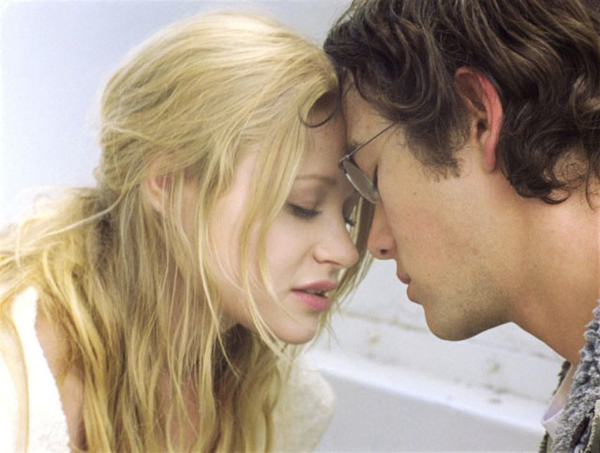
Too trifling to comment with any weight on the racial issues it raises, “Something New” still manages to work as a pleasant, if casually paced, romance with a pair of attractive leading performers.  The feature debut of music video director Sanaa Hamri, “Something New” tracks the dating ups and downs of smart, successful Kenya McQueen (Sanaa Lathan), a demanding and particular young professional whose plan to find an IBM (that’s an Ideal Black Male) goes topsy turvy when she falls for Brian (Simon Baker), the white landscape architect who’s designing her backyard garden.  Hamri, shooting Kriss Turner’s screenplay, uncorks the predictable complications, but the movie’s success rests with the easygoing chemistry between Lathan and co-star Baker.

Following a double cute-meet: an initial, awkward blind date paired with a chance encounter at a pre-wedding party thrown by a mutual acquaintance, Kenya agrees to hire Brian, who shows up at her door in his beat-up pickup truck with playful golden retriever in tow.  Everyone knows that these opposites will most definitely attract, and before much of the soil has been tilled, Kenya and Brian have shared a tender kiss in the rain.  Convincing herself (and her family and friends) that Brian is the one doesn’t come as easy as the kiss, however, and soon enough Kenya’s self-doubt steers the couple over some rocky terrain.

To make matters worse, competition arrives in the shape of handsome attorney Mark (Blair Underwood), who outwardly seems to possess the perfect combination of tall-order requirements on Kenya’s list.  Viewers will not have to consult a crystal ball to guess the movie’s eventual outcome, but those engaged with Lathan’s adept handling of an often ridiculous set of obstacles might find even the more familiar elements worth watching.  Surrounded by a solid cast, including Donald Faison as Kenya’s womanizing brother, Alfre Woodard (doing her best with a mostly strident, underwritten character) as Kenya’s ever-critical mom, and Earl Billings as Kenya’s understanding dad, Lathan navigates the thorny dilemma that finds her stuck in a tough spot.

“Something New” clearly aspires to themes beyond the girl-meets-boy plot that drives the action, but much of the film’s discussion of the politics of interracial dating wind up as speeches instead of believable conversation.  The movie’s heart is nearly always in the right place, but some of Kenya and Brian’s outbursts come off as preachy and forced.  Especially trying are the “Sex and the City”-cloned roundtables with Kenya and her girlfriends, a series of mostly unfunny filler scenes which never play like natural exchanges.

Not surprisingly, “Something New” is lightest on its feet when Kenya and Brian are alone, working out the delicate maneuvers of new lovers with the additional burden of disapproval from those whose opinions count (Mike Epps, as the boyfriend of one of Kenya’s pals, best embodies the skepticism of Kenya’s circle).  Both Lathan, who has been terrific in a handful of films, and Baker, still looking for a really big breakout role, breathe life into their roles that doesn’t exist on the page.  “Something New” may not entirely live up to its hopeful title, but the lead actors almost take it there.

Bubble

Bubble1

Movie review by Greg Carlson

Steven Soderbergh’s “Bubble” will undoubtedly be remembered more for the circumstances surrounding its distribution than for its content or cinematic quality.  Debuting simultaneously this week in theaters, on pay-per-view, and on DVD, Soderbergh seems to be offering a direct challenge to the traditional expectation of a window between theatrical run and home video release.  While the movie only gathered a tepid 70K in the 32 theatres showing it, reports from the distributor claimed a total weekend return of some five million dollars.  Depending on how one looks at it, this could signal the beginning of a shift in the way movies will eventually be released to the public.

Shot on high definition video – although the muddy colors, flat lighting, and frequent focus shifts look more like the results of consumer-grade tape – “Bubble” is purportedly going to be the first of six low-budget properties that will see the same type of opening day simultaneity.  Soderbergh is no stranger to innovative, do-it-yourself moviemaking, and he has maintained an aggressive, if not always successful, blend of lavish projects (“Ocean’s Eleven”) and edgier pursuits (“Full Frontal”).  Along with directing “Bubble,” Soderbergh also shot and edited, employing pseudonyms for those tasks.

Working from a lightly-sketched screenplay by Coleman Hough, Soderbergh comments on the emptiness and banality of low-income life in a small town on the Ohio-West Virginia border.  Set in a doll factory, which affords ample opportunity for unsettling shots of the grotesque and fascinating process of assembling tiny imitations of babies, “Bubble” focuses on the relationship between middle-aged Martha (Debbie Doebereiner) and quiet Kyle (Dustin James Ashley).  None of the principal performers in the movie are professional actors, and the casting choices bring a layer of documentary-like realism to the movie that suggests a purposefully designed minimalism.

An uneasy triangle forms when pretty, single mother Rose (Misty Dawn Wilkins) is hired at the factory.  An immediate threat to the comfortable friendship of Martha and Kyle, Rose’s arrival injects some tension into the movie, especially when it is revealed that there is more to her than either Kyle or Martha first guesses.  A shocking murder is committed less than one hour into the movie’s very brief running time, and the final section delivers an absorbing investigation that showcases Soderbergh’s near-obsessive sense of restraint.  Decker Moody, as the police detective who interviews the people involved with the crime, is ideally suited for his role.

Given the reception of “Bubble,” one would assume that viewers would opt to stay home for a movie rather than go out to see it if the choice is offered.  While the cost of a new DVD, even discounted, totals more than the price of a movie ticket, consumers might enjoy the freedom of being able to start, stop, and replay the movie – especially in the comfort of a well-appointed home theater.  The “Bubble” DVD also includes two audio commentaries, a deleted scene with an alternate ending that provides information that significantly alters the version shown in theaters, and some additional content covering the lives of the actors and the casting process.  Having immediate access to this material changes the experience of “Bubble,” enhancing its value.

The New World

Newworld1

Movie review by Greg Carlson

The myth of Pocahontas is simultaneously durable and sketchy, and perhaps this is part of its appeal.  Filmmaker Terrence Malick’s treatment of the story necessitates a great deal of invention, but the final impact of his fourth feature “The New World” is somewhat disappointing when lined up against his other films.  Malick devotees need no convincing that he is a filmmaker unlike any other, a master director unafraid to put visual lyricism ahead of conventional, dialogue-driven plotting.  “The New World” displays nearly all of Malick’s familiar touches, but it fails to replicate the epiphanies and grandeur of his 1970s masterworks “Badlands” and “Days of Heaven.”

The first section of “The New World” is the strongest, as a British exploration led by Captain Newport (Christopher Plummer) arrives in Virginia to the magisterial strains of Wagner’s “Das Rheingold” as the native Powhatan emerge from the trees to greet the strange-looking aliens.  Spared from the hangman’s noose by Newport, Captain John Smith (Colin Ferrell) is ordered to lead an expedition to the natives’ settlement.  While the other members of his group are killed, Smith is miraculously saved by Pocahontas (Q’orianka Kilcher), the daughter of the tribal leader.  Smith stays with the natives for some time, during which he forms a deep bond with the curious and beautiful Pocahontas.

Malick lavishes attention on the closeness of Smith and Pocahontas, painting the unhurried lifestyle of the natives as a harmonious balance between human beings and nature.  Mostly avoiding any explicitly depicted sexual relationship between Smith and Pocahontas, Malick nevertheless suggests an eroticized, prelapsarian sensuousness that discreetly sidesteps the considerable age difference between the central characters, as well as reinforces the fantasy construction that love between a Native American and an Englishman excuses the ugly reality of what Europeans would inflict during colonization and beyond.

Later, Pocahontas marries John Rolfe (Christian Bale), and her sad transformation is manifested in the change from her customary furs and skins to the constricting and uncomfortable togs worn by “proper” ladies.  Arriving in England for an audience with royalty, Pocahontas discovers her very own new world, and ace cinematographer Emmanuel Lubezki’s camera fixes on manicured hedges and soaring architecture in a way that parallels Smith’s earlier fascination with Powhatan culture.  Pocahontas, now christened Rebecca, comes back into focus in a series of moments that bear Malick’s ethereal, almost mystical, stamp.  These last moments reverberate with a bittersweet and tender sense of sorrow.

Like Malick’s other films, “The New World” will no doubt benefit from multiple viewings, not to mention the inevitable stream of scholarly articles that will dissect the director’s purposefully unstated intentions.  One leaves “The New World,” however, with the gnawing impression that there should have been something more to it.  Malick detractors will also carp about the fuzzy internal monologues delivered by Pocahontas, Smith, and Rolfe, which lack the haunting urgency of Linda Manz’s voiceovers in “Days of Heaven.”  Despite its shortcomings, “The New World” surpasses the majority of the thoughtless drivel released to the public, and even those unfamiliar with Malick’s other movies will marvel at the film’s many charms.

Glory Road

Gloryroad1

Movie review by Greg Carlson

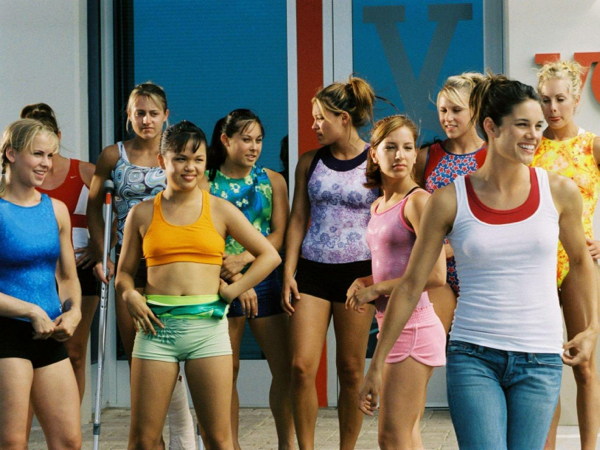
Yet another entry in Disney’s lineup of sports movies based on real events, “Glory Road” joins “Remember the Titans,” “The Rookie,” and “Miracle” as a mostly enjoyable – if not altogether penetrating – exercise in history at the movies.  In other words, beyond the central fact that the 1965-66 Texas Western Miners won the NCAA Basketball Championship, “Glory Road” gets the Jerry Bruckheimer makeover, which means that the movie takes generous liberties with the record in order to arrive at the most entertaining, and hopefully profitable, version of events.  “Glory Road” is not exactly “Hoosiers,” but the charismatic casting choices form a likable ensemble.

Josh Lucas, a tremendously talented actor still in search of a truly star-making part, makes a strong impression as coach Don Haskins, the driven taskmaster who contributed to NCAA history by starting five black players in the championship game versus Kentucky on March 19, 1966 – a tournament first.  Despite the film’s familiar touchstones (learning that hard work on fundamentals pays off, putting the team first, etc.), Lucas finds a few moments in which the square-jawed earnestness that defines his character resonates with sincerity.  It’s no mean feat to deliver motivational locker-room speeches without the been-there and done-that feeling, and Lucas sells it like a pro.

Following a leisurely section in which Haskins recruits his players from spots around the United States, the movie alternates between scenes of basketball and the development of the theme that racial integration on the basketball court can teach audiences about an underreported aspect of civil rights.  “Glory Road” deserves some credit for placing the struggles of Haskins’ players front and center.  Surly crowds shower the team with refuse, hotel rooms are violated and racial epithets are scrawled on the walls, and in one harrowing incident, a player is assaulted by a group of racists in a restaurant bathroom (it has been reported that dramatic license has been taken with much of the above).

By the time the movie has reached its final act, it is clear that writers Christopher Cleveland and Bettina Gilois have prioritized the off-court challenges faced by the Miners, but the rendering is usually far too superficial to inspire deep reflection.  Presumably for the sake of excitement, a few facts (in addition to the ones listed above) are fudged.  Among them: Haskins coached the Miners to the famous championship in his fifth season with the team, not during his first, as the movie has it.  Additionally, the film suggests that the championship game was the first time Haskins went with five black players as the starting lineup, but he had done this in games prior to the showdown with Kentucky.

Despite the truth-stretching, “Glory Road” might raise awareness of a transitional time in college athletics.  Audience members should stay for the end credits, in which a number of the actual subjects, including Haskins, Pat Riley (who played on the Kentucky team as one of “Rupp’s Runts”), and several of the Texas Western players, share their recollections of the noteworthy contest.  Combined with game footage, the comments from the real-life participants prove to be more compelling than much of what was fictionalized.

Paradise Now

Paradisenow1

Movie review by Greg Carlson

An often harrowing study of a pair of young Palestinians intending to carry out a suicide bombing mission in Israel, Hany Abu-Assad’s “Paradise Now” is simultaneously a tense thriller and a meditation on the absurdity of the ultimate self sacrifice.  The production of a movie interested in dealing with this particular content assumes a certain amount of high-wire peril, especially considering that location shooting in Nablus and Nazareth is inherently dangerous and also because the humanizing of suicide bombers demands at least some level of audience identification with the film’s protagonists.

Focusing on two West Bank auto shop mechanics, “Paradise Now” scarcely gives itself enough time to set up the characters of Said (Kais Nashef) and Khaled (Ali Suliman) before they are informed that they have been called on to carry out a mission on behalf of a group of unnamed anti-Israeli militants with whom they associate.  Said, the son of an executed Palestinian, is desperate to lash out against what he feels is an oppressive life fraught with perpetual humiliation and shame.  Khaled is not as fleshed-out, but the relationship of the two friends drives the action once the suicide run (which meets with all sorts of complications) gets underway.

Abu-Assad, himself an Israeli-born Palestinian, understands the precariousness of his subject matter in such a way that “Paradise Now” occasionally tries on too many hats.  Containing elements of the crime film as well as cooking up an ill-timed romantic storyline, “Paradise Now” is most surprising for its gallows humor.  The director devotes a substantial amount of time to the preparations made by the bombers, and the videotaping of farewell speeches provides several bleak jokes, including a running gag about water filters.  Once the preparations are complete, rounded out by some none-too-convincing pep talks from other members of the militia, Said and Khaled make their way toward the border.

“Paradise Now” addresses many possible reasons why young men like Said and Khaled would choose to “martyr” themselves for what they believe.  To Abu-Assad’s credit, the movie largely skips any lengthy historical contextualization, choosing instead to let the self-doubts of its central characters guide the complexity of suicide as a tool of resistance.  The film also includes the argument for non-violence in the character of Suha (Lubna Azabal), a well-educated young woman who becomes romantically involved with Said.  Suha’s dialogue is some of the best written in the script, penned by director Abu-Assad and Bero Beyer, one of the film’s producers.

If Suha is the voice of reason in “Paradise Now,” Said represents the grim reality of all too common headlines.  The final act of the film, marred slightly by its elaborate turnabouts, still manages to quicken the pulse.  Abu-Assad expertly modulates the building suspense, keeping the audience guessing about the outcome literally up to the final seconds.  “Paradise Now” is not the sort of film that is likely to change one’s opinion on the Middle East, but its thoughtfully written characters certainly provoke thought concerning the motives of those who would die in the name of their cause.

Memoirs of a Geisha

Memoirsofageisha1

Movie review by Greg Carlson

A glacially-paced miscalculation, “Memoirs of a Geisha” is among the weakest of the large budget studio films in the hunt for this year’s award-season glory. Directed by Rob Marshall as his follow-up to the Academy Award-winning “Chicago,” “Memoirs” clumsily adapts Arthur Golden’s wildly popular 1997 novel. Eschewing subtlety and detail for garishness and simplicity, the screen version of “Memoirs” arrives as watered-down melodrama, and will likely appeal only to aficionados of the Far East as it is so often depicted in American popular culture.

Dropping non-Japanese performers into several key roles (a move that caused a minor publicity stir as the movie was ramping up for release), “Memoirs” winnows the plot into a blood-simple retelling of the “Cinderella” fairytale, complete with stand-in prince and fairy godmother and virtually all the other familiar plot points intact. Zhang Ziyi (now credited with the customary name order switched to the American style as Ziyi Zhang) plays Sayuri, a poor girl sold into servitude as a pre-teen. Desperate to reunite with her sister and escape the cruel conditions of the okiya, or geisha house, where she is essentially imprisoned, Sayuri instead finds herself under the wing of the wise Mameha (Michelle Yeoh).

This alliance is set up precisely to oppose top-geisha Hatsumomo (Gong Li), a calculating and manipulative rival whose viciousness seemingly knows no limits. Somewhat awkwardly, Sayuri romantically idealizes a generous and much older man known as the Chairman (Ken Watanabe), despite the fact that she meets him when still a little girl. Time, however, is a flexible concept in “Memoirs,” and many years are compressed to keep the story chugging along. Additionally, Marshall is far more interested in eye-popping costumes and production design, and everything else takes a back seat as a result.

You never forget that that you are watching a simulacrum filtered through a decidedly Western lens, but that fact is cold comfort given the script’s unwavering insistence on the English-language. Even when translating Japanese words, “Memoirs” sticks with the stilted, halting mispronunciations that have plagued Asian characters in Hollywood films for decades. For fans of the main actresses, “Memoirs” will prove to be a difficult experience, as visions of much better films made by Zhang Yimou and Wong Kar Wai will take the place of the tacky soap opera on display.  Only Gong Li partially overcomes the limitations of the script, infusing her single-minded harpy with a measure of pathos to counterbalance lines like “I shall destroy you!”

Marshall is the one figure most clearly out of his depth here, and only the staging of a wild dance number performed by Zhang Ziyi on towering platform shoes (which, for just a second, calls to mind Pee Wee Herman’s “Tequila” number) wakes the film from its deep slumber. Short of that distraction, “Memoirs” cannot seem to find a decent ending, limping along with an extended coda that reunites the principal characters following the devastation of World War II. Unlikely to draw the kind of audience needed to propel itself toward award nominations, “Memoirs” will disappear as surely as the anachronisms it presents.

The Squid and the Whale

Squidandthewhale1

Movie review by Greg Carlson

Following a script writing team-up with Wes Anderson on “The Life Aquatic with Steve Zissou,” filmmaker Noah Baumbach delivers his strongest feature film to date in “The Squid and the Whale,” a semi-autobiographical period piece fictionally recounting the fallout from the divorce of his parents.  Set in 1986, “The Squid and the Whale” brushes aside its many anachronisms, favoring a comfortable, laid back, and lived-in approach that recalls the work of several of Baumbach’s French New Wave heroes.  Smart, funny, and painful all at once, “The Squid and the Whale” is one of 2005’s best movies, and should not be missed.

Filled with visual, musical, and linguistic motifs, “The Squid and the Whale” presents itself immediately as a labor of love.  Baumbach’s memorable characters demonstrate a tightrope walker’s balance between astonishing cruelty and a deep facility for well-meaning honesty.  Several characters manage to describe the presence of this status by scolding one another with the line “Don’t be difficult.”  The Berkmans might say the most horrible things to each other, but only because they lack the ability to express themselves in the less transparent ways used by so many less interesting families.

While many factors contribute to the disintegration of Joan and Bernard Berkman’s marriage, Baumbach emphasizes the crossing trajectories of their careers.  Vain, selfish Bernard (a sensational Jeff Daniels) cannot get his most recent work published, and browbeats everyone around him.  Daniels is wonderful in the role, teasing out every detail of Bernard’s embarrassing self-pity and elitist contempt for the “philistines” he warns his two sons to avoid (and avoid becoming).  Joan (an equally terrific Laura Linney) watches her own star ascend even as Bernard’s flames out; a piece in The New Yorker merely seals the deal.

Older son Walt (Jessie Eisenberg) sides with Bernard and unleashes his frustration and fury on his mother.  Troubled little Frank (Owen Kline) prefers the warmth and comfort offered by Joan.  Things become more complicated when Joan starts hanging out with Frank’s tennis instructor (a very funny William Baldwin), and Bernard offers the spare room in his new dump to a stimulating and aggressive writing student (a coquettish Anna Paquin).  Baumbach’s biting wit is used to great effect throughout the movie, and all the major roles include delicious opportunities for the actors.

Baumbach unflinchingly mines some dark-hearted themes, including the pettiness attending a split-up and the confusion of adolescent sexuality.  Walt’s slavish adoration of Bernard leads to unfortunate romantic choices, and Frank numbs his own pain with alcohol, colorful profanity, and creative masturbation.  The filmmaker retains his comic gifts, however, and “The Squid and the Whale” bursts with hysterical allusions, from “Short Circuit” versus “Blue Velvet” to misinterpretations of “Breathless” to dismissals of the “lesser work” of Fitzgerald and Dickens.  The title of the film, a reference to the Museum of Natural History’s frightening “Clash of the Titans” diorama, goes to work on several levels.  Even if the obvious reading is a metaphor for the struggle of Joan and Bernard’s divorce, Walt’s eye-opening epiphany that closes the film allows us to see the fearsome behemoths as father and son.

Syriana

Syriana1

Movie review by Greg Carlson 

An ambitious and complicated tale of corruption in the big oil industry, writer-director Steven Gaghan’s “Syriana” is a mostly thrilling, always interesting ensemble film that has much to say in its 126-minute running time. Linking together CIA operatives, Texas petroleum executives, Beltway attorneys, Islamic terrorists-in-training, slippery politicians, and wealthy Gulf princes, “Syriana” weaves an intricate web of overlapping tales. Similar in style to “Traffic,” which earned Gaghan a screenwriting Academy Award, “Syriana” expertly balances its interest in world-stage economic power gamesmanship with pulse-quickening, spy-game suspense. Impatient filmgoers might find the multiple plotlines distracting, but Gaghan’s efforts add up to a smart, terrifically entertaining movie.

Based on former CIA agent Robert Baer’s bestseller “See No Evil,” “Syriana” features George Clooney as a longtime spook who has spent his career doing very dangerous things in the world’s most hazardous countries. As Bob Barnes, Clooney anchors the film’s scariest plot thread, and given 2005’s coverage of prisoner and detainee torture, much of what his character experiences feels eerily authentic. Matt Damon plays an energy expert who consults the son of an emir (though no country is specified, the vibe is heavily Saudi Arabian). In the least flashy of the three juiciest parts, Jeffrey Wright is beautifully subtle as a corporate lawyer discovering all kinds of dirt during a gigantic energy company merger.

A number of other well-known faces, including Chris Cooper, Christopher Plummer, Amanda Peet, and William Hurt, appear in smaller – but still essential – roles. Alexander Siddig, as Damon’s royal employer, Akbar Kurtha, as Siddig’s younger brother and rival for the throne, and Mazhar Munir, as a young, troubled, migrant from Pakistan, are also well-cast. Munir’s journey from the oil field where he loses his job to the madrasa where he first hears the teachings that radicalize him to his chilling final destination provides one of the movie’s most thought-provoking arcs.

One of the strongest aspects of Gaghan’s storytelling emerges from his unwillingness to simplify characters as “good” or “bad.” While it is fair to say that the career politicians are never made to smell like roses, almost all of the major characters work from the convictions of their own reasons (to paraphrase Jean Renoir). The result allows viewers to come to their own decisions about what makes these folks tick. Gaghan also gives us just enough of the mundane – the uneasy relationship between Wright and his alcoholic father, for example – for us to see ourselves in these otherwise extraordinary people. In this sense, the multiple points of view are no detriment to the film.

If “Syriana” leaves anything out, it must be the idea that U.S. intelligence-gathering in the Middle East has been inadequate to the point of ineffectual. Granted, the sweep of Gaghan’s spin rests squarely on the greed-is-good fraudulence committed while the government looks the other way (Tim Blake Nelson delivers a rousing speech to this end), but the implications for national security lurk especially in the margins of Munir’s tale. Iraq is never directly mentioned in the movie, but its massive shadow looms large.

MirrorMask

Mirrormask1

Movie review by Greg Carlson

A completely disappointing mélange of computer-generated imagery and live action footage, “MirrorMask” plays out onscreen like a graphic novel come to life, but lacks the breathing room necessary to fuel the imagination of its viewers. The film brazenly wears its illustrated origins on its sleeve, as the final opening credit reads “designed and directed by Dave McKean.” It’s dubious whether design ought to share equal billing with direction, but in any case, the title is apt: McKean has made a movie stuffed to bursting with densely layered pictures. Sadly, it offers little else.

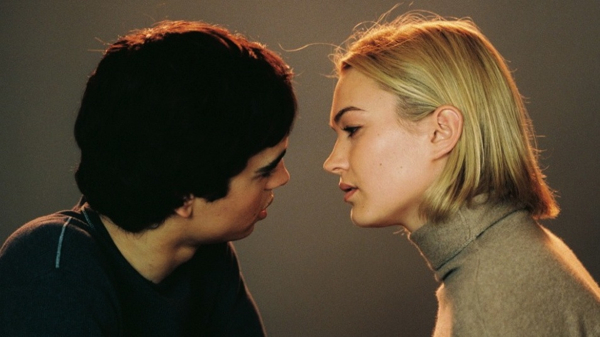
Created along with occasional partner Neil Gaiman, McKean’s dreamscape scarcely sustains thirty minutes, let alone feature length. Rebellious teen Helena (Stephanie Leonidas) can’t stand her life as a performer in her family’s traveling circus. In a reversal of the age-old chestnut, the young girl wishes to leave the big top and join the “real world.” A testy blow-up with her mother precedes a backstage collapse, and Helena blames herself for her mom’s unnamed ailment. On the eve of her mother’s operation, Helena – possibly dreaming, possibly not – disappears down the rabbit hole to enter a strange world known as the Dark Lands, where she must locate the Mirrormask, a shiny MacGuffin that will restore balance to both the fantasy realm and Helena’s waking existence.

Like “The Wizard of Oz,” “MirrorMask” presents principal actors in multiple roles, but the effort proves entirely fruitless given the film’s nonexistent character development. Helena’s guide is a masked juggler named Valentine (Jason Barry), and their awkward co-dependency is rendered even more confusing with a late suggestion that they might discover romance with one another. So much of the script adheres to a stop-start haphazardness, frustration sets in early. Helena’s mother manifests herself in three guises, but not a single one is memorable or moving. The same goes for the rest of the speaking parts.

McKean finds some success with a few otherworldly dream-inhabitants, particularly the so-called Monkeybirds, a group of gorilla-bodied creatures sporting pigeon-like heads with removable beaks. Their acrobatic presence livens up the leaden adventure for a few minutes at least. A set of rainbow-winged sphinxes challenges Helena, as does a library with flying books. Many other Dark Lands denizens resemble work done by other artists, including Hieronymus Bosch, Paul Klee, Jan Svankmajer, the Brothers Quay, and Terry Gilliam. In one strange sequence that belongs in a better movie, Helena is serenaded by a roomful of mechanized jack-in-the-box figures warbling Hal David and Burt Bacharach’s familiar tune “Close to You.”

For all the attempted visual wonder, “MirrorMask” will put most audiences to sleep. Surprisingly, for a movie about a wonderful alternate universe, there are no juicy characters. When Helena encounters the ebony-eyed Queen of Shadows, we yawn. Nothing is at stake, and everything that has led to this moment is simple-minded, empty, and devoid of interest, drama, or suspense. Weirdly, one longs for Helena’s return to her old life, which promises at least a glimmer of hope that she will interact with her mom or dad using something resembling recognizable human feelings.