Old School

Oldschool1

Movie review by Greg Carlson

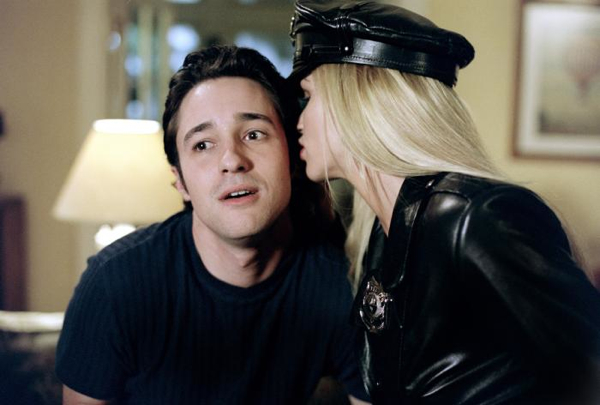
Todd Phillips, the writer-director whose perpetual fixation with all things (academics excepted) collegiate has served him from the documentary “Frat House” to the surprisingly funny “Road Trip,” takes another run at it with “Old School,” a mildly entertaining comedy with some unfortunately lengthy stretches in between the laughs. Based on the well-worn premise that recapturing one’s youth is as worthy an endeavor as anything related to growing up, holding a job, and spending time with your family, “Old School” coasts by on the charm of its lead trio, funnymen Will Ferrell, Luke Wilson, and Vince Vaughn.

While the thought of three dolts in their mid-thirties starting up a college fraternity in order to avoid eviction is not likely to capture any prizes for originality, the film displays a relatively high level of enthusiasm from its leads, despite the turgid, bottom-feeding script. Phillips’ direction is leagues below “Road Trip,” feebly cobbling together ideas that might have sounded humorous in the planning stage, but fail in the execution. Misogyny is practically required in sex comedies targeted at young males, but the women in “Old School” – especially the lead romantic interest for Wilson’s character – are ignored to the point where they virtually disappear.

As dull, cuckolded businessman Mitch, Luke Wilson has the least colorful role to play. Mitch leaves his girlfriend (Juliette Lewis, appearing in one of the movie’s many cameos) after discovering her predilection for group sex with complete strangers. He moves into a large home near his alma mater, soon to be joined by Ferrell’s Frank and Vaughn’s Beanie (each one suffering from nebulous, unspecified marital miseries). Vaughn riffs on his signature smug persona, this time as a soccer coach, father of small children, and owner of a regional electronics chain. As a relative newcomer to the big screen (having pulled the ripcord on his SNL parachute), Ferrell shows considerable big screen promise, delivering even the most suspect dialogue with excellent comic timing.

The biggest problem with the movie is not its vulgarity, but its complete lack of unity and coherence in plotting and pacing. Add to that the weak and aimless screenplay, which never bothers to offer a good explanation for the disparate types of pledges recruited for the upstart fraternity, and you’ve got a spotty hour and a half. The oddball assortment of wannabe frat boys includes an octogenarian, a morbidly obese young man, and a bunch of nameless, faceless clods too old to be in college; it adds up to nothing but an arbitrary way to generate “comedy.” Worst of all, Jeremy Piven is saddled with the humiliating task of playing the stereotyped evil-creepy school administrator who stands in the way of the good guys.

Following a thoroughly inept sequence where the ragtag frat must negotiate a series of scholastic and athletic challenges to prove its worth to the powers that be (the same thing was done much better in “Revenge of the Nerds”), the story quickly, inconsequentially winds itself down. Other name brand talent shows up in cameo roles, most notably Andy Dick as an in-home fellatio instructor, Craig Kilborn as a philandering cad, and Seann William Scott as a mullet-coiffed petting zoo proprietor. Snoop Dogg practically phones in his fleeting spot, arriving just long enough to perform a few seconds of a song at a raging party. Only Ellen Pompeo, as Mitch’s high school crush, manages to shine despite being perpetually upstaged by beer kegs and nude streaking.


Talk to Her

Talktoher1

Movie review by Greg Carlson

Aglow with the recent surprise Academy Award nomination for its masterful director Pedro Almodovar, “Talk to Her” finds itself immediately in the front rank of the Spanish filmmaker’s impressive list of credits. With “Talk to Her,” Almodovar has topped his excellent “All About My Mother” (1999) and perhaps drawn even with the film many consider to be his masterpiece, the audacious, irrepressible “Women on the Verge of a Nervous Breakdown” (1988). Assuming Almodovar is just getting warmed up – he is only in his early fifties – his many admirers must be salivating at the prospect that the next phase of his career might deliver yet another series of fantastic movies.

Almodovar’s films – which typically carom between slapstick and serenity with astonishing ease – often hinge on the kinds of coincidences beloved by soap operas, but the practically fearless director always manages to locate emotional complexity in the inhabitants of his colorful ensembles. Outrageous things are expected to happen to Almodovar’s characters, but throughout it all, these people remain hopelessly and gloriously human. Best of all, Almodovar consistently demonstrates a sublime level of comfort with even his most obsessive, wrong-headed, misguided, and forlorn characters, offering them empathy where most would find only contempt.

This is certainly the case with Benigno (Javier Camara), the troubling, sexually-ambiguous mama’s boy who attends the bedside of beautiful, comatose ballerina Alicia (Leonor Watling) with the kind of zeal and devotion one usually finds reserved for the Virgin Mary. Benigno, we come to learn, has fallen madly in love with Alicia after seeing her rehearse at the dance studio across the street from his apartment. Following the freak traffic accident that renders Alicia catatonically lifeless, Benigno uses his experience as a nurse to become Alicia’s primary caregiver in the hospital where her psychiatrist father assumes she will receive the best care.

Meanwhile, journalist and travel-guide writer Marco (Dario Grandinetti) begins a relationship with a female bullfighter on the rebound from a painful breakup with another toreador. Lydia (Rosario Flores) is as full of life and energy as Alicia is without, but by a perfectly Almodovarian twist, the torero ends up in a coma and is placed in the same hospital as Alicia. Benigno and Marco become friends, bonding over the bizarre circumstances in which they find themselves. Along with Almodovar, the audience begins to relish the remarkable irony that these two women are completely unaware of the affectionate dedication and concentrated commitment the two men lavish upon them.

Almodovar mirrors the ardor of Benigno and the perseverance of Marco with a jaw-dropping homage to silent film that depicts a kind of forerunner to “The Incredible Shrinking Man” by way of Ferdinand Zecca, Georges Melies, and J. Stuart Blackton. In the piece, a tiny lover demonstrates his complete faithfulness and fealty to the woman responsible for his altered state by doing something nearly unprintable (and certainly too fun to spoil here). Despite the wild inclusion of this fantasy diversion (the film also includes magnificent side-trips to take in Pina Bausch’s dance theatre and Caetano Veloso performing a song), “Talk to Her” is fairly tame by Almodovar standards. It is also one of the best films of the year.

The Hours

Hours1

Movie review by Greg Carlson

At its best, Stephen Daldry’s screen version of Michael Cunningham’s Pulitzer Prize-winning novel “The Hours” is a cinematic tour de force – a delicately handled meditation on those elusive, solitary Woolf-ian intelligences that resist even adequate treatment in the cinematic format. At its worst, the movie is an operatic muddle – an occasionally hoarse disarray of an actor’s showcase, providing more than the usual supply of opportunities to set fire to the scenery. The intersections of madness and genius are perennial catnip to the givers of awards (see the ridiculous, already dated “A Beautiful Mind”), and on that count, “The Hours” is sufficiently mobilized.

Operating as a shored-up triptych that doesn’t always gel, the film covers three women in three time periods: uber-writer Virginia Woolf (Nicole Kidman and prosthetic nose) in 1923 composing “Mrs. Dalloway” while fighting off the demons of her mind, suburban housewife Laura Brown (Julianne Moore) in 1951 finding her own fragile hold on marriage and motherhood coming unglued even as her life is transformed by reading “Mrs. Dalloway,” and Clarissa Vaughan (Meryl Streep) in 2001 loosely acting out the part of a modern day Mrs. Dalloway as she prepares for a party to honor her former lover, a poet now dying of complications from AIDS.

The agenda of “The Hours” is decidedly grim, and Daldry meets the challenge head-on with an opening set piece that imagines Woolf’s suicide by self-drowning in March of 1941 as a languid, romanticized Pre-Raphaelite painting. Weighed down with stones in the pockets of her coat, Woolf’s submergence is attended with thanatological fervor: gliding along underwater, her shoe comes loose in a fetishized tableau that would do John William Waterhouse proud. Taking one’s own life is firmly established as a central motif, and the succeeding stories will attend to the sad topic in ways both expected and surprising.

While Kidman (false proboscis and all) excels at capturing subtlety and nuance in her handling of a difficult role (witness, for example, an exquisite, heartbreaking train station scene between Virginia and husband Leonard, played by Stephen Dillane) and Streep is as peerless as ever, Julianne Moore’s segments are easily the film’s most troublesome. For some reason, Daldry chooses the 1951 setting as a staging ground for the most artificial and extravagantly over-designed theatrics of the movie, and despite Moore’s noble efforts, too much information is missing to connect all the dots. With the exception of a few quotations of Woolf’s, screenwriter David Hare has done away with voiceover – an admirable choice that proves a hindrance in at least this portion.

The supporting cast is almost uniformly impressive, featuring some memorable work by Ed Harris (who takes it a little too far a little too often) as Clarissa’s former lover, Jeff Daniels (in what amounts to an extended cameo), Claire Danes as Clarissa’s daughter, and Allison Janney as Clarissa’s partner. Moore is assisted by her old colleague John C. Reilly, whose presence always makes even the best-staffed films more interesting, as well as Toni Collette, in what has to be the movie’s oddest diversion. Besides the terrific Dillane, Kidman’s scenes are fleshed out by the presence of Miranda Richardson as Woolf’s sister Vanessa Bell. The movie remains firmly in the grip of its three leads, however, and audiences looking for a fearless plunge into the heart’s darkest reaches should be pleased by the results.


The Pianist

Pianist1

Movie review by Greg Carlson

With “The Pianist,” master filmmaker Roman Polanski delivers one of his most engaging and fully realized movies in ages. An uncompromising, unsentimental adaptation of concert pianist Wladyslaw Szpilman’s memoir of surviving the Holocaust, “The Pianist” affords Polanski an opportunity to explore some of what one imagines are the most painful memories of his own childhood (the director’s mother died in the gas chambers while the young Polanski lived by his wits on the streets of Krakow). In fact, Polanski has not worked in Poland since the time of his debut feature, “Knife in the Water,” which he made in 1962.

One need only examine the film’s opening scene to appreciate the uniquely skewed worldview of Polanski, who depicts Szpilman (an excellent Adrien Brody, arguably turning in his best performance to date) at work in a Warsaw radio station, elegantly and serenely engrossed in Chopin as the windows are rattled by the explosions of German shells. Szpilman refuses to cease playing, even as the technicians in the sound booth pack up and head for cover. Not until a percussive blast literally knocks him from his bench does the pianist decide he should leave. Szpilman’s defiance – marked by a standoffish distance he maintains with others – will ultimately aid and hinder him in equal measure.

Like other wealthy families, the Szpilmans are totally convinced that the Nazis will be stopped by the Allies before things become unbearable. Together, they make the tragic, catastrophic decision to remain in their home, even as the Germans establish control of the city. Swiftly, absurdly, they are forced – along with nearly 500,000 other Jews – into the tiny Warsaw ghetto. Polanski details the progression of events with a chilling economy: privately, the Szpilman family angrily resists the Nazi edicts printed in the local paper. On the streets, however, they wear Star of David armbands and step over corpses as they try to carry on in the face of unimaginable horror.

“The Pianist” won the Palme d’Or at Cannes last May, and arguably, it deserved the accolade. The film struggles, particularly in the second half, to maintain the stunning parsimony that characterizes the breathless early sections (Szpilman’s solitariness and isolation become utterly relentless). Szpilman’s relationship to his music – a central motif that results in a number of the film’s most memorable incidents – often disappears into the background when it should be driving his instincts for survival. Thankfully, Polanski does not overlook the music when it counts the most, and the concluding portions of the movie provide much needed closure.

“The Pianist” is certainly in keeping with Polanski’s preoccupation with alienation and fear, and its subject matter offers audiences their best opportunity yet to connect with the director’s most unifying themes. Employing large-scale studio sets (in Germany) and computer-assisted special effects that conjure up, among other things, miles of bombed-out buildings, Polanski finds some unforgettable images amid the wreckage. The simplest ones remain the most effective: a lingering shot of the empty Umschlagplatz, the square where people were gathered prior to being loaded onto trains headed for concentration camps, is difficult to shake off. Strewn with suitcases but no people, it is a forceful reminder.

Rabbit-Proof Fence

rabbit1.tif

Movie review by Greg Carlson

Australian director Phillip Noyce, the helmer behind such wastes of time as “Sliver,” “The Saint,” and “The Bone Collector,” has practically erased the bad memories of his recent Hollywood sludge with the masterstroke of making two prestige art films in a single year. Along with an updating of Graham Greene’s “The Quiet American,” Noyce has directed “Rabbit-Proof Fence,” an emotionally wrenching historical drama that turns its mostly unflinching gaze on the Australian government’s disgusting, decades-long policy of removing “half-caste” Aboriginal children from their mothers in the name of “saving them from themselves.”

Set in 1931, “Rabbit-Proof Fence” uses its titular symbol – the series of transcontinental dividers designed to protect farm crops from voracious rabbits – as a reflection of the centuries-long cultural clash between white European “settlers” and the country’s indigenous population. To this day, the Australian government struggles with the nasty shadows of eugenics, racism, and even genocide, but seventy years ago, administrators like A.O. Neville (played in the film by Kenneth Branagh) crowed about the benefits of “breeding” the unenlightened blood out of the “primitive” population in order to give the Aboriginal people opportunities in society (read: jobs as servants and laborers).

The idea of forcibly taking children away from their mothers is nightmarish, and the scenes of Molly (age 14), Gracie (age 10), and Daisy (age 8) – two sisters and a cousin – being hauled off to a government-run school/boarding house/slave camp will turn the stomach of all but the most hardened misanthrope. Molly (Everlyn Sampi), Gracie (Laura Monaghan), and Daisy (Tianna Sansbury) are all played by non-actors, and Noyce’s results with the trio are consistently impressive. While Branagh is saddled with the thankless task of bringing to life a misguided and ignorant antagonist, Noyce thankfully spends most of the film’s time with the three little girls, observing many of the awesome details of their odyssey.

It takes Molly only one day at the government dormitory to figure out that she needs to leave. Taking Daisy and Gracie with her, she sneaks away under cover of heavy rain (so as to frustrate the efforts of preternaturally gifted tracker Moodoo, played by David Gulpilil, from the outback classic “Walkabout”), and begins a journey of some 1200 miles, in order to be reunited with her mother. The arduous trek, which the girls made entirely on foot, took them more than two months, and the entire quest was fraught with the triple threat of eluding recapture by government trackers, finding enough food to sustain them, and avoiding detection by farmers who might potentially contact Neville’s office.

Shot by ace cinematographer Christopher Doyle, “Rabbit-Proof Fence” tempers the girls’ unrelenting endurance and determination with the otherworldly beauty of the stark and haunting Australian landscape. It is uncertain how many details of the girls’ flight were concocted specifically for the film (Christine Olsen’s screenplay was based on an account by Molly’s daughter Doris Pilkington), but the essential facts remain stunning regardless of dramatic flourish. Seeing footage of the real, 85-year-old Molly and the 79-year-old Daisy, who appear at the conclusion of the film, is a powerful exclamation point to all that has come before, but hearing Molly tell what happened to them after their 1931 adventure is a genuinely tragic, thoroughly astonishing coda.

Real Women Have Curves

Realwomenhavecurves1

Movie review by Greg Carlson

After picking up the Audience Award at last year’s Sundance Film Festival, it is easy to see why “Real Women Have Curves” is popular with moviegoers.  Alternately working the timeworn traditions of a mother-daughter generation gap struggle and the rites-of-passage, coming-of-age awakenings of a young high-school graduate, the film sparkles with a sense of its own hearty universality.  “Real Women Have Curves,” as its clever title suggests, also adds to its mix the running theme of weight and self-image – a central issue addressed in virtually every scene in the film.  This story has been told before, but the winning performances of the entire cast, and the measured composure of the script, help make the movie a thoroughly enjoyable experience.

Set in the working class sunshine of East Los Angeles’ Boyle Heights, “Real Women Have Curves” begins on 18-year-old Ana Garcia’s (America Ferrera) final day of classes at Beverly Hills High School (Ana’s bus ride from East L.A. to get to BHHS immediately sets up the cultural divide between the working class and the wealthy, and reminds the audience that Ana has already pushed herself hard in order to be able to go to school in Beverly Hills).  Ana’s compassionate teacher, Mr. Guzman (George Lopez), recognizes the young woman’s intelligence and potential, and has taken steps to help Ana apply to NYC’s Columbia University.

Naturally, Ana’s traditional, tightly-knit family expects her to help out at older sister Estela’s (Ingrid Oliu) small, sweltering dress-making business.  Matriarch Carmen (stalwart favorite Lupe Ontiveros) goes one better, insisting that Ana lose weight in order to lure a husband.  Even though Ana wants none of this – especially her mother’s unwelcome meddling – she begrudgingly accepts a job at Estela’s little factory, ironing dresses in sauna-like conditions.  Rebellious and bitter at first, Ana soon begins to realize how hard her family works, and discovers that she is torn between going to college and obeying the wishes of her family.

First-time director Patricia Cardoso, working from a screenplay by George LaVoo and Josefina Lopez (that has been adapted from Lopez’s play), filters the narrative through the eyes of Ana, and Ferrera is perfectly cast, capturing the delicate balance of assertiveness and apprehension that can seem overwhelming to young people caught between childhood and adulthood.  Cardoso also recognizes that Ontiveros is a seasoned veteran with expertise and personality to spare, and makes sure that the radiant actress is given plenty of opportunities to craft a character of enormous depth (equally manipulative and tender, Ontiveros is an absolutely hilarious when she claims to be pregnant).

“Real Women Have Curves” occasionally suffers from its own earnestness, but Ontiveros and Ferrera are abetted by strong supporting players, including Oliu, whose Estela is intriguing enough for her own movie.  Obviously, the film’s focus is fixed on the female characters, but Jorge Cervera Jr. and Felipe de Alba, as Ana’s father and grandfather, are marvelous in their smaller roles, projecting the warmth and compassion needed to temper some of the more outrageous and exasperating shenanigans of Carmen.  While it would have been welcome to explore more of Ana’s internal thoughts, “Real Women Have Curves” maintains an energy and liveliness to match its sincerity.

Elling

Elling1

Movie review by Greg Carlson

A Norwegian entry for the Best Foreign Language Film at last year’s Academy Awards, Petter Naess’ comic “Elling” is a typical, familiar “Odd Couple” tale of two mentally ill men who must learn to cope in the world in spite of their status as social misfits. Fortunately, “Elling” surpasses the majority of feel-good movies trading in this narrowly-defined subject matter by remaining refreshingly light on the obligatory life lessons so often preached in fare like “Rain Man and “Awakenings.” Naess works hard to overcome the obvious limitations of the static, location-bound script (“Elling” was a successful stage play prior to becoming a film), and finds an unsentimental tone that should please most audiences.

Based on a novel by Ingvar Ambjornsen, both the stage and screen versions of “Elling” focus on the relationship of the title character to his unsophisticated roommate (and eventual best friend). Per Christian Ellefsen plays Elling, a slim, fussy, agoraphobic who was looked after by his mother until her death landed him in a state psychiatric institution. Kjell Bjarne (Sven Nordin) – as practically required in this sort of comedy – is the polar opposite of Elling. Kjell Bjarne (comically, Elling always refers to him by first and last name) is a giant, loutish, bear of a man who rarely bathes and spends most of his time lusting after beautiful young women. Once their term in the hospital is complete, the men are moved into a small apartment in Oslo, assigned a social worker, and expected to essentially take care of themselves.

In the early parts of the film, Naess sticks to the formulaic game plan: Elling and Kjell Bjarne must learn to answer the telephone, buy their own groceries, cook and clean for themselves, and stick to their modest welfare budget (social worker Frank Asli, played by Jorgen Langhelle, is surprisingly understanding when the boys ring up a hefty phone bill for calls to a sex line). Even though the apartment has two bedrooms, the men prefer to share a room just like they did in the institution. Their debate over what to do with the leftover space (library versus workshop) generates a clever motif that is periodically revisited.

Of course, some larger conflicts are needed to propel the action forward, and Elling’s world is shaken up when Kjell Bjarne takes a shine to the pregnant, single, upstairs neighbor Reidun (Marit Pia Jacobsen). Reidun returns Kjell Bjarne’s affections, effectively shutting out Elling, who in many ways has come to depend on his friend as much as he did on his mother. Angry and frustrated, Elling talks himself into attending a poetry reading, where he unknowingly makes the acquaintance of a once-famous writer named Alfons Jorgensen (Per Christensen). Before you know it, all four characters have come together for one of those required road trip-outings that finds them spending a weekend at Alfons’ lake cabin.

While much of the humor in “Elling” is derived from the superficial differences between Elling and Kjell Bjarne, the actors inhabit their roles with considerable charm and impressive depth. Both performers worked together on the stage version, and their rapport translates easily to celluloid. Naess’ collaborator, screenwriter Axel Hellstenius, also worked with the director on both the stage and screen versions of the story, and their intimate familiarity with all the details of the comedy has allowed them to tweak favorite moments (like Kjell Bjarne’s frequent head-butting, or Elling’s sly transformation into the “Sauerkraut Poet” as soon as he puts on a pair of oversized sunglasses) to perfection. Remake rights to “Elling” have already been sold, and an American version is reportedly in the works.


Far from Heaven

Farfromheaven1

Movie review by Greg Carlson

His most accomplished film to date, director Todd Haynes’ “Far from Heaven” is certainly one of 2002’s strongest American movies, and is likely to bring an Academy Award nomination to actress Julianne Moore. Lavishly, meticulously recreating the mise-en-scene of 1950s Technicolor melodramas, Haynes aestheticizes and fetishizes his raw materials, from the stilted, overly formal dialogue that masks and clouds the intended meaning of the words his characters speak to the lavender-hued scarf that blows down from the crimson-leaved treetops. Haynes has self-consciously filtered every detail of his movie through the lens of artifice, and the result is a compelling portrait that shows just how little things have changed over the last forty-five years or so.

“Far from Heaven” is essentially a reworking of a handful of Douglas Sirk movies, particularly “All That Heaven Allows,” in which forty-something widow Jane Wyman faces social ostracism for dating her gardener, played by Rock Hudson, a man some fifteen years her junior. Haynes shrewdly rethinks a handful of the story’s underlying thematic engines, making his central character a young wife to a closeted homosexual (Dennis Quaid) rather than a widow. The gardener with whom she finds comforting kinship and support is an African-American (Dennis Haysbert). Fortunately, the director also chose to align himself with Sirk’s incomparable appreciation for subtext.

“Far from Heaven” takes place in 1957 in a suburb of Hartford, Connecticut, where Cathy and Frank Whitaker radiate the values of Eisenhower-era contentment as “Mr. and Mrs. Magnatech” – a title referring to Frank’s job as an executive with a TV industry firm, bestowed upon the pair by the gossipy local society pages. On the surface, Cathy appears to be the model of the happy homemaker, but one night she takes dinner to Frank’s office and discovers him kissing another man. Frightened, confused, and shattered, Cathy internalizes and represses her feelings, putting on a brave face in order to maintain the illusion of the perfect family and the perfect life.

Meanwhile, Cathy begins to grow close to her gardener, a widower with an eleven-year-old daughter. His name is Raymond Deagan, and because his skin is not the same color as Cathy’s, tongues start to wag as soon as the two are seen talking to one another. Haynes is masterful in sketching (with Sirkian precision and skill) the kind of oppressive nexus of homophobia, racism, and classism that continues to choke American society, and with a few reaction shots here and a few well-selected lines of dialogue there, we share in Cathy’s misery and frustration over how things can become so messed up so quickly. Haynes never comes close to allowing Cathy to act on any physical desire for Raymond – despite the intensity of their relationship – and her emotional disintegration as a result of this is palpable.

“Far from Heaven” succeeds because Haynes loves his characters, and lets them lead the action (the director conceded that he was worried about how audiences might misinterpret his emotional sincerity). Quaid and Haysbert are fantastic, but Moore is magnificent, and turns in one of the finest performances of her already impressive career. Her Cathy is an unusual and surprising creation, a woman who does everything she can to loosen the shackles of her existence even as she recognizes the inevitability of her failure. It is tragic to contemplate Cathy’s fate, especially after all of the bold actions she takes to avert the cruelty of her circumstances, but it is precisely the fierceness of her struggle that makes her so great.

Bowling for Columbine

Bowlingforcolumbine1

Movie review by Greg Carlson

“Bowling for Columbine,” the latest documentary from professional provocateur Michael Moore, is as disturbing and heartbreaking as it is funny. Moore’s combination of ironic wit and genuine emotion has been the filmmaker’s trademark since his auto industry polemic “Roger & Me” made him a celebrity in 1989, and his new movie continues the darkly comic tradition. Where “Columbine” departs from the writer-director’s earlier work, however, is in the mission of its inquisitiveness: while nobody is going to mistake Moore for anything but a true blue liberal, the movie is not a so much a strident argument for gun control as it is a study of America’s love affair with mayhem and violence. Moore seems more comfortable on camera than ever, and perhaps that’s because this time he doesn’t know the answers to his questions before he asks them.

Last May, “Columbine” became the first documentary to compete at the Cannes Film Festival in nearly fifty years. The distinction is deservedly earned, as the film quickly establishes itself as vintage Moore, stitching together a heady collection of the director’s typically strange characters alongside the famous folk who always seem to find themselves on the receiving end of Moore’s skewer. While some audiences might not appreciate the film’s disorganized, scattershot approach, many of its scenes are undeniably electrifying. Moore visits with acquitted Oklahoma conspirator James Nichols, who hung out with brother Terry and Tim McVeigh on his farmstead. Nichols comes across as completely unhinged, at one point putting a loaded gun up to his own head. In the same scene, we are treated to one of the film’s most hilarious exchanges: Moore to Nichols: “Why not use Gandhi’s way? He didn’t have any guns and he beat the British Empire.” Nichols to Moore: “I’m not familiar with that.”

Moore is never short on eye candy, bouncing between a 50s TV commercial for Sound-O-Power toy guns, clips from Chris Rock’s standup (the brilliant “Five Thousand Dollar Bullets” bit from “Bigger and Blacker”), the Michigan Militia’s pin-up calendar, a bank that gives away a free gun when you take out a CD (their motto: More bang for your buck), and dozens and dozens of archival clips that range from the horrible (military executions, R. Budd Dwyer’s press conference suicide, and security camera footage of the Columbine shootings) to the eccentric (an industrial promo for a school security company that shows a kid pulling an endless supply of hidden weapons out of his jacket and baggy pants). Fargo’s own KXJB is thanked in the credits for providing tape of Carey McWilliams (a former school classmate of this author), a blind man who received a permit to carry a concealed weapon in October of 2000.

Like Moore’s other movies, “Columbine” showcases a handful of truly unforgettable moments that receive more careful, in-depth treatment than most of the anecdotal segments. Along with a pair of victims of the Columbine shooting, Moore treks to the headquarters of K-Mart in Troy, Michigan, attempting to “return” the seventeen-cent bullets now lodged in the bodies of two young men (the killers had legally purchased some of their rounds at the discount chain). Easily the film’s centerpiece, Moore is rendered speechless – a rare occasion – when his persistence results in a statement from K-Mart agreeing to stop selling handgun and assault rifle ammunition in all of its stores.

Moore finishes his movie with an examination of a school shooting in his hometown of Flint, Michigan that claimed the life of a six-year-old girl. Coming down hard on a “welfare to work” program that forced the mother of the first-grade shooter to spend long hours on a bus to Auburn Hills so that she could make minimum wage at one of Dick Clark’s fast food restaurants (while Clark’s company received tax breaks for using the program), Moore confronts a surly Clark – who has never looked more unpleasant, foolish, or arrogant. Following that exchange, Moore finally hits the mother lode when he is granted an audience with NRA chieftain Charlton Heston. Heston’s ugly, insensitive answers pale when compared to the surprisingly articulate responses of Marilyn Manson, who had spoken to Moore earlier in the film. While the privileged Heston blathers on with his rehearsed “personal freedom” rhetoric, Manson offers a startling answer to Moore. When Moore asks Manson what he would say to the people of Littleton, Colorado, Manson replies that he wouldn’t say anything – instead, he would listen to what they have to say.


Solaris

Solaris1

Movie review by Greg Carlson

The great pleasure of Steven Soderbergh’s “Solaris” lies in the film’s identity as the most elliptical, thought-provoking, and enigmatic movie released by a major Hollywood studio this year. Few directors other than Soderbergh – who has cannily alternated his projects between narrative-fracturing, low-budget, poetic meditations like “The Limey” and big-name, big-budget, crowd-pleasers like “Ocean’s 11” and “Erin Brockovich” – could get away with such a ruminative, haunting, deliberately challenging piece. Soderbergh does it – with George Clooney in the leading role no less – and delivers in yet another genre previously untapped by the “Traffic” Oscar winner.

Based on a novel by Stanislaw Lem and previously made by Andrei Tarkovsky in 1972, “Solaris” bravely, gamely explores the limitations of human imagination, pushing well past the usual sci-fi questions about humankind’s place in the universe and the existence of a higher intelligence or deity. Clooney plays psychologist Chris Kelvin, a brooding, heartbroken, empty vessel of a man devastated by his beloved wife’s suicide. While attending to his own shattered life, Kelvin receives a message from an old friend indicating that something has “gone wrong” on the Prometheus space station that orbits the mysterious planet Solaris, a churning, volatile orb that changes colors like a chameleon.

Kelvin takes the mission, and upon his arrival at Prometheus, discovers that only two of the original crew continue to draw breath, and neither one seems able to offer much explanation of what recently happened. Understandably perplexed, if not downright shaken, Kelvin retreats to his quarters, and when he opens his eyes the following morning, he has been reunited with his wife – now very much alive. The planet Solaris, it seems, has created a doppelganger conjured up from everything that Kelvin knew about her. Played by Natascha McElhone, Rheya is a marvel both to Kelvin and to herself. In other words, the new incarnation of Rheya has free will, but negotiates her place in the world strictly out of Kelvin’s perceptions of the original – the new Rheya wants to kill herself, for example, but only because Kelvin remembers her as suicidal.

Like Hitchcock’s “Vertigo,” Solaris spends a great deal of its running time exploring the obsessions of a deluded protagonist who deeply misinterprets his own obsessive love for another person. Emotional catastrophe is inevitable in both films, but “Solaris” makes a worthy peer to Hitchcock’s masterpiece because Soderbergh’s handling of the content is sufficiently absorbing to transcend the outward quietness and stillness so despised by moviegoers who like their entertainment pre-digested, and with little room for imagination. “Solaris” might not be as personal to its director as “Vertigo” was to Hitchcock, but it is remarkable that both films were made by studios, and not independently produced.

“Solaris” is the kind of movie that relishes asking more questions than it answers, and by the conclusion, reality has been smeared into a blur – time seems to double back on itself and the audience is left to ponder whether there are more possible outcomes than the ones eventually reckoned by Kelvin. Some will certainly roll their eyes that Dylan Thomas’ line “and death shall have no dominion” forms a central thematic motif, but perhaps the key to the movie is contained within the poem. Soderbergh, however, is not interested in the definite (his own gorgeously meditative cinematography notwithstanding). The very first thing Rheya says to Kelvin when he makes her acquaintance is “Don’t blow it.” The line is funny – pure Soderbergh – but it is also filled with the idea that the possibilities of what could happen next are without limit.