Igby Goes Down

Igbygoesdown1

Movie review by Greg Carlson

Movies about smarty-pants teenage boys who think of themselves as tortured, misunderstood souls are not everyone’s idea of a swell time, but filmmakers keep cranking them out – and are not likely to stop in the near future (blame Salinger, I guess). From “The Graduate” to “Harold and Maude” to “Rushmore,” the pissed-at-the-world viewpoint of the sullen young man is catnip to the pissed-at-the-world young movie director, even though by now we are all familiar with the concept that the world isn’t fair, rich people are suspect, adults are generally weak-willed cheats, and pretty girls will make a snack of your heart while you gasp and writhe on the floor.

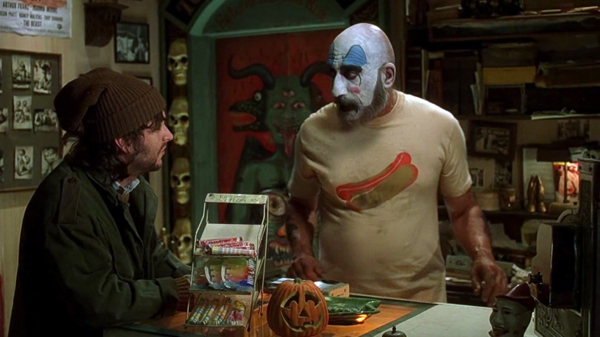
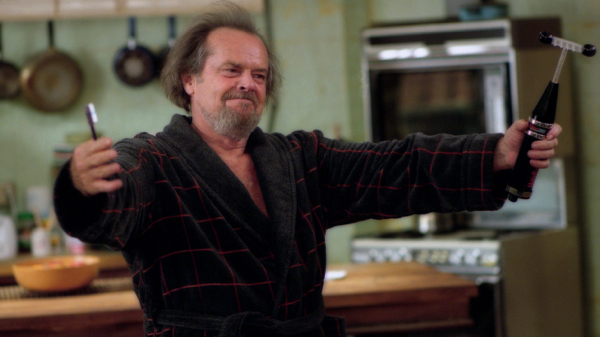
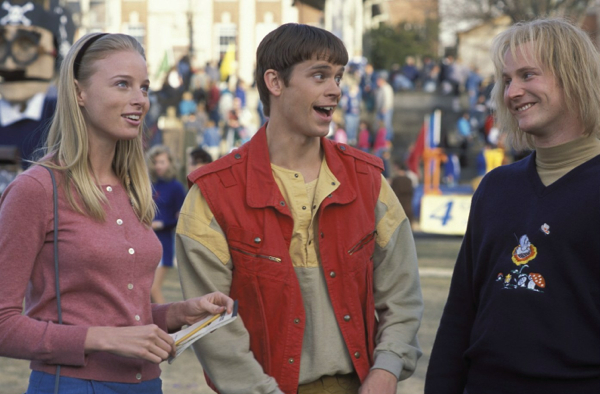
This is the general idea of Burr Steers (how is that for a movie-perfect name?), whose “Igby Goes Down” introduces us to a family of wealthy, messed-up miscreants and their hangers-on. Young Jason “Igby” Slocumb, Jr. (expertly inhabited by Kieran Culkin) is not yet eighteen, but has managed to find himself booted out of every private school foolish enough to accept his mother’s money. Igby’s orbit includes his snooty older brother Oliver (Ryan Phillipe), his institutionalized dad Jason (Bill Pullman), his overbearing mom Mimi (Susan Sarandon), his serpentine godfather D.H. (a wickedly wonderful Jeff Goldblum, stealing every scene in which he appears), D.H.’s junkie mistress Rachel (Amanda Peet), Rachel’s performance artist pal Russel (Jared Harris), and ice cream sundae enthusiast/Igby’s love interest Sookie (Claire Danes).

While the novel-like structure of the movie allows the viewer to sort out the self-absorption in between the liaisons and blow-ups, Steers works up a sweat in order to gain a few scraps of audience sympathy for the callow Igby. Dripping acid, the director’s own screenplay never misses an opportunity to have its characters say and do things meant to elicit gasps from the audience (the film begins with Igby and Oliver hastening Mimi’s death with a plastic bag over her head). The arch, sarcastic tone is likely to be taken as either the movie’s primary asset or greatest liability – depending on the stomach one has for pitch black comedy. Only a small handful of sympathy-inducing flashbacks to Igby’s childhood (with Rory Culkin standing in for his older brother) lift the veil on the nearly omnipresent bitterness.

The triumph of casting Kieran Culkin in the title role is that he is able to simultaneously irritate and charm as the insufferable Igby. Even though his bad behavior is always neatly explained and excused (via the horrors of his unfortunate upbringing), Igby hones his ironic rejoinders to an edge so fine that they nearly account for his uncanny ability to lure Rachel and Sookie into his bed. And while it is somewhat hard to believe that Igby should prove adorably irresistible to not one but two older women, the casual sexual attitude evinced by the characters contributes to the feeling of wayward emptiness that is the glue of Igby’s fragile lifestyle.

Culkin’s performance proves that what Steers lacks in depth he makes up for in characterization, and the filmmaker’s well-observed takes on the supporting roles elevate the movie above its prima facie shallowness. Goldblum, for example, is so compelling that one could easily imagine a whole movie dedicated to his repugnant adulterer – the scene in which he turns on Igby, for example, is frighteningly believable, as is the stunning moment when he walks out of a restaurant without saying a word to the speechless, discarded Rachel. “Igby Goes Down” is not always this consistent, but at its best, it overcomes its own smugness to reveal a satisfying wit.


Tony McRae Interview

Casablanca1

Interview by Greg Carlson

From November 10 through November 14, 2002, the Fargo Theatre will screen a series of five classic Hollywood motion pictures honoring the veterans of WW2.

The films include “Casablanca,” “From Here to Eternity,” “Twelve O’Clock High,” The Bridge on the River Kwai,” and “Patton.” All shows will be introduced by film critic and historian Tony McRae.

The High Plains Reader’s Greg Carlson talked with McRae about the film series.


GC: Tell us a little bit about the genesis of this series.

Tony McRae: In early 2001, I realized that the 60th anniversary of WW2 was nearly upon us, and that many of those who lived through the period, both veterans and others, might not be around for the 70th or 75th anniversary.

If we were going to do something to honor these people, now was the time.


GC: What is it about WW2-themed movies that audiences find so compelling?

Tony McRae: There has been a tremendous interest in what we now call “The Greatest Generation.” Perhaps America has a need for a more black-and-white time, or at least what we think of as a time when there were clear-cut rights and wrongs.

This need was demonstrated after 9/11 when we honored those firefighters and police who gave their lives to help others.


GC: The films are organized in such a way as to cover the length of the war, as well as a variety of important historical events. It is interesting to me that “Casablanca” was made while the war was taking place.

Tony McRae: “Casablanca” had its genesis before we entered the war, when many Americans didn’t want us to get involved in Europe’s problems. Of course, Pearl Harbor changed all that, so “Casablanca” became a testimony of sorts to those like Rick Blaine who entered the war reluctantly.

Hollywood got behind the war effort with everything it had, and rushed out topical movies to boost morale. It was surprising in many ways that so many good movies were made.

There was a lot of racism at the time, with the Nazis and Japanese demonized and vilified. At the time this was perfectly acceptable.


GC: Were there any films that you wanted for the series but were unable to get?

Tony McRae: I was hoping for “The Story of G.I. Joe” and “The Best Years of Our Lives,” but they were unavailable. The first is a combat film, the second the most vivid picture of what post-war life for returning veterans and their families was like.

Still, we have a great line-up that will take us from before America entered the war to the end of the war and the coming peace. The movies we’ll screen are not combat movies per se, especially “Casablanca” and “From Here to Eternity,” both of which give a sense of pre-war America’s thinking.


GC: What is your own favorite WW2 movie?

Tony McRae: “Casablanca” is my favorite movie, period. Permit me to quote from my film site: I was shaped by the war, and, frankly, by Hollywood’s portrayal of it. Nostalgia has a persuasive force, yet I cannot be persuaded that it alone is capable of holding me for these many years.


GC: The focus of the series is to honor the veterans of WW2. Talk a little bit about the importance of what the men and women of that generation accomplished.

Tony McRae: Wow! That’s too much for me. I remember so clearly young men going off to war and coming home on furloughs, their uniforms so spiffy, and then I’d go to the College, the movie house in College Point in Queens, and see the Movietone newsreels and battle movies with John Wayne, Dana Andrews, Robert Montgomery, and I couldn’t help putting those young men from my home town into those movies. They were my heroes.