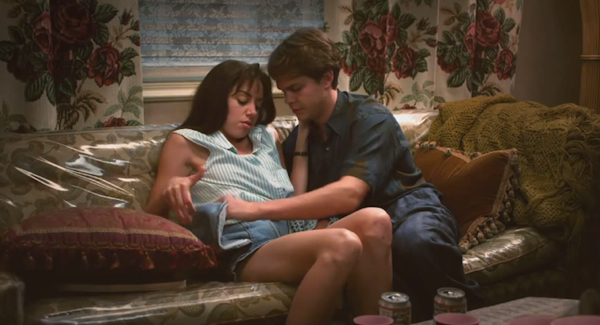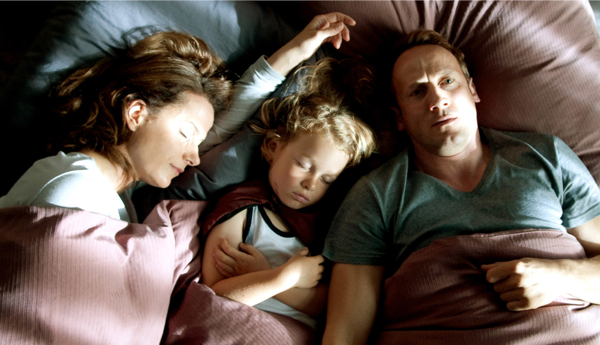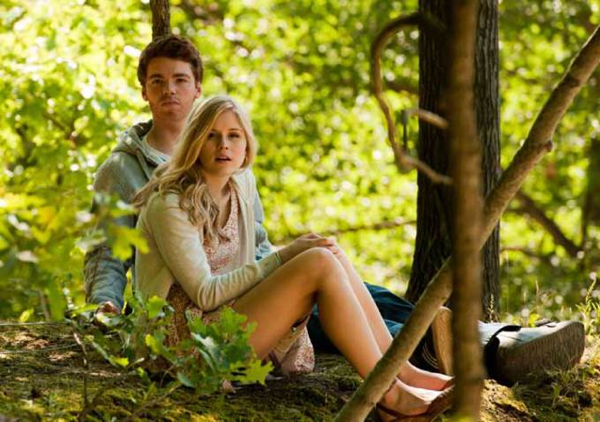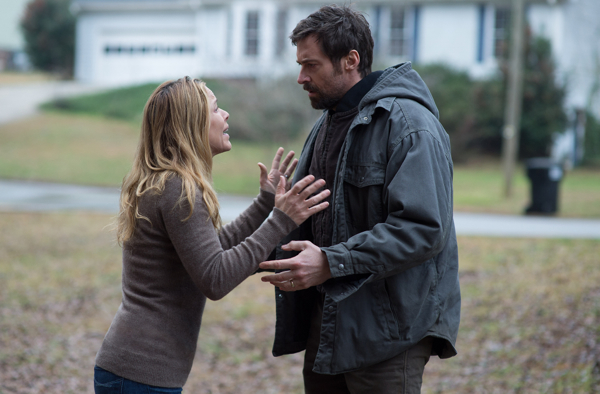
To the Wonder

Tothewonder1

Movie review by Greg Carlson

The mixed reviews that have followed the near inevitable accounts of film festival boos and cheers for Terrence Malick’s “To the Wonder” report that the prestige filmmaker has paddled even deeper into the sea of idiosyncratic cinematic storytelling marked by the obscurity and inscrutability of deliberately withheld information and violations of the artist-audience contract. Because of chronological proximity, “To the Wonder” will be compared to the “The Tree of Life” more than to Malick’s earlier movies, even with the presence of several of the auteur’s longstanding thematic interests and storytelling devices. It might be a stretch to define the plot of “To the Wonder” as a love triangle, seeing as Malick has no use for plot and that one side of the triangle is little more than a “Giant”-inspired interlude.

In close collaboration with cinematographer Emmanuel Lubezki, Malick continues to refine the visual sensibilities that include subjective, swooping and dancing camera arcs, and the almost non-stop continuity interruptions and jump cuts that stitch together the bits and pieces selected from miles of footage collected during the shoot. Additionally, Malick retains his trademark use of whispery, fragmented voiceover narration, which provides as much or more verbal communication than any truncated slivers of interactive dialogue. “To the Wonder” features zero in-depth, sustained conversations and many have remarked that you probably see more shots from behind Ben Affleck’s taciturn Neil as he looks at something than images of his face.

One of the reasons Venice Film Festival audiences chortled at Javier Bardem’s yearning Father Quintana almost certainly has to do with Malick’s unwillingness to deliver a character via the expectations of the classical Hollywood cinema. The miserable priest ministers to prisoners and parishioners, wealthy and poor. He speaks of Christ’s presence, but the holy man wrestles internally with struggles as traumatic and personal as those faced by Bergman’s Tomas Ericsson or Bresson’s cleric of Ambricourt. To be sure, however, “To the Wonder” is nowhere near as satisfying as “Winter Light” or “Diary of a Country Priest.”

Affleck and Bardem are bigger stars than Olga Kurylenko, but what constitutes point of view belongs to her displaced single mother Marina, a fragile young woman made all the more alien when she accepts Neil’s invitation to leave Europe for the monotonous McMansions and Sonic Drive-Ins dotting the otherwise vast and empty Oklahoma landscape. Malick is now in his late 60s, but the years seem to have sharpened his appetite for the visual appreciation of the unknowable feminine. One reading of the filmmaker’s construction of Marina finds the old master out of his depth, infantilizing and disabling his character via what might be described as exotic othering. Marina’s blank slate condition frustrates and confuses as she lurches from childlike playfulness to violent outbursts called forth by some imprecise mental anguish.

The distinctions between the stoic and action-averse Neil and Marina’s constant twirling, whirling, and spinning suggest that Malick holds to old-fashioned and outmoded conventions that gender male “madness” as a matter of melancholic, Hamlet-like intellect and female “madness” as the biologically and emotionally codified erotomania of Ophelia. In one scene, Neil and Marina visit the office of an OB/GYN who recommends the removal of Marina’s IUD following unspecified but implied cause for concern. Marina is also informed that a hysterectomy will not be necessary. What can we make of this or of anything else that we see when Malick conceals so much more than he illuminates?

On the Road

Ontheroad1

Movie review by Greg Carlson

Any film adaptation of Jack Kerouac’s “On the Road” would have a tough time living up to the unrealistic expectations ascribed to the cult book, and Walter Salles’ decent effort at least stays between the ditches. Neither an embarrassing letdown nor a transcendent prize, the movie – much like Salles’ version of “The Motorcycle Diaries” – uses really beautiful people to impersonate larger than life figures who might not have been quite as physically glamorous. Salles perhaps makes an argument that “On the Road” is not, after all, unfilmable, but aside from a few judiciously selected quotations, the movie sorely misses the rhythm and poetry of Kerouac’s words and voice.

The legend and reputation of “On the Road” cast a skyscraper-sized shadow over the film. The devoted will await every arrival of a figure immortalized by JK (as in, “there’s Viggo Mortensen playing Old Bull Lee who was really William Burroughs!”). The uninitiated might be less charitable, given Salles’ fondness for sticking all sorts of ace thespians in one-off scenes of economized duration. Along with Mortensen, the support ensemble includes Amy Adams, Kirsten Dunst, Elisabeth Moss, Terrence Howard, and Steve Buscemi, who, other than Dunst, mostly disappear in a blink.

The principals are allotted enough screen time to develop some semblance of character and both Kristen Stewart as Marylou and Garrett Hedlund as Dean Moriarty suggest glimmers of the magnetism and charisma that so attracted narrator Sal Paradise to each. Both performers leave a more lasting mark than Sam Riley, whose portrayal of Kerouac avatar Paradise is unobjectionable if unexceptional. Hedlund’s enthusiasm suits the grinning hedonism of Kerouac’s fictionalized version of Neal Cassady, although Salles, working from a script by Jose Rivera, holds Dean at a distance that somewhat diminishes the impact of the character’s fate and prevents the viewer from seeing him as anything more than a symbol of childlike/childish insatiability.

Not surprisingly, the inherently masculine point of view gives Salles some trouble and the director struggles to see the women of “On the Road” beyond the narrow option limited to sexually available vessel or bitter, nagging anchor. In one of the movie’s saddest scenes, the selfish and perpetually irresponsible Dean invites wife Camille to go out on the town, even though he knows she has no choice but to stay home with their baby. For all the heat generated by the rejection of societal norms, the birth of the Beat universe as canonized in popular culture marginalizes the contributions of women.

The post-WW2 period detail is effectively communicated via the costumes and cars if not the coiffures, but “On the Road” could use a more liberal dose of the Benzedrine, booze, and marijuana-fueled orgies that represented such a shocking rejection of conventional behavior in that small window of time before rock supplanted jazz as rebellion’s aural stimulant of choice. Even the experimental sexual bi-curiosity is presented with chaste, white glove decorum that never delivers on an early Signet edition’s cover copy come-on promising to tell us “all about today’s wild youth and their frenetic search for experience and sensation.”

Room 237

Room2371

Movie review by Greg Carlson

Following a small avalanche of conspiracy theories that explore, among other things, Native American genocide, the bureaucracy of the Holocaust, the myth of the Minotaur, and a faked Apollo 11 moon landing, one of the interview subjects in the delightful “Room 237” addresses what is perhaps documentarian Rodney Ascher’s central question – why Stanley Kubrick would deliberately make “The Shining” so complicated – with the reply, “Why did Joyce write Finnegan’s Wake? It’s a way of opening doors from a hermetically sealed reality into possibilities. It’s also a way of trapping someone like me.”

Few directors have sustained the level of cult-like devotion inspired by Kubrick, and the most engrossing subject of Ascher’s film is not the plausibility or veracity of the “hidden in plain sight” clues attributed to the notoriously meticulous auteur, but rather the way in which film spectatorship can make room to empower both viewer and artist via the imaginary conduit that links fan and superstar genius. These connections are even more common in the wake of Twitter feeds, like buttons, and blogs – as evidenced by the rabbit-hole exegeses of Kevin “Mstrmnd” McLeod, a Kubrick disciple who reportedly declined the invitation to be interviewed for “Room 237.”

Ascher’s movie opens with a lengthy and detailed disclaimer that disavows any endorsement by the Kubrick 1981 Trust, Kubrick’s family, Warner Bros. Entertainment, “The Shining Filmmakers,” and Kubrick himself (despite the fact that Kubrick has been dead since 1999). This sets the stage for both the film’s farfetched claims and the rather stunning extent to which nearly the entire enterprise is stitched together out of clips from “The Shining” and many of Kubrick’s other films, as well as titles as unexpected as “The Thief of Baghdad,” “All the President’s Men,” “Spellbound,” and “Apocalypto.” In one piece of visual editorializing, Ascher includes a clip of Stephen King as the doomed yokel Jordy Verrill in “Creepshow.”

The King versus Kubrick subplot manifests in the alteration of Jack Torrance’s Volkswagen Type 1 from the red of King’s novel to the yellow of Kubrick’s film. The seemingly minor change is complicated by the movie’s inclusion of a wrecked red Beetle seen post-collision with a semitrailer, an image that suggests to many viewers a symbolic announcement that Kubrick intends to make the movie version of “The Shining” his own. Ideas like this one, along with arcane deliberations on purposeful continuity errors ranging from disappearing chairs to reversing carpet patterns, are shared via Ascher’s nine-chapter organization.

Ascher’s decision to not show any of his five primary interview subjects focuses attention on the clips taken from “The Shining.” The images are so detailed, so abundant, and so often re-contextualized, one marvels at the extent to which Ascher tests the limits of the doctrine of fair use. During the festival run of “Room 237,” a number of writers addressed the possibility that copyright claims and legal headaches might prevent the film’s wider distribution, a story parallel to recent discussion surrounding Randy Moore’s “Escape from Tomorrow,” shot at Walt Disney World and Disneyland without permission.

Every Kubrick devotee should have no problem settling on a favorite theory from the range of hypotheses shared in “Room 237.” One of the most appealing segments looks at maps and floor plans suggesting that Kubrick designed an Overlook Hotel schematic that places windows where they couldn’t possibly open to the outdoors. This element of “Shining” scholarship has been thoroughly documented, and Rob Ager’s online videos on spatial disorientation are an excellent companion to “Room 237.”

Another wildly creative expression of textual potency lives in the “Dark Side of the Rainbow” style synchronicities that emerge from screening “The Shining” simultaneously forward and backward with both video channels superimposed, a rather absurd notion that yields some hallucinatory jolts. These, and so many other improbable points of view, argue that “The Shining” ranks high on the list of sources that have inspired some serious pop culture apophenia, and if you haven’t sampled the goods, make a reservation to visit “Room 237.”

Spring Breakers

Springbreakers1

Movie review by Greg Carlson

Hard to believe that Harmony Korine, the puckish provocateur who counts among his influences Cassavetes, Herzog, Lynch, Malick, and von Trier, is already forty years of age. At the time not much older than the members of the doom generation culture he depicted when his screenplay for Larry Clark’s “Kids” was produced in 1995, Korine has pushed buttons and tested limits from “Gummo” to “Trash Humpers,” remaining an eternally youthful agitator whose gift for troublemaking almost eclipses his talents as an auteur. While “Spring Breakers” at first seems like an unorthodox choice for the man whose unreleased projects include a documentary series of self-incited street altercations called “Fight Harm,” closer examination of the weirdly hypnotic new feature feels entirely of a piece with Korine’s oeuvre.

It’s highly unlikely that “Spring Breakers” would have received as much mainstream attention had Korine not persuaded former Disney-affiliated pop princesses Selena Gomez and Vanessa Hudgens to engage in lurid physical displays in part designed to set ablaze existing “good girl” statuses. An obligation to spend nearly every onscreen moment dressed in bikini or less appears to be a contractual prerequisite for the primary quartet (Gomez and Hudgens are joined by Ashley Benson and Rachel Korine), a group of young women almost inexplicably desperate to make the pilgrimage to the sunny beaches of Florida.

Following a night of debauchery that lands our protagonists in jail, James Franco’s Alien (“Look at my shit!”), a posturing hustler whose cornrows compete with his glittering grill for most outrageous affectation, posts bail and forms an unwholesome attachment to the vacationers. Franco’s loopy, wannabe kingpin/pimp reframes the action and the game performer holds little if anything back in an oily tour de force, fellating gun barrels and covering Britney Spears’ “Everytime” with equal diligence and purpose. The individuation of Alien stands in stark contrast to the faceless interchangeability of the protagonists (only Gomez’s Faith, by virtue of her nervous apprehension, is made distinct from the other women).

Alien’s self-constructed identity highlights one of the thorniest issues at play in “Spring Breakers,” and both Richard Brody in “The New Yorker” and Aisha Harris in “Slate” build their challenging critiques around perceptions of Korine’s failure to address race with the same level of skill he applies to the other targets of his mockery. Harris argues that Korine “[reproduces] a racist vision of the world in which black lives matter less than white ones” and Brody invokes Mailer’s “The White Negro” along with suggesting that Korine holds a “stereotypical and reductive view of black life as one of drug dealing and gang violence.”

“Spring Breakers” resembles Korine’s previous work in that the presentation conflates satire and spectacle. The cocktail allows the film to operate like a drug-resistant superbug that resolutely masks the director’s clearest intent. The religious might bristle at Korine’s comfort with Faith’s ability to toggle between devotion and the pursuit of pleasure, but the straightforward presentation of her values, magnified by the character’s later exit from the circus, feels earnest and without condescension. Part of me kept waiting for her to come back.

According to Josh Eells in “Rolling Stone,” Korine uses the term “post-articulation” as a way to describe “Spring Breakers.” The movie’s ambitious editing, photography, score, and mise en scene combine to replicate the discombobulated swoon of a powerful, hallucinatory trip. The jumbled chronology, visual rhymes and repetitions, and looped fragments of dialogue embrace the glitches and abstractions that favor emotion and mood over logic and reason. The director’s ironic application of this strain of metafictive technique shields Korine from a certain kind of judgment, whether “Spring Breakers” merits it or not.

The Call

Call1

Movie review by Greg Carlson

Fleet, confident, and cognizant of its genre obligations, “The Call” is a surprisingly effective white-knuckle kidnapping thriller. Showcasing Halle Berry in what seems like her first decent role in ages, director Brad Anderson’s nerve-rattling exercise in split-second decision making owes its most significant debts to Alfred Hitchcock, who might have enjoyed the high-concept series of problems to solve and would probably have excused a few of the film’s lapses in narrative logic. Hitchcock’s own movies often incorporated the kind of unbelievable coincidence dispatched to pump the narrative adrenaline of “The Call.”

Berry’s Jordan Turner is a seasoned LA 911 operator who works in “The Hive,” a sophisticated, high-tech call center that serves as the nexus between all manner of trouble and the first responders dispatched to assist. While the impressive set design imagines a state-of-the-art mission control, “The Call” economically establishes the stressful climate where highly trained dispatchers are always just one click away from unspeakable mayhem. The Russian roulette nature of emergency services means that some calls will not end well. One day, during a home invasion crisis, Jordan arguably makes a mistake that costs a young woman her life.

One of the chief pleasures of “The Call” is the number of refreshingly egalitarian depictions of work and other relationships involving women. The filmmakers credited with the story, Jon Bokenkamp and spouses Richard and Nicole D’Ovidio, deliberately opted for a female lead after Ms. D’Ovidio heard a National Public Radio story on the topic of 911 calls. The movie’s core relationship develops (largely in real time) between Jordan and Abigail Breslin’s Casey Welson, the abducted teenager taken by the same perpetrator involved in Jordan’s fateful earlier call. While “The Call” does subject Breslin’s character to a lurid bondage display, the film’s sensibilities are fare less offensive than the casual sexism of the weekend’s other studio release, “The Incredible Burt Wonderstone.”

“The Call” loses much of its momentum once the bad guy arrives at his hideout destination with Casey. The previously taut script abruptly shifts attention to the murderer’s elaborate preparations in a plot device that thieves from “Psycho” and “The Silence of the Lambs.” This misstep is a common variation on the “Fallacy of the Talking Killer,” identified by Roger Ebert as the trope facilitating the rescue of the imperiled by a pokey, unhurried villain who messes around just long enough for help to arrive. Additionally, the audience is asked to believe that level-headed Jordan would fail to contact Officer Paul, her caring, on-the-case boyfriend played by Morris Chestnut, en route to the creepy, isolated location where her gut tells her Casey is imprisoned.

While Jordan’s brand of last act derring-do nearly functions as a kind of stylistic requirement ala “heroine confronts monster all by herself,” the denouement adds a wild rape-revenge comeuppance initiated by traumatized Casey (possible, if not plausible) and participated in by Jordan (logically suspect and wholly out of character). This coda is far and away the movie’s riskiest gambit, and some viewers will reject the farfetched turn of events that functions in practically every way like a violation of tone in the movie’s previously established universe.

Oz the Great and Powerful

Ozthegreatandpowerful1

Movie review by Greg Carlson

While the comparisons are as inevitable as they may or may not be unfair, Sam Raimi’s “Oz the Great and Powerful,” like any Emerald City media post-dating the 1939 musical film, will try and fail to match the transcendent, resplendent sights and sounds of what is surely one of the most beloved motion pictures ever imagined. Plenty of other entries exploring aspects of or paying homage to the Baum canon have come and gone, including the author’s own trio of shorts that appeared in 1914 and 1915. None of them, from “The Wiz” to “Return to Oz” to “Wild at Heart,” has managed to put a dent in the indestructible armor of MGM’s “Technicolor triumph.”

As the title magician of this so-called prequel, James Franco has been both praised and denounced for his performance. Whether you find his womanizing charlatan Oscar Diggs redeemable and endearing or self-conscious and ineffective, one of the glaring losses to the franchise is the lack of a female protagonist. As played by Judy Garland, Dorothy Gale’s richness of character is communicated through a delicate balance of tenacity, courage, and endangered innocence. By comparison, the grown-up Oscar’s parallel odyssey pales. “Oz the Great and Powerful” is not without a trio of outwardly powerful females, but the script’s thudding repetitiveness demolishes any sustained interest in Rachel Weisz’s Evanora (the likely Wicked Witch of the East) and Michelle Williams’ Glinda, whose function as Diggs’ love interest is ill-advised.

Mila Kunis’ physical attractiveness contributes to one of the film’s only operative casting surprises given her not-so-secret metamorphosis, but the performer is given shockingly little of importance to do. By the time the smoke clears, you’ll be pining hard for Garland, Frank Morgan, Margaret Hamilton, Ray Bolger, Jack Haley, Bert Lahr, and Billie Burke. The human beings in the new movie are overshadowed by the high-gloss polish of the CG environments, suggesting that “Oz the Great and Powerful” is as much an animated movie as it is a live action one. In terms of visual style, though not narrative exposition, the monochrome Academy ratio prologue outstrips any of the saturated baloney that transpires once we arrive in Oz.

One of the insurmountable problems presented by “Oz the Great and Powerful” occurs in the personae of substandard characters who join the future wizard on the Yellow Brick Road. Zach Braff’s Finley, a painfully dull flying monkey who engages in interminable scenes of malfunctioning dialogue, competes with Joey King’s China Girl for the title of least welcome new sidekick. Others, including Bill Cobbs and Tony Cox, are so poorly realized and saddled with such half-witted inanities, you can’t help but feel embarrassed for them as they spit out David Lindsay-Abaire and Mitchell Kapner’s lousy dialogue.

Plot parallels to “Army of Darkness” and especially the science-embracing “A Connecticut Yankee in King Arthur’s Court” climax aside, “Oz the Great and Powerful” feels scrubbed free of any of the subversive intelligence that got Raimi noticed in the first place. Sure, being given the keys to a cherished property governed by the strict control of a corporate parent assumes the likelihood of a steam-pressed, machine-tooled entertainment by executive committee, but next to Raimi’s previous feature “Drag Me to Hell,” the sterile, imitation “Oz” is never breathless but always out of breath.

Hal Hartley Interview

Halhartley1

Interview by Greg Carlson

Filmmaker Hal Hartley will be in Fargo on Wednesday evening, March 6 to screen his most recent feature “Meanwhile” as well as thirty minutes of additional, specially selected material. Hartley is the recipient of the 2013 Ted M. Larson Award from the Fargo Film Festival, and will follow the screenings with an on-stage conversation. “Meanwhile” is available at Hartley’s website Possible Films.


“Meanwhile” places its protagonist in a New York City that appears to be mutating and changing through busy construction and enterprise of all kinds. How does NYC compare to Berlin, where you lived for several years?

It’s about speed. Berlin mutates very slowly, NYC by the day! Part of the irony of Joe’s story is that these brief easy generous encounters he has happen in a city that is perfectly unsentimental. There is no point in becoming fond of a certain street or a cafe or a group of shops. They’ll be gone in a decade.

Even the kinds of people one would, say in Berlin, associate with a certain neighborhood… That happens less and less in New York. It’s in constant flux. But kindness does happen. Easy selfless interaction between strangers. It’s odd.


In “Meanwhile,” Joe Fulton seems to spend a great deal of his time helping others, even at his own expense. Is Joe a genuine altruist?

DJ Mendel (who plays Joe) and I never discussed Joe’s altruism. In fact, we found it more helpful to think of his willingness and ability to help others as some kind of “defect.” Some kind of obsessive compulsive disorder.

He’s a can-do guy, a born fixer, but he has trouble prioritizing his efforts. He can’t keep himself from fixing something if it is broken. Anyway, if Joe is an altruist, he doesn’t know it. We knew we were creating a character who is very unusual this way.


Where does altruism fit in a society accelerated by and in the grip of the solipsism fostered by handheld electronics, smart-phones and social media?

Again, I don’t know if I can call it altruism if it is, on Joe’s part, unconscious. But we found comedy in the fact that this perfectly honest and forthright man would be (to the police, for instance) suspicious for being forthright, not calculated and perfectly transparent. But Joe would certainly seem to challenge solipsism. He doesn’t seem to acknowledge a boundary between himself and others.

I think it is worth pointing out that I have been taken to task by some younger journalists in the mainstream entertainment press for being “dogmatic” in this film. I find that really interesting. I can only guess they take umbrage with Joe’s impatience with a young girl’s histrionic suicide appeal. Or maybe it is Joe’s never complaining about his own plight?


As we spend time with Joe, there is little outward difference between his public and his private behavior. His basic decency raises as many questions as it answers. To what extent is Joe designed to be presented to the viewer as “what you see is what you get”?

Yes, I’m not a big one for subtext. Joe’s complexities are there to be seen for what they are, contradictions, even, that become meaningful, if not perfectly analyzed, as he moves through his day.


I understand that at one point, “Meanwhile” might have been an ongoing series. It occurred to me during the movie that so many of the people encountered by Joe – like Danielle Meyer’s Wendy, Chelsea Crowe’s woman on the bridge, and Penelope Lagos’ Tuesday – invite all sorts of intriguing possibilities. Do you think about or construct inner lives for all these characters? Or is the mystery more appealing?

I myself do construct all sorts of inner lives for the characters. And I imagine possible further interaction between the characters. It starts in the writing but once I cast a role the personality and the manner of the actor suggest things too.

For instance, Penelope’s sharp, concise, ultra efficient manner as she first read for Tuesday gave me and her the idea that, though she distrusts Joe, she is intrigued by him too. If I had gone on to make a series there would have been a love affair going on there at some point.


Joe never meets Tuesday in person, but the audience is allowed the privilege of seeing that she has taken the time to read his substantial, unpublished book. Books are often present in your work as a very particular mode of communication distinct from face-to-face, interpersonal interaction. What is special to you about the printed word?

People reflect more when they read. More so than when they watch movies, I think. And in most cases more than when they are talking to each other. Though, of course, there are exceptions.


Do you spend more time reading books or watching movies?

Reading books.


You have often mentioned Terrence Malick as a filmmaker whose work you admire. What recent films and filmmakers earn your recommendation?

I don’t watch films until they have been out for two years and all the silliness and hype are over and forgotten. That said, of course, Malick, the films of Kelly Reichardt: “Old Joy” and “Wendy and Lucy.” Olivier Assayas’ “Carlos” miniseries… Godard’s “Film Socialisme,” a great little film called “Exit Elena,” by a young man from Brooklyn called Nathan Silver…

Mike Scholtz Interview

Autosave-File vom d-lab2/3 der AgfaPhoto GmbH

Interview by Greg Carlson

Full disclosure: I have known filmmaker Mike Scholtz since I was in elementary school. His sister Ann spotted me reading X-Men comic books during milk break and figured Mike and I would hit it off. Not long after, Mike invited me to his birthday sleepover party, which happened during the time when people rented a VCR and three movies for a weekend. He selected “2001: A Space Odyssey,” “Eraserhead,” and “The Making of Thriller.” To this day, we spend time discussing Stanley Kubrick, David Lynch, and Michael Jackson.

Mike’s first feature-length documentary, “Wild Bill’s Run,” has enjoyed a successful film festival run and will be shown on Thursday, March 7 during the Fargo Film Festival’s evening session. Mike will be in attendance to talk about the strange trip of Minnesota outlaw and adventurer Bill Cooper.


Greg Carlson: If I remember correctly, you became acquainted with Bill Cooper’s story through a 2006 Minnesota Monthly article by Paul Lundgren that eventually led you to a treasure trove of 16mm film from the expeditions. Has Paul seen the movie and shared his reactions with you?

Mike Scholtz: That’s true. Paul’s article dealt almost exclusively with the second act of Bill Cooper’s life, when he was accused of being Minnesota’s top drug smuggler and landed himself on the U.S. Marshal’s Ten Most Wanted List. But Paul was equally fascinated by the Arctic expedition that Cooper led before all the criminal allegations started piling up. Paul got me in touch with the expedition members—who had recently rediscovered a whole bunch of the 16mm footage they shot in the 70s—and we started making the film.

When Paul finally saw “Wild Bill’s Run,” he was delighted. He’d become seriously obsessed with Bill Cooper and I think he might’ve gone broke spending the rest of his life tracking down every angle of this story. It was fun for him to have someone else do a little bit of the dirty work. I guess that makes him sound like a puppet master. I know he’s already dreaming up other documentary ideas for me to adapt and/or adopt some day.


GC: A question about questions. What is the best thing anyone has asked about “Wild Bill’s Run” at a post-screening Q & A?

MS: Can I share the worst thing, instead? Although I guess it was kind of the best thing, too. Our screening at the Free Range Film Festival was one of my favorites. We had more than 300 people crammed into this old wooden barn outside of Duluth. But the Q & A after the film was bizarre. All of the questions were about snowmobile repair. I’m sorry, but I just don’t have any idea what a blower belt is. Fortunately, some of the members of the expedition were on hand to answer those questions. It’s always fun when those guys can join me for a Q & A and to see them treated a bit like celebrities.


GC: Have you ever ridden a snowmobile?

MS: My dad took me for a snowmobile ride when I was 8 or 9 years old. It was dirty, smelly and loud. So I hated it. I realize that makes me a pretty lousy ambassador for my own film. But I absolutely love the design of vintage snowmobiles, if that’s any consolation.


GC: What is the allure of the chinstrap beard?

MS: Cooper was kind of a genius when it came to selling himself as a product. I don’t know how many Arctic expedition leaders think to hire two full-time photographers just to document their journey. But he did. And he also realized, pretty early on, that the only way to stand out from the rest of the identically-dressed expedition members would be to have some crazy facial hair. That chinstrap beard sets you apart from the crowd. I’d recommend it for anyone who wants to be remembered.


GC: Short of discovering that Bill Cooper is alive, what is the one thing you did not or could not get that you wish you could have included in WBR?

MS: I wish I could’ve returned to some of the Arctic locations that Bill Cooper’s expedition visited in the 1970s. I would’ve loved to talk to some of the people who might’ve remembered the sight of these dirty, lost Americans stumbling into their towns and villages. It just didn’t seem worth the expense, since I already had so much fantastic Arctic footage from the 70s. But it would’ve been fun.


GC: Of all the festivals and places WBR has played, which has been the most exciting/rewarding for you?

MS: I have to cheat and give two answers here. The most exciting festival was the Banff Mountain Film Festival in Alberta, Canada. I think they must pump adrenaline through the HVAC system at the Banff Center. When I arrived for that festival, they told me straight up that my film was a weird and almost controversial pick for them. Banff specializes in adventure, but their programmers and audiences tend to steer clear of films that feature motorized sports (like snowmobiling).

I think they were actually a little nervous about running the film. But it played to a huge audience that really loved it. Shortly after that, they invited “Wild Bill’s Run” to play with some of their other favorites from the festival on the Banff World Tour. So, thanks to Banff, my film is playing all over the world.
The Hot Springs Documentary Film Festival was just as rewarding. They hold that festival now in a giant old art deco hotel. Your room and all the screenings are in one building. You can literally roll out of bed and head downstairs and see screenings all day long every day for 10 days. It was like summer camp for documentary filmmakers. I almost cried when I had to leave all my new friends behind there.


GC: I know you are a devoted admirer of “The King of Kong.” What are some other non-fiction movies that inspire you?

MS: I do love “The King of Kong: A Fistful of Quarters” very, very much. I think it’s a nearly perfect example of the kind of story you can only tell with a documentary, the kind of story that fits in the truth-is-stranger-than-fiction category. Had somebody written those characters and situations, it just wouldn’t have been believable.

Other films that have inspired me in one way or another include “F for Fake,” “Manda Bala,” “American Movie” and anything by Werner Herzog. He has a knack for uncovering deep wells of twisted weirdness inside even the most mundane interview subjects.

I’m also a huge fan of sports documentaries like “When We Were Kings” and “Dogtown and Z-Boys.” Since I don’t follow sports at all, I often have no idea how the films are going to end. It’s nice to be surprised. As a kid, I loved the documentary TV series “In Search of…” hosted by Leonard Nimoy. So I really wanted “Wild Bill’s Run” to feel a little bit like a long-lost, extra-long episode of that show. That was the biggest inspiration for this particular film.


GC: A couple decades ago you worked at the Fargo Theatre and now you have a movie playing in the Fargo Film Festival. Congratulations.

MS: I’m pretty excited to have “Wild Bill’s Run” play at the Fargo Film Festival because I practically grew up inside the Fargo Theatre. I live in Duluth now, but I still like to think of the Fargo Film Festival as my hometown festival. I try to come every single year, even if I don’t have a film playing.

Amour

Amour1

Movie review by Greg Carlson

A measured memento mori coiled with the director’s signature refusal to indicate any absolute moral transparency, Michael Haneke’s “Amour” meticulously chronicles the physical decline of an octogenarian music teacher whose gradual slide into end-of-life helplessness is witnessed and attended to by her husband. Confining the action almost entirely to the Parisian apartment shared by Georges (Jean-Louis Trintignant) and Anne (Emmanuelle Riva), Haneke frames the action – or lack thereof – in long takes of the quotidian repetitions (eating, using the bathroom, getting into or out of bed) that the able-bodied take for granted.

Until now, to American audiences Emmanuelle Riva was best known for her turn in Alain Resnais’ 1959 classic “Hiroshima mon amour,” even though the performer has appeared in movies directed by Gillo Pontecorvo, Jaco Van Dormael, Jean-Pierre Melville, Georges Franju, Krzysztof Kieslowski, and recently, Julie Delpy. Currently in her mid-eighties, Riva constructs a harrowing, immersive portrait of a woman who has lived a productive life. Sally Chivers writes that “silvering screen” movies commonly use disability narratives, so much so that old age and illness in film are more often then not co-located. Chivers’ observations do not diminish the poignancy of “Amour,” which can certainly take a position in the company of work like “Away from Her,” and perhaps one day “Ikiru”  “Wild Strawberries,” and “The Ballad of Narayama” (both Kinoshita and Imamura).

Arguably, “Amour” is Haneke’s most conventional and straightforward examination of the human psyche, outwardly exhibiting fewer signs of the twisty provocations and manipulations that mark the challenging experiences of “Code Unknown,” “The Piano Teacher,” “Cache,” “The White Ribbon,” and especially both versions of the disturbing “Funny Games.” The accessibility of “Amour,” however, should not be mistaken as an invitation for audience consensus – a characteristic Haneke deliberately avoids. Instead, the movie provides through Georges’ consciousness the ambiguity and mystery necessary for self-reflection.

While Riva has garnered more press attention than Trintignant thanks to her Academy Award nomination, the narrative of “Amour” is filtered through the point of view of husband, partner, and father Georges. The audience is invited to share his nightmares, and in an oddly moving and touching motif, we also see his reactions to the surprise appearance of a pigeon that gains access to the apartment. As Anna’s condition worsens, daughter Eva (Isabelle Huppert) asks her father what happens next, and Georges answers by saying, in essence, “the same as what happened before, until it is over.”

Haneke has spoken of his disdain for what he described as the disempowerment of the spectator in American film, and even though watching his movies can result in feelings of dread, anxiety, and alarm, there is no question the auteur continually makes a conscious effort to achieve the kind of transcendence that Paul Schrader means when talking about the cinema of Robert Bresson. Like Bresson, Haneke is unrelenting in his quest to both understand and visualize the internal. In interviews regarding “Amour,” Haneke claims that it was not his intention to make a film about dying, but rather to examine the question of how we cope with the suffering of the ones we love. That is a fine line distinction, and there’s no question “Amour” is both.

Side Effects

Sideeffects1

Movie review by Greg Carlson

WARNING: The following review reveals key plot information. Read only if you have seen “Side Effects.”

The politics of Big Pharma front a wicked, sleazy homage to psychosexual thrillers in Steven Soderbergh’s smartypants divertissement “Side Effects,” an enjoyable genre workout that gleefully mashes up Alfred Hitchcock and Joe Eszterhas without batting an eye. Fooling the audience into believing the movie’s point-of-view will favor the mental health struggles of Rooney Mara’s Emily Taylor, Soderbergh cunningly reveals that Jude Law’s Dr. Jonathan Banks is the film’s real fulcrum. Working from a script by frequent collaborator Scott Z. Burns, Soderbergh, as usual, keeps the gears turning so efficiently it isn’t until the credits roll that you begin to wonder how badly you’ve been hoodwinked.

Emily’s husband Martin (Channing Tatum) emerges from a four-year prison sentence for insider trading anxious to reclaim his marriage and his career. Emily struggles with the changes, and soon after Martin’s release, steers her car into the wall of a parking garage in an apparent suicide attempt. Psychiatrist Banks begins seeing Emily, prescribing a series of ineffectual anti-depressants and consulting with Emily’s previous doctor, Victoria Siebert (Catherine Zeta-Jones), who suggestively says, “I think seeing a man will help her.” Banks’ interest in his new patient, complicated by suggestions both subtle and curious, raises the ire of Banks’ wife and the suspicions of the viewer.

Soderbergh’s best directorial instincts serve “Side Effects” in ways parallel to many of his recent titles, including “Contagion,” “Magic Mike,” and even “Haywire.” He never takes things too seriously, even when he is directing what is presumably drama. He never shows overt contempt for the characters – both decent and villainous – that work hard to attain their objectives. His sense of structure nearly always points toward a craftsman who values meticulous pacing and timing, and the division of “Side Effects,” marked by the surprise on-screen murder of an important character, echoes the gambit of “Psycho” with diabolical precision. Right in the middle of it all is Mara, effectively cast in the movie’s plummiest role. Is Emily unhinged or cagey? Both at once?

One does not even need to have read/seen “The Celluloid Closet” to recognize the “evil lesbian” rhetoric that (mis)informs characters in all kinds of films. Given Soderbergh’s tendency to mess with his audience, there is plenty of room for debate as to whether either Mara’s or Zeta-Jones’ characters are homosexual. Burns’ screenplay suggests the strong possibility that both women might be feigning same-sex attraction to manipulate the situation. Even so, this particular class of femme fatale stereotype, present in “Black Swan,” “Basic Instinct,” “Single White Female,” “Bound”  “Wild Things,” “Chloe,” and numerous others, may be the least imperative ruse in the movie’s playbook.

More fascinating than the sexual depravity and desperation is the movie’s incorporation of several classic bait-and-switch traps, including hidden recording devices, photo blackmail, double jeopardy escape plans, threats of electroshock, and one bizarre instance in which the reaction to a placebo is either a tour de force performance or an exhibition of the most disturbing psychopathy. The corporate drug industry milieu receives just the right dose of the filmmakers’ criticism, from the comical, bogus promotional Ablixa website (“Rare side effects may also include confusion…”) to the way in which the chemically altered state of the union attempts to solve every problem by developing a pill to pop.