Iron Man

Ironman1

Movie review by Greg Carlson

More than 45 years have passed since Iron Man’s initial appearance in the 39th issue of “Tales of Suspense,” and even though the “Golden Avenger” was never as popular as Spider-Man, he receives lavish treatment in the feature film directed by Jon Favreau. Better than the average comic book to film adaptation, “Iron Man” fulfills all the criteria of the genre. From a slightly retooled origin story to a budding romance to a climactic showdown with an enemy who might once have been a friend, “Iron Man” connects all the dots. After the dust settles, a post-credit roll surprise virtually guarantees sequels and spin-offs.

Casting Robert Downey Jr. as cocky billionaire Tony Stark was easily the smartest move made by the producers of the film. Downey, who plays the title character with the biting wit and playful insouciance that has been the actor’s stock in trade for a pair of decades, takes a page from Johnny Depp’s “Pirates of the Caribbean” playbook; essentially isolating himself from everything happening around him on the screen, he shares a wink and a smile with the audience and can scarcely be bothered to relate to the movie’s other characters. It cannot be an accident that the film’s biggest laughs erupt from Stark’s relationship with his fire extinguisher-wielding workshop robot.

The movie’s supporting cast members aren’t given quite enough to do. Jeff Bridges plays the wonderfully-named villain Obadiah Stane, but his storyline occasionally feels clipped and rushed, especially by the time Iron Man faces off against Stane’s Iron Monger. Gwyneth Paltrow is smart and convincing as secretary Pepper Potts, even though she does not seem to mind Stark’s libidinous carousing with other women. Terrence Howard, as pal James Rhodes, fares the worst. With the exception of a nod to future Iron Man/War Machine possibilities, Rhodes is a second banana all the way, and Howard never finds a way to enhance the underwritten role.

Transposing the Marvel Comics genesis from the Vietnam era to present day Afghanistan, “Iron Man” trades in Communist enemies for a group of Taliban-like guerillas known as the Ten Rings. The most salient elements of Iron Man’s birth, including the symbolic shrapnel lodged near his heart, are presented intact. Other details are modified and streamlined. Favreau allows Stark, held captive by the Ten Rings in a mountainous hideout, plenty of time to forge the prototype Iron Man armor. Oddly, even though the bad guys monitor the American’s every move via closed circuit television, they fail to notice that he is not crafting the missile system they have demanded.

Favreau understands that action movies require breathing room in between the razzle dazzle of the CGI-fueled smash-ups. When Stark perfects his ultimate weapon, viewers – especially ones of the teenage male variety – will thrill to images of Iron Man dispatching insurgents with ridiculous accuracy. An extended dogfight between Iron Man and a pair of F-22s offers the special effects wizards an even better opportunity to demonstrate the latest step in the evolution of movie magic. The animators do a fine job, but “Iron Man” is arguably at its best when Stark isn’t hidden behind the helmet of his nearly invincible steel suit.

Forgetting Sarah Marshall

Forgettingsarahmarshall1

Movie review by Greg Carlson

In “Forgetting Sarah Marshall,” the latest Judd Apatow-produced comedy to prominently feature performers who have appeared on “Freaks and Geeks,” actor Jason Segel does double duty as the movie’s screenwriter. Despite the candid raunchiness, which is now presented as a matter of fact in the Apatow universe, Segel’s mostly routine screenplay lacks the zest displayed by “Superbad,” penned by pal Seth Rogen and Evan Goldberg. To be fair, “Forgetting Sarah Marshall” has more in common with the relationship-focused “Knocked Up,” but the movie sometimes comes across as half-baked. It resembles a sitcom episode more than it should.

Segel plays composer Peter Bretter, a decent fellow whose ambitions to complete a puppet rock opera based on “Dracula” have been placed on the back burner since he began collecting steady paychecks writing moody instrumental filler for a “CSI”-esque TV cop show. Better yet, the slacker doofus is blessed with the improbable good fortune to be the real-life boyfriend of the series’ hot star, the Sarah Marshall of the title (played by Kristen Bell). Their too-good-to-be-true romance melts down in the opening sections of the movie, propelling Peter into tearful one-night-stands to salve his shattered heart. For virtually no other reason than convention, Peter ends up in Oahu at the very same resort where Sarah has shacked up with her new beau, a narcissistic British rocker with the wonderful name Aldous Snow (Russell Brand).

With the big pieces of the puzzle in place, “Forgetting Sarah Marshall” introduces the typical complications, and in spite of the painful awkwardness, nobody seriously considers just leaving. Peter is befriended by gorgeous front desk clerk Rachel Jansen (Mila Kunis, easily the best thing about the movie), and even kindergartners would recognize that she, not Sarah, is the one for Peter. Perhaps we are meant to believe that Rachel sympathizes with Peter because she went through a harsh break-up of her own, but she falls for him too quickly. Kunis, however, works wonders with her underwritten role, easily holding down the movie and besting the entire cast. She should have been the movie’s central character.

Several Apatow regulars are launched into orbit around the principal quartet. Paul Rudd plays a forgetful surf instructor. Jonah Hill appears as an eager waiter starstruck by Snow. The usually trusty Bill Hader is out of focus as Peter’s scolding brother. Honeymooner Jack McBrayer struggles to consummate his marriage. In a better movie, the various subplots would connect and contribute to the central storyline, but here they function mostly to pad out the running time. Worse, the talented actors play caricatures rather than characters.

Even when the film settles on the main thread of action, director Nicholas Stoller cannot seem to make it all work. Segel himself might take some of the blame for writing his own screen counterpart as an aimless, people-pleasing softie, but the movie tanks in its treatment of the title character. Presented variously as a calculating cheater and a self-centered starlet, Sarah is not seen as a recognizable person until it is too late. Even then, her own insecurities compromise her integrity and put Peter in jeopardy. By the end, one is not sure whether to feel sorry for Sarah or to hate her for the way she has behaved.


Shine a Light

Shine A Light

Movie review by Greg Carlson

Paid attendance for another Rolling Stones concert film assumes a kinship with the subject matter, and fans new and old alike are offered plenty of sights and sounds to quicken the pulse during the course of Martin Scorsese’s spry crack at one of rock’s unstoppable acts. It may or may not be the same as winning an Oscar, but Scorsese joins an elite rank of filmmakers who have attempted to capture some essence of the Stones. Over the years, Jean-Luc Godard, Hal Ashby, Robert Frank, and Albert & David Maysles directed the band to varying degrees of success, and Scorsese’s encomium serves as an excellent companion piece to several of the earlier works.

Assisted by a jaw-dropping army of some of the finest cinematographers in the game, including Robert Richardson (the credited lead D.P.), Robert Elswit, Ellen Kuras, Andrew Lesnie, John Toll and Emmanuel Lubezki – to name a handful – Scorsese puts the viewer right on the stage of NYC’s Beacon Theatre. The movie’s tongue-in-cheek prologue sees the increasingly wizened Scorsese acting the part of the befuddled maestro, wringing laughs from his inability to track down a set list. After a speakerphone conference with Mick Jagger, a mock-exasperated Scorsese whimpers that it would be nice to be allowed a camera that moves. It’s all something of a put-on, working as a kind of tease before the band takes the stage.

“Shine a Light” is not “The Last Waltz,” but then, not as much is at stake. The Rolling Stones have defied the odds as the years have yielded to the decades, and like Bob Dylan, the subject of Scorsese’s superior “No Direction Home,” the group deserves some credit for its unprecedented longevity. Yes, they are obliged to perform “Jumpin’ Jack Flash,” “(I Can’t Get No) Satisfaction” and “Start Me Up,” because the largest numbers of fans love to hear them. The deeper cuts are more satisfying, however, and “Shine a Light” slips in several outstanding arrangements, including a terrific (albeit slightly sanitized) “Some Girls,” a delightful “Far Away Eyes,” and a sweet Keith Richards/Ron Wood duet on the former’s signature “You Got the Silver.”

The unlikely trio of special guests – Jack White, Christina Aguilera, and Buddy Guy – are allotted one number each. In what might be the movie’s highlight, White and Jagger trade lines on a tremendous rendition of “Loving Cup,” often sharing the microphone for the song’s ebullient refrain. Jagger was 37 years old when Aguilera was born, but he still feigns well-practiced libidinousness on a decent run at “Live with Me.” Buddy Guy, age 70 at the time of filming, has a few years of seniority on the Stones, and they treat him with appropriate reverence. His switchblade-sharp work on Muddy Waters’ “Champagne & Reefer” hurts so good, an awestruck Keith gives his guitar to Guy at the song’s conclusion.

Periodically, Scorsese intercuts career-spanning interview footage of the band. It mostly serves to reinforce the inspiring journey of four decades of hard work as the fellows now write their autumnal chapter. The images are also striking for containing evidence of Jagger’s patience and politeness. In clips dating to the 1960s, he courteously answers a battery of inane questions, exposing their ridiculousness with his earnest-sounding responses. Surely, he would rather be on stage, and for the most part, “Shine a Light” is happy to oblige.

Smart People

Smartpeople1

Movie review by Greg Carlson

A shapeless mess of half-formed characters and overly familiar scenes of bitter domesticity, “Smart People” does not appear to have been crafted by moviemakers who share the title’s description. Even with an excellent cast containing several familiar faces, “Smart People” switches between shrill exhibitions of passive-aggressiveness and melancholic bouts of serious self-pity. With minor exceptions, none of the movie’s inhabitants is likable enough for audience members to muster much sympathy, and the low-key direction and leisurely pacing will cause some to check their watches more than once.

Dennis Quaid plays Lawrence Wetherhold, a crusty Carnegie Mellon English literature professor still reeling from the death of his wife. Resented by students and barely tolerated by colleagues, Lawrence holds the world in contempt for the miserable state of his day-to-day existence. Along with the typical bursts of withering verbal sarcasm, we know that Wetherhold is a jerk because he takes up two spaces with his shoddy parking. One such incident leads to an unlikely act of rash physicality and a mild injury to the professor’s cranium. The convenient head trauma brings Wetherhold into contact with lonely ER doctor Janet Hartigan (Sarah Jessica Parker), a former student who once harbored an inexplicable crush on the grouchy sourpuss.

Forbidden by the hospital to drive his vehicle, Wetherhold reluctantly grants his irresponsible slacker brother Chuck (Thomas Haden Church) room and board in exchange for chauffer duties. Once ensconced in his brother’s house, free-spirit Chuck forms an unlikely bond with niece Vanessa (Ellen Page), a studious Young Republican who outwardly ridicules her uncle’s lack of ambition. Glad for the company, Chuck introduces Vanessa to alcohol and weed, and she repays him with an awkward and inappropriate crush. Both sets of couples are mismatched for comic effect, but Mark Poirier’s script is so zealous, every intended point of connection between opposites turns out to be a missed opportunity.

Page delivers another performance that shows off her effortless charm as a wiseass, but Vanessa Wetherhold is no Juno MacGuff, and her incestuous affection for Chuck lands like a brick. Actor Ashton Holmes, who plays Vanessa’s poet brother James, suffers through a part so completely underwritten he didn’t even rate inclusion on the movie’s one-sheet. Quaid is thoroughly unlikable in the film’s key role. Why a successful physician like Parker’s Hartigan would tolerate his arrogance and self-absorption is never successfully explained. Of the principal cast, only Thomas Haden Church comes close to playing someone who might be fun to know.

First time feature helmer Noam Murro relies too heavily on syrupy score cues from once and future Extreme guitarist Nuno Bettencourt (who at one point virtually plagiarizes Jimmy Page’s “That’s the Way” chord structure). Collaborator Poirier’s writing doesn’t help matters, but Murro fails to find a comfortable tone. It is uncertain whether the viewer is supposed to identify with the dysfunctional clan or chuckle at their obvious faults. The moviemakers seemingly want to have it both ways, and the result is an inedible stew. “Smart People” has nothing on similarly themed works from which it seems so obviously derived. Skip it and rent “The Squid and the Whale” or “Wonder Boys” instead.


Stop-Loss

Stoploss1

Movie review by Greg Carlson

In “Stop-Loss,” Kimberly Peirce mostly follows the strong filmmaking instincts she displayed in her chilling feature “Boys Don’t Cry,” although the story this time is far less gripping. A war movie in the sub-category of “returning home” tales, “Stop-Loss” jettisons political fire in favor of a handsomely drawn portrait of a small town coming to grips with the social costs exacted by combat. The movie’s vibe is occasionally reminiscent of Vietnam films like “The Deer Hunter” and “Coming Home,” two well-remembered late-70s works that overshadow “Stop-Loss” in most respects. American audiences will likely ignore the movie, and it is precisely this apathy about the war in Iraq that hamstrings the film’s thematic agenda.

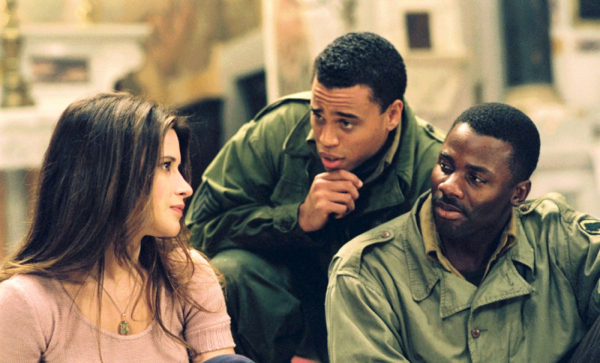
Ryan Phillippe, who recently played a disillusioned soldier of World War II in “Flags of Our Fathers,” applies more of the same clenched-jaw stoicism to his Staff Sgt. Brandon King. Depicted by the moviemakers as a squared-away, by-the-book straight arrow, King is overwhelmed by grief and guilt when he loses men in tense urban combat in Tikrit. Once he and pals Steve (Channing Tatum) and Tommy (Joseph Gordon-Levitt) return to Brazos, Texas, it is instantly clear that stateside readjustment will not come easy. Peirce ladles out generous portions of genre tropes, from post-trauma flashbacks to alcohol soaked binges to domestic abuse.

Abbie Cornish, who plays Steve’s long-suffering fiancée Michele, receives second billing and a seat in the getaway car next to King when he goes AWOL. “Stop-Loss” might have had something more powerful to say about the coping mechanisms of family members with loved ones in the military, but the story is unrelentingly filtered through King’s eyes, leaving Cornish with little to do beyond react to King’s run of troubles. All of the movie’s female characters are given precious little screen time, and suffer the same fate.

“Stop-Loss” caroms wildly between shoulder-shrugging support for the war and the central character’s indignation at being mistreated by a government he dutifully served. Despite spitting out a line of profanity admonishing George W. Bush (likely designed to draw cheers of approval in many theaters), the movie plays it completely safe in the arena of too-familiar gung-ho abstractions like honor, duty, and brotherhood. As a result, the movie cannot win, since doves will feel let down by the outcome and hawks won’t stand for the movie’s long road trip of bitter disobedience.

Peirce can be commended for at least trying to make a serious-minded feature about a conflict that is still unfolding, but the movie is too confused, toothless, and squishy to stand for anything specific. Does Peirce disagree with a policy that, in essence, operates as a “back door draft” (to use the movie’s term) to keep overtaxed soldiers on the front lines? One might say the answer is “I guess so,” but “Stop-Loss” feints when it should be swinging hard. It acquiesces when it could take a stand. The movie, which too often relies on the adrenaline-fueled, ass-kicking jingoism of chest-thumping American might, flits between scenes that would be at home in a recruitment video and reminders that young men come home missing their eyesight or limbs. This ambiguity is a liability, and “Stop-Loss” never finds a solid grip.

Starting Out in the Evening

Autosave-File vom d-lab2/3 der AgfaPhoto GmbH

Movie review by Greg Carlson

Frank Langella shares a tremendous performance as Leonard Schiller, a fading, aging novelist courted and flattered by the attentions of an ambitious graduate student in “Starting Out in the Evening.” Adapted from the 1998 novel by Brain Morton, Andrew Wagner’s screen adaptation is a literate, quiet experience that will please voracious readers as much as it will bore those who crave action and spectacle. Deliberate, placid and visually quite stunning, the labor of love was shot in less than three weeks on a budget of roughly half a million dollars on location in New York City.

Despite flirting with the pitfalls of a May-December story, “Starting Out in the Evening” sets its sights on a great deal more than the expected trappings. The movie is self-conscious enough to acknowledge the naked ambitions of its central characters, and we get to know them as fully rounded individuals prone to the twists and turns of vanity and self-doubt. The appropriately named Heather Wolfe (Lauren Ambrose) might be the more obviously calculating of the central pair, but the movie doesn’t skimp in revealing just how much the nearly forgotten Schiller basks in the fawning sweet talk of the much younger woman. Who wouldn’t enjoy being called important and underappreciated?

The movie is slightly less compelling when it leaves the company of Schiller and Wolfe for Schiller’s almost forty-year-old daughter Ariel (Lili Taylor). Ariel, desperate to have a child before she reaches middle age, rekindles a romance with an old beau (Adrian Lester) even though he refuses to consider the possibility of starting a family. The draining hourglass metaphor that drives both father and daughter might work better on the page than on the screen. Taylor, however, is an accomplished performer, and her presence in the movie is welcome, especially in the slightly bitter dutifulness she brings to her occupation as the offspring of a once lauded artist.

“Starting Out in the Evening” succeeds in the depiction of Schiller’s caution in the presence of the beguiling Heather. The old man initially keeps his admirer at a distance, painfully aware that a quid pro quo offer is on the table from their first meeting. Heather wants a story, a thesis, and eventually a publication out of the relationship; Schiller knows it but succumbs to his ego anyway. When the opportunity for physical intimacy rolls around (with a kind of persuasive inevitability), the movie hits its stride. An erotically charged pas de deux, beginning with an anointing by honey and ending with a shot of aching restraint, is memorably rendered and thoroughly believable.

Sometimes, the movie comes close to taking itself too seriously. Schiller himself is nearly humorless. Characters occasionally seem to point out the all too obvious, which can feel slightly condescending. “Starting Out in the Evening” is nothing if not earnest, though, and all four of the major actors are terrific. When Schiller and Wolfe venture outside his tastefully appointed Upper West Side hibernaculum, we glimpse the dog-eat-dog enterprise of NYC’s publishing world, stuffed to bursting with cruelty and rejection. It is no wonder the moviemakers side with the austere, old-fashioned wordsmith whose time has come and gone.

Drillbit Taylor

Drillbittaylor1

Movie review by Greg Carlson

Tepid comedy “Drillbit Taylor” might have been titled “Superbad: The Early Years,” given the movie’s familiar teaming of an overweight motormouth, a slimmer, more sensitive best pal, and a bizarre, third-wheel goofball bringing up the rear. Unfortunately, the characters in the more recent movie aren’t nearly as charming or as smart as Seth, Evan, and McLovin. Despite a producing credit for Judd Apatow, an appearance by Leslie Mann, and writing contributions by Seth Rogen, “Drillbit Taylor” is strictly bottom-shelf material completely unworthy of the talents involved. Interestingly, another writing credit belongs to Edmond Dantes, the pseudonym of the often-AWOL 1980s teen-movie kingpin John Hughes. Needless to say, “Drillbit Taylor” is no “Ferris Bueller’s Day Off” – from which it cops several gags. Heck, it isn’t even “Weird Science.”

Owen Wilson plays the movie’s title character, a homeless con artist who agrees to protect the nerdy schoolboys from the unwanted attentions of a thuggish bully. The movie never decides whether the audience should primarily identify with the title character or the hapless kids who hire him. Caroming haphazardly between the two points of view, “Drillbit Taylor” manages to forego character development almost entirely: McLovin was lavished with the kind of tiny details that made him three-dimensional in “Superbad,” but his “Drillbit Taylor” counterpart remains irritatingly shapeless. The same is true for nearly everyone else.

“Drillbit Taylor” goes overboard with unnecessary montages, and in one of them, Adam Baldwin shows up sporting the same style of military jacket worn by his character Linderman in the cult classic “My Bodyguard.” Presumably, Baldwin is on hand to acknowledge the moviemakers’ debt to the earlier film, but he merely serves as a painful reminder of the superiority of the original article. “Drillbit Taylor” gleefully references all kinds of pop movie culture of the past thirty years or so, from Wilson’s Colonel Kilgore attire to the “Fight Club”-esque intimacy of male bonding through violence. The references, apropos of nothing, just sail past.

If the movie has a silver lining, it is manifested in the comic touch of Leslie Mann. As a teacher whose poor judgment has led her through a series of relationships with dirtballs and losers, Mann could easily anchor her own feature instead of being stuck with the thankless task of playing the love interest to the less interesting Drillbit. Mann and Wilson share a weird chemistry, and both actors are good enough to convince us that their dysfunctional relationship, despite its lack of logic and plausibility, could happen. The way that the two lustily eyeball each other during their first meeting in the faculty lounge is one of the few genuinely funny moments in the whole movie.

The failure of “Drillbit Taylor,” however, rests with its timid conventionality. “Knocked Up” and “Superbad” were often praised for their willingness to incorporate a level of sensitivity nearly always absent from the raunchy slapstick designed for young male audiences. “Drillbit Taylor” feels like it pulls all its punches, and it is most definitely impaired by its PG-13 rating. Director Steven Brill never finds the right rhythm for the half-baked screenplay, and the laughs are few and far between.

Persepolis

Persepolis1

Movie review by Greg Carlson

Marjane Satrapi’s four volume graphic novel memoir “Persepolis” comes to life in beautifully rendered animation in the Academy Award-nominated movie of the same name. Recounting the author’s journey from childhood to young adulthood, “Persepolis” will offer the majority of its American viewers the rare opportunity to peek inside a largely unknown world of experiences. In addition to its memorable design, which breathes stark, expressionistic life into Satrapi’s drawings, the movie neatly balances coming-of-age themes common to all cultures with the particularity of the social and political upheaval of the Islamic Revolution.

The story commences in Tehran in the late 1970s, as Marjane’s progressive family watches in fear as the Shah’s monarchy crumbles under Khomeini. As one repressive system yields to something even more frightening, Marjane (voiced as a kid by Gabrielle Lopes) takes things in stride, mostly trusting the word of her family, skeptically challenging her teachers at school, and ignorantly acting out with a group of friends. Satrapi, who co-wrote the adaptation and co-directed the movie with comics artist Vincent Paronnaud, stuffs the frame with all kinds of humorous detail, including her own mania for pop music. Acquired on the black market, the cassette tapes Marjane adds to her collection include an eclectic range of performers: ABBA and the Bee Gees vie with Michael Jackson and Iron Maiden.

Once the Iran-Iraq War commences, Marjane’s parents send her to the French Lycee of Vienna, and the separation leaves a lasting impression on the youngster as she struggles through puberty. In terms of plot, “Persepolis” adopts a linear, episodic chronology, but Satrapi infuses the narrative with her ever-changing personal philosophy, made all the more impressive by the author’s healthy dose of self-deprecation. As Marjane explores a range of ideologies, including nihilistic and existential leanings that feed into her anger and depression, the movie retains a refreshing honesty about the changes one undergoes on the path to maturity.

“Persepolis” includes a few brief color sequences, but the majority of the movie unspools in elegant black and white. Despite the film’s computer assisted enhancements, the traditional 2D, hand-drawn work, which was completed on paper and then felt-tip inked by a team of artists, immediately evokes an unmistakable warmth that cannot be replicated by software. Animation enthusiasts will positively swoon at the craftsmanship of the feature, and it is a safe bet to suggest “Persepolis” will be scrutinized by animators interested in alternatives to the dominance of 3D modeling and graphics programs like Maya. At times, “Persepolis” nods to animation history, with cutout-style moments that recall seminal work like Lotte Reiniger’s “The Adventures of Prince Achmed.”

Not too surprisingly, the Iranian government has voiced displeasure at “Persepolis,” and made a successful bid to have the movie withdrawn from the Bangkok International Film Festival. A few screenings of “Persepolis” have taken place publicly in Tehran, although according to the Middle East Times, a number of scenes were censored before the showings received the go-ahead. Viewers in the United States might take the privilege of criticizing their political leaders for granted, but “Persepolis” hardly strikes one as anti-Iranian. If anything, it aches with the central character’s longing and love for her homeland, even as she lives in exile.

The Bank Job

Bankjob1

Movie review by Greg Carlson

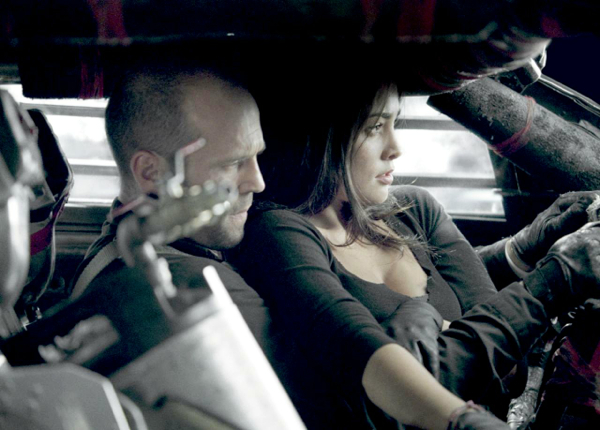
Jason Statham effectively plays the leader of a gang of robbers in “The Bank Job,” a decent British caper movie in the classic tradition. Loosely based on actual events that took place in London in 1971, the screenplay prefers speculation and invention to historical precision, which ideally suit the movie’s working class ambitions and dry sense of humor. Statham has been primarily known to American audiences for his tough guy roles in Guy Ritchie movies as well as for his martial arts proficiency in the “Transporter” films. In “The Bank Job,” the actor is provided a chance to shine as a more dimensional character, and demonstrates a genuine charisma that should lead to bigger and better opportunities.

Despite its convoluted plot involving compromising photos of Princess Margaret, the Black militant known as Michael X, corrupt police officers, a sleazy Soho porn producer, an ex-model turned government instrument, and a possible media blackout driven by national security concerns, director Roger Donaldson manages to keep the intertwined plot threads relatively clear, mostly entertaining, and nearly always on track. So many balls in the air at once inevitably reduce the allotment of time that can be devoted to developing the supporting players, but with few exceptions, the characters are fleshed out and interesting.

Statham’s Terry Leather is a sports car mechanic and dealer who reconnects with old flame Martine (Saffron Burrows) when she approaches him about tunneling under a Lloyds vault to make off with the contents of safe deposit boxes. Like all heist movies, a team of specialists is required, and “The Bank Job” fulfills its obligations efficiently, introducing a Rogues Gallery of affable conmen who certainly appear to be more amateur than professional. Martine, hoping to earn immunity following an airport drug bust, doesn’t tell the fellows that in essence, they are being set up, since she is literally and figuratively in bed with an operative and every step of the burglary is being monitored by spooks from MI5.

The safecracking itself is picked up by a ham radio operator listening in to walkie-talkie chatter (one part of the movie that is rooted in history), and the suspense cranks up as one set of cops closes in while the intelligence agents watch and wait. Donaldson has an affinity for the nearly bumbling thieves, and the plot often employs fortunate breaks and blind luck to keep the protagonists one step ahead of the various factions that would like to apprehend them. By the final act, the cat and mouse games turn on a series of public meetings in which documents are to change hands, and Statham partakes in some of the physical violence that seems to be expected of him.

“The Bank Job” doesn’t compare to legendary genre examples like “Rififi” or even more recent offerings like “Inside Man,” but there is something reassuring about the clockwork expectations of caper flicks that enthusiasts will find appealing. Burrows’ smoldering femme fatale complements Statham’s steely eyes and square jaw. Donaldson doesn’t quite seem to know what to do with their relationship, and cuts away when the two succumb to their mutual attraction. In a different movie, the adulterous romance might have been explored in more detail, but “The Bank Job” is strictly about business.

The Other Boleyn Girl

Otherboleyngirl1

Movie review by Greg Carlson

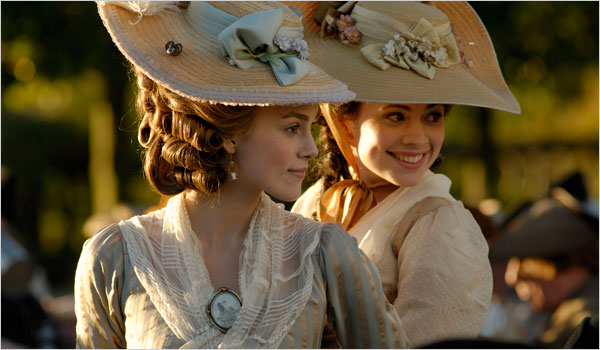
Streamlining the Philippa Gregory novel upon which it is based and stream-rolling a good chunk of historical record, “The Other Boleyn Girl” generates interest in the casting of Natalie Portman and Scarlett Johansson, two starlets who often make choices a cut above their well-paid young peers. Originated on high definition digital video, the movie boasts a reasonably attractive look in comparison with 35mm motion picture film. A prequel of sorts to Shekhar Kapur’s “Elizabeth” films, “The Other Boleyn” girl easily trumps last year’s “Elizabeth: The Golden Age,” which traded a strong central performance for a stilted screenplay and a gargantuan sense of self-importance. The ambitions of “The Other Boleyn Girl” are substantially less bombastic, and the result is a workmanlike, if forgettable, period costume drama.

As Anne Boleyn, Natalie Portman turns in a strong and colorful performance. While Johansson’s Mary is faithful and naïve, Portman’s Anne is devilish and calculating. Portman manages the challenge of playing a character whose manipulative scheming shifts precariously toward the unsympathetic. When lashing out at her sister, Anne’s ambition can make her ugly, but Portman finds complexity underneath the icy surface, and she ultimately wins the sympathy of the viewer, especially when facing the executioner’s blade.

The movie is not without serious deficiencies, and chief among them is a blithe ignorance regarding the politics behind the couplings that dominate the action. In essence, “The Other Boleyn Girl” unfolds like a sudsy teen-focused TV show, turning Henry the Eighth into a smoldering, conceited football quarterback perpetually led around by his single-minded desire to bed every attractive female in sight. There is little that can be done by Eric Bana, who succumbs to a flat and undernourished depiction of a priapic monarch. Henry’s desire for a male child is merely given lip service; this king just wants to get it on.

Despite Anne’s iron-willed determination and sharply honed sense of self, “The Other Boleyn Girl” also fails to adequately examine the reprehensible manner in which papa Thomas Boleyn (Mark Rylance) and his brother-in-law the Duke of Norfolk (David Morrissey) openly and shamelessly use the beautiful sisters as sexual pawns in a bid for favor, power, and wealth. As Anne and Mary’s mother, Kristin Scott Thomas occasionally rages against the ethical void created by the literal pimping of her children, but the movie certainly could have paid more attention to the ways in which gender impacts governance and the affairs of state.

The wonderful Ana Torrent, whose performance in Victor Erice’s masterful “The Spirit of the Beehive” in 1973 has assured her cult status, comes the closest to exploring the double standards dividing men and women in “The Other Boleyn Girl.” As Katherine of Aragon, Torrent radiates a courtly calm. Katherine’s inability to produce a male heir jeopardizes her position as queen consort in the Tudor line, but her long marriage to a philandering royal has given her a perspective unfathomed by the impetuous Anne. Had the movie shared more of Katherine’s point of view, it might have been more than just another screen melodrama imagining the lives of crowned heads.