Movie review by Greg Carlson
A number of critics and media outlets have already noted the variety of cinematic antecedents that have influenced writer-director Amy Wang’s movie “Slanted,” pointing out how the story of a frustrated teenager mashes “Mean Girls” with “The Substance” in a body horror package that misses the bullseye. Wang borrows peak prom humiliation from “Carrie,” but her film lacks the depth of characterization for any of the social commentary to penetrate with the kind of incisive sting found in the work of Jordan Peele. “Slanted” premiered at SXSW in March of 2025 and now finds its way to theaters one year later.
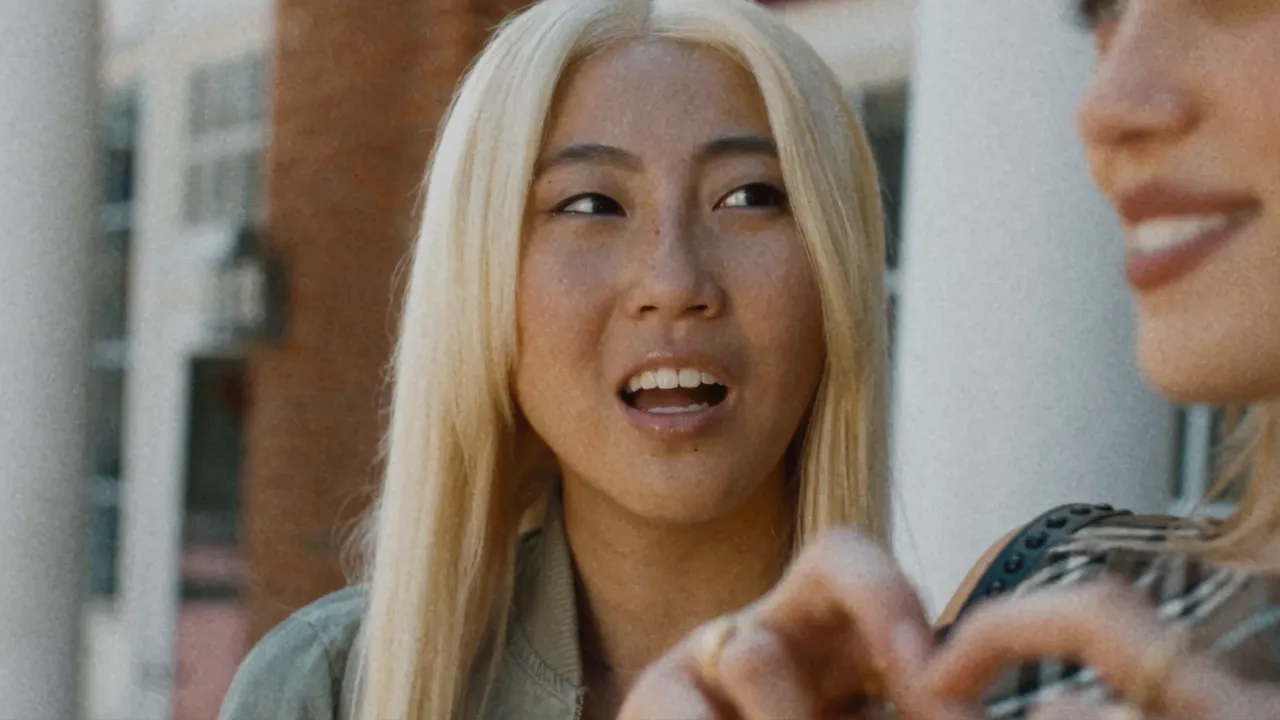
The talented Shirley Chen, who made a splash in “Beast Beast” and “Didi,” portrays protagonist Joan Huang, a Chinese-American adolescent whose white peers have long discriminated against her on the basis of her physical appearance. Desperate to have a shot at being crowned prom queen, Joan tricks her mother into giving consent for ethnic modification surgery that results in a radical transformation. Now passing as a white girl rechristened Jo Hunt (and played post-operation by Mckenna Grace), Joan cozies up to popular alpha Olivia (Amelie Zilber) before her actions prove that you should be careful what you wish for.
Wang uses the relationship that Joan shares with her parents (Fang Du and Vivian Wu) to explore the domestic aftermath of her physical metamorphosis, feeling out the upsetting absurdity of encountering an “imposter” before mom and dad start to reckon with their beloved daughter’s choice to so forcefully reject their heritage and personal history. These scenes, which alternate with the development of Joan/Jo exploring the newfound privilege of whiteness in a white world, should be the place where Wang digs into the toughest and most substantive issues revolving around the difficulties faced by third culture kids.
Instead, despite Du and Wu doing everything in their power to overcome the thinly-realized parts, Wang shifts our attention to the academic setting. We shouldn’t demand too much logic from such a wild, science fiction-adjacent premise, but none of the staff, teachers, or administrators at Joan’s school question the timing of her disappearance or the arrival of Jo as a “new” student. Only Joan’s friend Brindha (Maitreyi Ramakrishnan) keeps up with the viewer by sniffing out the truth. The depiction of their friendship is another squandered opportunity, as Wang fails to make space for Brindha to confront Joan with thoughtfulness that might require some painful self-reflection.
The ugliness of racism shows up on several rather curious occasions. Of these, a bleakly comic karaoke music video called “It’s Good to Be White” trumpets the joys of white supremacy, taking center stage in one of the film’s most unsettling scenes. But Wang plants additional markers of America’s awful tendency toward bigotry and intolerance. For example, the mascot of Joan’s high school is the Wizards, but the logo looks more like a Klansman than Merlin the Magician. The blonde homogeneity of Olivia’s clique has a whiff of Stepford Wives-style conformity, especially when everyone shakes their dressing and salad containers in the lunchroom. These touches, however, are spaced far enough apart that we frequently second-guess Wang’s intended tone.