Movie review by Greg Carlson
Working from a script by Rashida Jones and Will McCormack, Olivia Wilde puts her own stamp on Cesc Gay’s play “Los vecinos de arriba,” which Gay made as a 2020 film known in English as both “Sentimental” and “The People Upstairs.” The story, revolving around two neighbor couples who experience a surprising evening together, unfolds largely over the course of a few hours and explores themes including love, lust, commitment and disconnection. The tantalizing farcical possibilities of an unexpected orgy and the relatively low cost of four performers in what is essentially a single location have turned Gay’s piece into a cottage industry.
Prior to Wilde’s take, audiences around the world have laughed, winced, and shed a few tears at cinematic iterations in Italy (“Vicini di casa”), France (“Tu plus si affinités”), Russia (“Neprilichnye gustosti”), the Czech Republic (“Ve dne v noci”), South Korea (“Witjip saramdeul”) and Switzerland (“Die Nachbarn von oben”). Jones and McCormack, longtime friends and writing partners who were romantically involved with one another many years ago, crack Gay’s writing by fine-tuning character specifics and peculiarities to the talents and charms of Wilde, Seth Rogen, Penélope Cruz and Edward Norton. The resulting feature has been called a return to form by those who thought Wilde stumbled with “Don’t Worry Darling” after the success of directorial debut “Booksmart.”
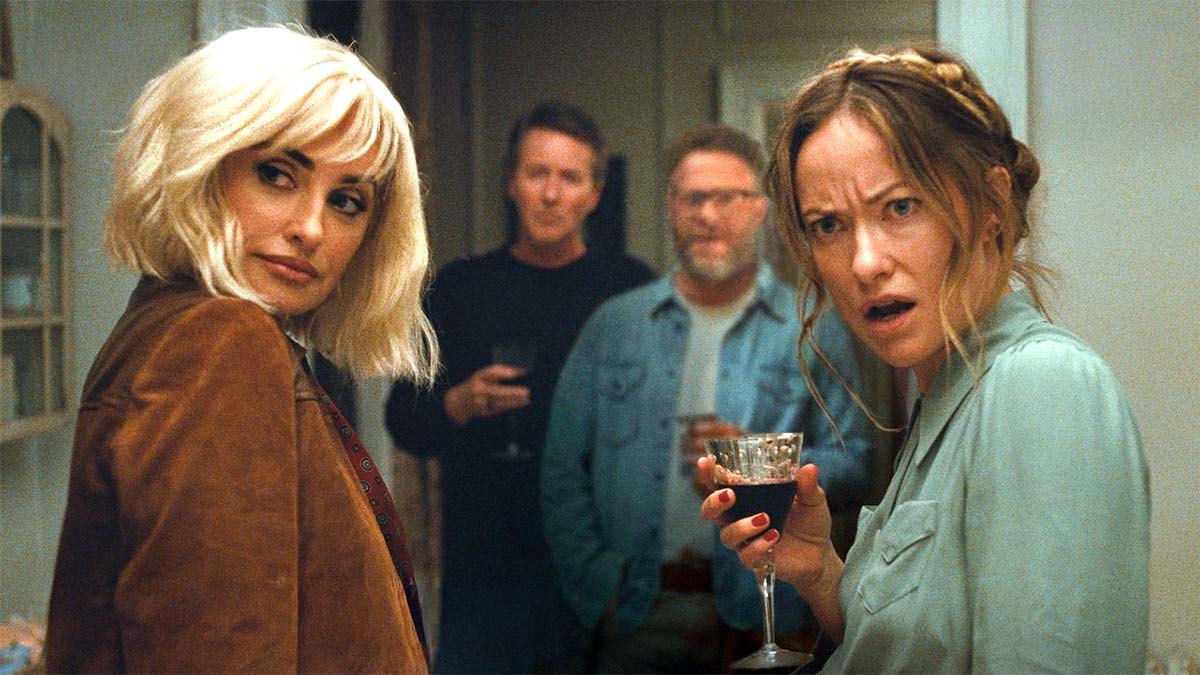
In addition to duties behind the camera, Wilde takes on the role of Angela, a nervous and insecure San Franciscan raising an almost teenage daughter with husband Joe (Rogen). Estranged from intimacy and barely navigating rocky marital waters, Angela and Joe prepare to welcome the smooth and attractive Hawk (Norton) and Piña (Cruz) – who have been disturbing the peace with some loud and boisterous sex – down to their apartment for food and drink. Joe intends to confront the thunderous sweethearts but things take a sharp turn when Hawk and Piña preemptively apologize for the volume of their lovemaking. The confession quickly becomes an admission; it turns out Hawk and Piña have some very progressive ideas when it comes to sexual experimentation.
Wilde avoids the pitfalls of set-bound claustrophobia by applying savvy compositions abetted by cinematographer Adam Newport-Berra and a silky editorial flow courtesy of Yorgos Mavropsaridis and Anthony Boys. Once the tension shifts from Joe and Angela’s bitter bickering to the potential for a guilt-free sex party, Wilde finds the perfect modulation between gears. Rogen’s affinity for physical comedy is matched by Norton’s unctuous smarm, while Wilde contrasts Angela’s anxious edges against the effortless manner in which Cruz communicates the tranquil confidence of Piña. Wilde makes space for all four performers to shine individually and together.
In movies that foreground deviation from sexual norms, difference and kink are more often than not played for broad laughs. Surprisingly, “The Invite” refuses to suggest that Hawk and Piña should be seen as aberrant freaks unworthy of our respect when it comes to matters of the flesh. The movie has been frequently compared to “Who’s Afraid of Virginia Woolf?” but Wilde’s treatment of Gay’s comic preoccupation with the possibilities of carefree pleasure and uninhibited sex takes up too much real estate to match the boozy recriminations and submerged pain that fuels the brilliant Mike Nichols adaptation of Albee. After a slapstick crescendo, Wilde confronts with wisdom and sincerity the misery that threatens to tear Joe and Angela asunder.