Movie review by Greg Carlson
Functioning as a companion to David Shadrack Smith’s “Public Access,” the provocatively titled documentary “Bang My Box: The Robin Byrd Story” educates viewers with a history lesson covering the wild high seas of a bygone era of personal media-making through the eyes of one colorful veteran and pioneer. Long before outlets like YouTube (or, for that matter, the World Wide Web) existed, lawmakers mandated space on cable television for regular citizens to produce programming. In NYC, the content of user–made shows on Manhattan’s Channel J almost immediately tested limits and stretched boundaries.
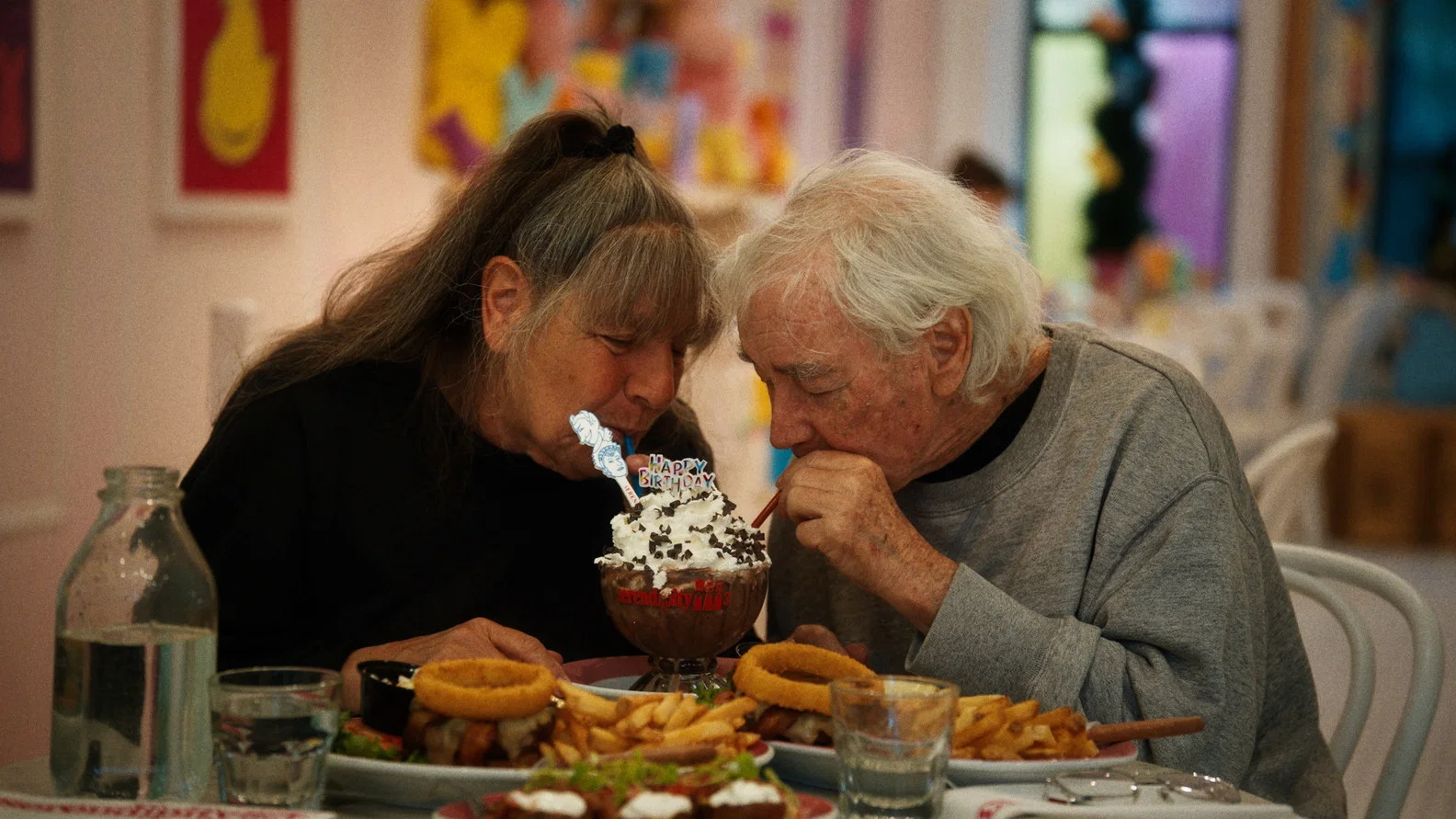
Enter Robin Byrd. Following guest hosting duties on a show called “Hot Legs,” the model/performer/activist learned the ropes of television behind and in front of the camera, branding her own title and joining several emerging series that explored facets of sexuality, sex positivity, sex work, and the sex industry. Filmmakers Jyllian Gunther and Stephanie Schwam, embedded with their subject as she wraps up her 60s, construct a warm and frequently moving tale of perseverance, commitment, and conviction. The physical and mental decline of Byrd’s husband Shelly, her partner of more than half a century who now struggles with dementia, prompts the pair to explore the donation of their extensive collection to a proper academic archive.
Gunther and Schwam click back and forth between the garish red neon of “The Robin Byrd Show” and the hoarder’s clutter of the Byrd family apartment and storage facility, fashioning a makeshift time machine that teleports Robin to her past glory as an influential and recognizable New York fixture. Byrd’s cult status occasionally spilled past the borders of the Big Apple; in 1997 and 1998, Cheri Oteri played the host in three “Saturday Night Live” sketches. Oteri contributes to “Bang My Box,” but Gunther and Schwam might have provided more detailed context. With very few exceptions, the filmmakers rely on audio-only interviews with Byrd supporters, a list that includes Annie Sprinkle, Porsche Lynn, Michael Musto, and Nadine Strossen.
The vintage clips taken from Byrd’s show highlight an almost anything-goes frontier focused on the hedonistic and the permissive. But Byrd’s personal philosophy extended to unwavering support for her many gay colleagues in a time of crisis. With HIV/AIDS ravaging the queer community and the policies of Ronald Reagan causing far more harm than good, Byrd reminded viewers to use condoms and reduce risk. “Bang My Box” might not go far enough to fully appreciate Byrd as frontline first-responder and outspoken defender of the marginalized, but scenes on Fire Island highlight her status as a kind of honorary mayor and beloved character.
In parallel to Byrd’s role as sex educator in a time of fear and uncertainty, the documentary stitches together a chapter on challenges to free speech made by organizations like Jerry Falwell’s Moral Majority and other Christian right groups and conservative politicians. One wonders whether Supreme Court outcomes would be different had the cases been tried before today’s justices, but Gunther and Schwam clearly hope viewers will connect the dots between then and now in the culture wars. As a reflective Byrd comes closer to a decision on the ultimate fate of her library of master tapes and other ephemera, we are taken by an equally important legacy: her tender caregiving for Shelly and her indefatigable joie de vivre.