Movie review by Greg Carlson
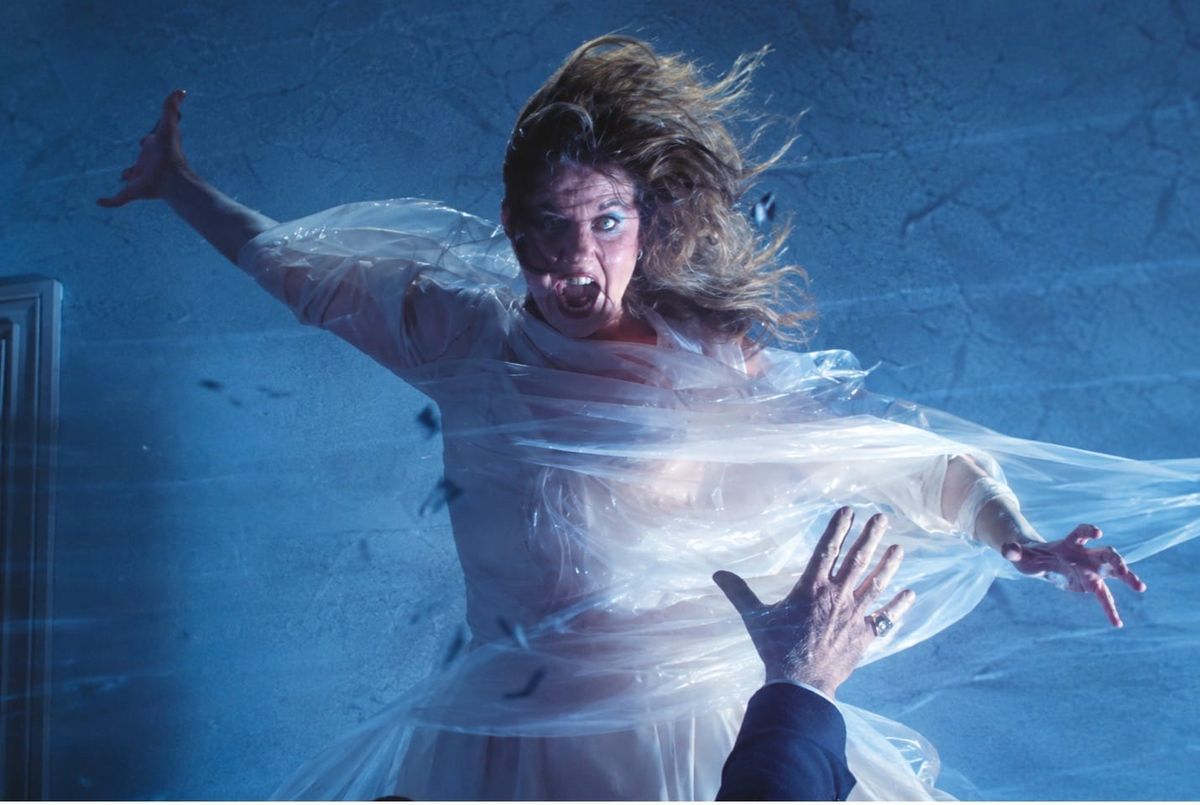
Cinephiles should make a point to seek out director David Kittredge’s thoroughly entertaining documentary “Boorman and the Devil.” Joining the ranks of strong behind-the-scenes, making-of examinations/exhumations that expand our understanding of a film far beyond the more sanitized supplemental material usually found as bonus features on physical media releases, the feature-length dissection of the notorious sequel to William Friedkin’s 1973 juggernaut “The Exorcist” praises filmmaker John Boorman for creative risk-taking even if his “Exorcist II: The Heretic” serves as a case study of catastrophe and failure.
The presence of Boorman as Kittredge’s principal interview subject is the secret sauce of the retrospective. The legendary moviemaker, now 93, offers candid, forthright, and clear-eyed self-critique that is light on boastful self-aggrandizement and heavy on sincerity. Kittredge, who often leaves his own questions and offscreen reactions in the edit, is assuredly a fan. But he never lets his own admiration for Boorman get in the way of the warts-and-all autopsy of everything that went wrong with “Heretic.” Boorman’s willingness to indulge what would be for many an embarrassing bridge too far consistently piques our curiosity and wins our respect.
In addition to the legendary director of “Point Blank,” “Deliverance,” “Excalibur,” “Hope and Glory,” and several other tremendous movies, Kittredge invites key production personnel and performers Linda Blair and Louise Fletcher to recount their own experiences on the film. Much time is set aside for their recollections of co-star Richard Burton, whose alcoholism and lack of professional preparation during a real phoning-it-in period of the actor’s career frustrated many colleagues in front of and behind the camera. Dots are methodically connected to show that the miscasting of Burton is just one of many troubles that would soon snowball into an avalanche of misfortune.
Boorman’s own hospitalization and absence from the shoot was caused by Valley fever, a lung infection he developed from breathing in spores contained in the soil trucked to the soundstage. As “Heretic” fell behind schedule, Boorman turned to Rospo Pallenberg (a screenwriter with whom he collaborated on an unproduced adaptation of “The Lord of the Rings,” as well as “Deliverance” and “Zardoz”) for major rewrites. The decision proved tremendously unpopular with cast and crew who resented Pallenberg’s seemingly unearned authority on the set. To be sure, there is no real villain in this tale, but Pallenberg perhaps comes closest.
Rather than look for individuals to blame, Kittredge approaches the story with curiosity and openness, much in the way that Boorman intended to reimagine Blair’s Regan MacNeil by moving the character beyond what he saw as the relentless victimhood and torture of the original. Attesting to Boorman’s refusal to offer up more of the same are filmmakers Mike Flanagan, Joe Dante and Karyn Kusama. Critics, including Stephanie Zacharek, Bilge Ebiri and Simon Abrams, also contribute smart and measured perspectives. It would be easy to pile on “Heretic” – toward the end Kittredge asks his interview subjects whether it is a good or bad movie and receives a wide range of answers – and “Boorman and the Devil” doesn’t shy away from tales of the disastrous reception faced by “Heretic” during the same summer that “Star Wars” rewrote the rules of studio moviemaking.