Don’t Worry, He Won’t Get Far on Foot

Don't Worry He Won't Get Far Still

Movie review by Greg Carlson

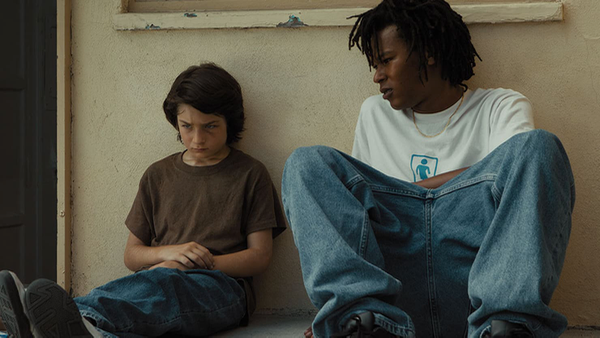
In the most Gus Van Sant scene in a very Gus Van Sant movie, John Callahan (Joaquin Phoenix) spills out of his wheelchair and into the street after picking up a little too much speed. The predicament elicits immediate concern for Callahan’s well-being, so the kind assistance from a group of skateboarding kids melts our fear into a glimmer of faith and hope for the world. “Don’t Worry, He Won’t Get Far on Foot” is named for the pitiless, Vantablack caption accompanying one of cult cartoonist Callahan’s quasi-autobiographical panels, and Van Sant honors his subject with this more cinematic title than the equally acerbic “Will the Real John Callahan Please Stand Up?”

Callahan, who died in 2010, regularly contributed to Portland’s alternative paper “Willamette Week,” and some of his cartooning is delightfully translated to inventive animation throughout Van Sant’s biopic. At Sundance and in additional interviews, Van Sant described his labor-of-love in bringing this particular story to the screen by repeating the anecdote that Robin Williams, who held the option on the film rights to Callahan’s biography, pitched the idea to Van Sant during “Good Will Hunting.” When the proposed movie never came together, Callahan quipped that we would “all be in wheelchairs” before it saw the light of day.   

Phoenix is predictably fantastic in the deeply-connected lead performance, and Jonah Hill expands his own bona fides as AA sponsor Donnie, a wealthy philosopher king whose endlessly inspiring wardrobe matches the breadth of his laid-back charm and generosity of spirit. Less successful is Van Sant’s integration of Rooney Mara’s Annu, a different kind of angel to Callahan than Donnie. Following a promising introduction, Van Sant’s screenplay just allows her to vanish, and the movie’s idiosyncratic rhythms keep you wondering when she might return. The director also invites a few old friends (and new) to the party, and the attendance of Udo Kier, Kim Gordon, and Beth Ditto at Donnie’s AA meetings will please the Van Sant faithful.

Along with Hill, Jack Black as Callahan’s ill-fated drinking companion Dexter deserves supporting performance accolades. In the film’s most visceral sequence, a painful, gut-churning reconstruction of the 1972 night that paralyzed Callahan, Van Sant does some of his best directing in years. Striking a perfect balance between the giddy, comic shenanigans of the souses (Callahan, then 21, was a veteran imbiber at 13) and the awful knowledge that the initially happy evening will not end well, the filmmaker puts together a doozy of a drunk driving cautionary tale.

Unfortunately, the sweaty-palms immediacy of that bad luck fable only periodically shows up in the rest of the loose and often meandering film, which could easily do away with fifteen or twenty minutes. The veteran filmmaker boasts one of the strangest filmographies of anyone who has made both intensely personal independents and sanded-smooth studio work-for-hire. Much of his recent output has failed to approach any of the magic of “Drugstore Cowboy” and “My Own Private Idaho.” Even so, “Don’t Worry, He Won’t Get Far on Foot” has plenty to recommend it, and the movie joins the ranks of cinema’s long list of stories fascinated with alcoholism and/or disability.

Trespassing Bergman

Trespassing Bergman

Movie review by Greg Carlson

Jane Magnusson and Hynek Pallas’ “Trespassing Bergman,” an often playful deconstruction of the work and life of the legendary Swedish filmmaker through the eyes of a murderer’s row of auteurs, is a guaranteed ticket for the hardcore cinephile. Stacked with observations from Tomas Alfredson, Woody Allen, Wes Anderson, Harriet Andersson, Pernilla August, Francis Ford Coppola, Wes Craven, Robert De Niro, Claire Denis, Laura Dern, Daniel Espinosa, Michael Haneke, Holly Hunter, Alejandro Gonzalez Inarritu, Takeshi Kitano, John Landis, Ang Lee, Alexander Payne, Isabella Rossellini, Martin Scorsese, Ridley Scott, Lars von Trier, and Yimou Zhang, the film’s real superstar is Bergman’s Faro Island compound — where the best parts of the movie take place.

Despite the black hole density of the concatenation of talking heads, Magnusson and Pallas don’t skimp on the film clips, photographs, and archival content of the indefatigable Bergman. Some of the behind-the-scenes footage has reportedly never been publicly available, offering yet another magnetic pull for fans. Career-spanning highlights from “Summer with Monika,” “The Seventh Seal,” “Wild Strawberries,” “The Virgin Spring,” “Persona,” “Scenes from a Marriage,” “Autumn Sonata,” “Fanny and Alexander,” and others are punctuated with insights that range from predictable (the neverending question asking whether “The Seventh Seal” is overrated) to the fresh (Haneke on Bergman’s use of violence).

Given the movie’s number of participating filmmakers, every viewer is likely to choose favorites. The ones visiting Faro, however, have the clear advantage, since the cameras capture their reactions to the eerie intimacies of Bergman’s pristinely preserved personal spaces. Guests remove shoes at the door and select a pair of slippers. Some, like Inarritu, examine the master’s graffiti on tabletop and wall chart, speculating on the possible meaning of the inscrutable hieroglyphics. Hilariously, Alfredson quips that being there feels like going to the “not fun house.” Denis, subjected to a loudspeaker looping a trespass warning, seems unnerved and uncomfortable. Landis, the odd man out, makes himself right at home.

The interlopers delight in poking through the well-organized shelves of Bergman’s famous, massive, personal videotape library, pulling cassettes of eye-catching titles and spotting surprising Hollywood blockbusters and offbeat genre flicks. Sometimes, Bergman’s handwritten notes adorn the cases — Haneke appears to get a real kick out of receiving a four-out-of-five star rating for “The Piano Teacher.” Magnusson and Pallas also make the most of unscripted, unguarded moments with their interviewees. It’s a glimpse behind the curtain, as walking encyclopediae Anderson and Scorsese test out ideas, fact-check, and practice their soundbites before the “real” recording begins.

For better or worse, the film’s most engaging interview is von Trier, who wears his heart on his sleeve in a set of passive-aggressive, love-hate speculations on his cinematic hero. Even so, the Danish director, unnamed but accused of sexual harassment and bullying by Bjork, and Allen, accused of sexual assault by Dylan Farrow, now cast dark shadows over the document. While Allen’s comments avoid the kind of ribald vulgarities and incitements on display in von Trier’s theories about Bergman’s own libidinous obsessions, the presence of the two moviemakers revises those parts of the film that deliberately address the ways in which Bergman dealt with sex onscreen and off.  

“Trespassing Bergman” showed this past week as part of the Minneapolis St. Paul International Film Festival and is available to view on-demand.

I Feel Pretty

I Feel Pretty

Movie review by Greg Carlson

Longtime writing partners Abby Kohn and Marc Silverstein make their joint directorial debut but don’t quite get everything right in “I Feel Pretty,” an Amy Schumer vehicle that jettisons the hard-R ribaldry of “Trainwreck” and “Snatched” for the potentially wider-appeal territory of PG-13 content. Schumer, who has long been the target of relentless trolls on platforms including Reddit, plays Renee, a woman — according to the official film website — “who struggles with feelings of deep insecurity and low self-esteem.” A spin class head injury causes Renee to see herself as the impossibly “perfect” supermodel-type unrealistically constructed and perpetuated in mass media imagery.   

Jeffrey Wells brought up thematic similarities between “I Feel Pretty” and the 1945 film “The Enchanted Cottage,” but it is far more likely that viewers will see parallels to obvious inspirations like “Big” (which is clip-checked in “I Feel Pretty”) and “Shallow Hal.” Additionally, “I Feel Pretty” uses key aspects of the Cinderella story, from magical transformation to broken spell, as well as a variation on the rags-to-riches aspiration of fantasy wish-fulfillment that drives “Working Girl,” “The Devil Wears Prada,” and dozens, if not hundreds, of other movies.  

As a person who is now “undeniably pretty,” Renee’s self-confidence empowers her to make all kinds of her own previously out-of-reach dreams come true, including a fast-track professional trajectory at the cosmetics company where she works. Whether or not the film’s wobbly screenplay engages in body-shaming, several critics have wondered if “I Feel Pretty” laughs with or laughs at the situations Renee must navigate. The depiction of Renee’s relationship with her two best friends (Busy Philipps and Aidy Bryant) is a highlight until Kohn and Silverstein choose to almost entirely ignore the consequences of Renee’s increasingly boorish and shitty post-transformation treatment of her pals.  

Specifically, “I Feel Pretty” misses that golden opportunity once Renee begins to behave with the entitlement that the traditional moralistic narrative tradition places hand-in-hand with the power bestowed by factors like physical beauty/attractiveness or wealth. As Manohla Dargis points out, Renee’s post-concussion attitude “…undermines the character, suggesting that she never was the inherently decent person she seemed to be.” Had the movie explored its “lessons learned” component with more seriousness, “I Feel Pretty” might have escaped becoming more like the thing it attempts to critique.

The contradictory messages of the climactic moment don’t make a lot of sense. Renee inexplicably semi-hijacks the public launch of her employer’s new bargain makeup line in an “everyone is beautiful” speech that somehow forgets the rhetorical function of the product being sold. And the film also never fully comes to grips with the fact that Renee was promoted precisely because she was perceived by her bosses as ordinary. Much safer, albeit just as predictable within the genre, is the wrap-up scene in which Renee reconciles with love interest Rory Scovel.  

In defense of Kohn and Silverstein, to the viewer, Renee looks like Renee at all times (which is just one thing that distinguishes the movie from “Shallow Hal”). In a “Vulture” interview, Schumer noted that the dialogue avoids specific indicators that the “new” Renee sees herself, for example, as thinner, even if much of the audience makes that assumption. Schumer also acknowledges the inherent contradictions of her big speech’s “Dove soap stuff” — plugging beauty products with messages of individuality and uplift. In general, that kind of ambiguity and contradiction (see also the wide range of positive and negative takes on the bikini contest scene) fuels genuinely interesting conversation around the film.    

Truth or Dare

Truth or Dare

Movie review by Greg Carlson

Leveraging whatever name-brand clout it might carry with the target demographic, “Blumhouse’s Truth or Dare” — the onscreen title for the pre and post-credit sequences — won’t make the kind of impact previously enjoyed by “Get Out” or, for that matter, the “Purge” series. Even so, the Jeff Wadlow-directed horror feature should draw teen viewers intrigued by the “And Then There Were None”-style trailer. Populated by a cast of young actors with plenty of television experience, the film can’t fully sustain the premise of a deadly, supernatural game of truth or dare, falling short of the superior, smarter “Nerve.”

Olivia (Lucy Hale) ditches her Habitat for Humanity service for a final spring break in Mexico with her group of close friends. Olivia’s bestie Markie (Violett Beane) harbors some serious psychological pain that won’t be explained until late in the film, and she acts out by cheating on her boyfriend Lucas (Tyler Posey). Oh, Olivia also has a serious, barely-concealed crush on Lucas. That inconvenience, and a dark secret she cannot bear to reveal to Markie, will come in handy as plot business when the movie begins to explore the dimensions of the cursed game that dogs the friends like the relentless entity in “It Follows.”

The theme of transference is also borrowed from “It Follows,” when we learn that the contenders cannot opt out of the high-stakes, consequence-heavy realities of the game. Refusing to play is not an option, since death also follows hot on the heels of anyone who violates the spirit of the challenges by either lying or not completing a dare. Why an ancient demon named Calax would bother with a party pastime so closely associated with the adolescent catnip of potential social embarrassment and/or physical intimacy is never satisfactorily explained, and “Truth or Dare” runs out of steam the more it pays attention to solving the mystery of Calax.

As for the revelations and predicaments that emerge from the ongoing turns in the game taken by the ensemble, the movie unsurprisingly leans heavily toward the grim, the gory, and the grotesque in a way that recalls the “Final Destination” films. Broken necks, severed tongues, and ballpoint pens jabbed into eye sockets are joined by a dispiriting number of scenes in which characters hold one another (and sometimes themselves) at gunpoint. But despite the lazy ubiquity of the drawn sidearm, “Truth or Dare” manages at least one exchange, between Hayden Szeto’s Brad Chang and Tom Choi’s Han Chang, that resonates with acute empathy.

The sexuality inherent in the popular conception of truth/dare challenges is not entirely absent from the film. In her “New York Times” review, Jeannette Catsoulis humorously pointed out audience reaction to the one provocation that involves intercourse. Spoiler alert: the viewers in Catsoulis’ screening questioned the “script’s notion of a dare,” even if the story logic argues that the participants feign reluctance and acknowledge that their act will hurt someone they both love. At least ten minutes too long, “Truth or Dare” never matches the charms of the recent “Happy Death Day,” a much more enjoyable high-concept title in the Blumhouse arsenal.        

Blockers

Blockers

Movie review by Greg Carlson

A welcome addition to the teen canon’s virginity-loss-quest subgenre, “Blockers” is a confident feature directing debut for multi-talented screenwriter/producer/performer Kay Cannon, previously best known for her work on “30 Rock” and the “Pitch Perfect” series. Smoothly mixing the hallmarks of bawdy situational humiliations and of-the-moment slang/profanity with the earnestness and sentimentality of many an afterschool special, Cannon does not need to clear a particularly high bar — but “Blockers” turns out to be mostly funny and sweet.

Lisa (Leslie Mann), Mitch (John Cena), and Hunter (Ike Barinholtz) are parents to a trio of childhood best friends now approaching the conclusion of high school. An on-a-whim pact made by Julie (Kathryn Newton), Kayla (Geraldine Viswanathan), and Sam (Gideon Adlon) to engage in prom night sex is discovered — the emoji and hashtag-heavy translation sequence in which the grown-ups figure it out is a highlight — and the desperate mama and papas rush to prevent any and all carnal relations. The subsequent action toggles between the foolhardy misadventures of the hapless protectors and the casual will-they-or-won’t-they turnarounds of the young women.

Nothing in “Blockers” is particularly innovative or unexpected, but several self-congratulatory articles, including Joanna Robinson’s “Vanity Fair” pieces, applaud the film’s handling of homosexuality, sex positivity, and affirmative consent. Robinson’s observations point to the incremental changes taking place within the studio system, but also serve as a reminder that for the time being, stories featuring central female characters consistently depicted with agency — especially in this genre — are the exception and not the rule.

Despite the big laughs and the big heart, “Blockers” does not hit a grand slam. Cannon errs on the safe side by spending a little more quality time with Mann, Cena, and Barinholtz during a crucial stretch when being with the kids would have added strength and depth to their characterizations. Even so, the director deftly handles a central theme that might have easily been lost: parents struggling to accept the impending adulthood and independence of their offspring and the looming reality of no longer being needed by their children in the same reassuring and familiar way.

That reality check shows up in a number of successful gags. Mitch may have the body of a professional fighter, but he cries easily and often. Hunter, a perpetual screw-up and embarrassment to Sam, is fully tuned-in to her fears and anxieties. Lisa, in a circumstance of supreme awkwardness that mirrors a nearly identical moment in “Why Him?,” realizes when it’s time to walk away and stop interfering. In parallel, the daughters make decisions of such responsibility that Manohla Dargis lamented the movie’s “aggressive squareness” and overall lack of freakiness/weirdness in her “New York Times” review.

I won’t disagree with the great Dargis, but I was satisfied by Cannon’s efforts large and small. Gary Cole and Gina Gershon roleplaying their own prom night fantasies top the heavily trailer-featured “butt chugging” ridiculousness. Viswanathan’s foulmouthed frankness works every time. Sarayu Blue, Hannibal Buress, June Diane Raphael, and Colton Dunn make the most of limited screen time. And the commitment of the film’s core sextet stays on target enough to imagine that “Blockers” will one day be remembered at least as fondly as “American Pie,” if not “Fast Times at Ridgemont High.”    

Isle of Dogs

Isle of Dogs

Movie review by Greg Carlson

Wes Anderson returns to animation with “Isle of Dogs,” a showcase of expectedly eye-popping production design and art direction that partially obscures a pricklier, flintier corner of the world than the one adapted from Roald Dahl’s “Fantastic Mr. Fox” in 2009. Writing the screenplay from a story credited to himself, Roman Coppola, Jason Schwartzman, and Konichi Nomura (who also performs in the film as Mayor Kobayashi), the particular auteur embarks on an often melancholy dystopian odyssey set in a hyper-stylized near future in which an infectious “dog flu and snout fever” epidemic sees the entire pooch population of a fictionalized Japan quarantined on the grim Trash Island.       

Predictably paying wall-to-wall auditory and visual homage to influential cinematic heroes (both Japanese and non-Japanese), Anderson doesn’t achieve the masterful emotional storytelling of Vittorio De Sica’s “Umberto D.” (for my money the greatest dog movie ever made), but anyone who has ever stared into the soulful eyes of a loyal hound will cheer the mission of protagonist Atari Kobayashi (Koyu Rankin), a boy determined to reunite with his best friend Spots (Liev Schreiber), the very first pup to be banished. Aided by a pack of four-legged exiles, Atari’s quest is merely the pretext for Anderson’s latest manifesto on the politics of resistance and rebellion.

Concerns, critiques, and misgivings about Anderson’s potential for cultural appropriation/insensitivity have driven an online conversation about “Isle of Dogs” that exists independently of many of the frontline reviews. Perhaps the key example, and certainly the one that most effectively articulates a real value question, is provided by Justin Chang in his insightful “L.A. Times” essay. Following an explanation of Anderson’s deliberate choice to provide the canines with the voices of recognizable American stars while withholding subtitles for the humans who speak Japanese, Chang writes, in part, “…all these coy linguistic layers amount to their own form of marginalization, effectively reducing the hapless, unsuspecting people of Megasaki to foreigners in their own city.” For what it’s worth, Chang has since distanced himself from the way in which this portion of his thorough and nuanced assessment has been isolated as a “battle cry.”

Additionally, Emily Yoshida extends the no-subtitle conversation in an intriguing anecdotal survey summarized for “Vulture” with the explanatory lead “What It’s Like to Watch ‘Isle of Dogs’ as a Japanese Speaker.” Like Chang, Yoshida stops short of full condemnation, placing the movie’s narrative and design flourishes in a category she describes as a “kind of opportunism,” resulting in a “heightened essence of the Japanese culture as filtered through a Western understanding.” Beyond the pair of reactions cited above, many critics have tagged American exchange student Tracy Walker (Greta Gerwig) as a white savior, while others have remarked on the function of Frances McDormand’s Interpreter Nelson.   

And despite the inclusion of Scarlett Johansson (more or less inhabiting the Felicity Fox role of coolheaded wisdom-imparter), Yoko Ono, Kara Hayward, and a scene-stealing Tilda Swinton, Anderson once again identifies most closely with the conversation-dominating male participants. No females belong to the central group of mutts made up of Chief (Bryan Cranston), Rex (Edward Norton), King (Bob Balaban), Boss (Bill Murray), and Duke (Jeff Goldblum) — the last four Anderson regulars — and that gender-divided reality is at least as awkward and problematic as any overt or covert stereotypes.

You Were Never Really Here

You Were Never Really Here

Movie review by Greg Carlson

Only Lynne Ramsay knows the details behind her departures on a couple of movies, but we have been fully rewarded by her picky, methodical project choices. With just a trio of previous features, all undeniably brilliant, the Scottish filmmaker delivers an instant cult classic with her fourth, the visceral “You Were Never Really Here.” Once upon a time, Ramsay circled “The Lovely Bones,” “Jane Got a Gun,” and a long-rumored sci-fi “Moby-Dick” without completing any of them. While the latter could still happen, the first two surely suffered when Ramsay moved on. Incapable of the ordinary, the undistinguished, or the routine, “You Were Never Really Here” easily cements her position as one of the most exciting visionaries working today.

Making the most of a completely engrossing central performance by Joaquin Phoenix that rises to the level of his work for Paul Thomas Anderson, Ramsay also creates magic with several other key collaborators, including, but certainly not limited to, composer Jonny Greenwood, cinematographer Thomas Townend, and editor Joe Bini. Ramsay’s films are all about the details, and like the best of her best, “You Were Never Really Here” establishes an idiosyncratic and original landscape that engulfs the willing viewer in a universe so subjective, our level of identification with the central protagonist feels at times almost physical.

Phoenix is Joe, a deeply damaged ex-FBI agent and combat veteran who now retrieves the missing, the kidnapped, and the lost by any means necessary. Working under the radar as a private contractor, Joe — often armed with a hardware store hammer — is freakishly good at his terrifying vocation. As the grim events unfold, it dawns on us that Joe’s fearlessness is wired directly to a deep well of self-loathing and suicidal ideation. It’s one of Ramsay’s great gifts to the audience, deliciously complicated by the wonderful presence of Joe’s mother (an outstanding Judith Roberts) and a handful of “Psycho” references.

“You Were Never Really Here” has also drawn multiple comparisons to “Taxi Driver,” with which it shares a relentless and not entirely stable antihero, themes bringing Joe into the world of politicians, and the violent rescue of a young woman being sold for sex. In addition, the grit, the sleaze, and the nocturnal New York action are braided with enough pounding heartbeats of woozy mania to make you wonder just whose fantasy is being visited. Not everyone will thrill to Ramsay’s adaptation of the novella by Jonathan Ames, but if you are game, the filmmaker proves she can run with — and in several cases outrun — Chan-wook Park, Jee-woon Kim, Dan Gilroy, Nicolas Winding Refn, and other contemporary crafters of cinematic cool.              

In each of her previous films, Ramsay has applied varying layers of sticky black comedy to grave and horrific circumstances, and “You Were Never Really Here” continues the streak with generous opportunities for death to laugh at Joe and those unlucky enough to be in Joe’s path. The self-destructive tough assuredly smiles back, and some of the most electrifying moments in the movie catch you cracking up in shock and disbelief. As always, Ramsay has a way with the perfectly placed pop song. Even though “You Were Never Really Here” doesn’t drop the needle as frequently as “Morvern Callar,” a scene featuring Charlene’s “I’ve Never Been to Me” is as funny/sad and perfect as anything you are likely to see this year.    

David Knudtson (1945-2018)

Weld Hall Pipe Organ

Reflection by Greg Carlson

The death of David Knudtson on March 11, 2018 breaks another of the few remaining links in the chain connecting our community to the legacies of great movie protectors and appreciators like Ted M. Larson, Rusty Casselton, and Hildegarde Usselman Kraus. Unfailingly modest about the instrumental role he played in motion picture exhibition in and around Fargo, Dave never received the amount of credit he deserved for his part in the establishment of the Red River Chapter of the American Theatre Organ Society, the preservation of the Fargo Theatre, and the behind-the-scenes visual documentation of special movie events, including visits by Lillian Gish and Colleen Moore.    

David was well-known to film fans who heard him play at Summer Cinema and Silent Movie Night. He made a deep impression on wave after wave of students in the film courses taught by Ted Larson at Minnesota State University Moorhead, conjuring inventive, often jaw-dropping live scores on the pipe organ in Weld Hall. Before or after the screenings, cup of coffee in hand, he gravitated toward those who expressed the same level of deep appreciation for and kinship with Buster Keaton, Mary Pickford, Douglas Fairbanks, Clara Bow, Charles Chaplin, Greta Garbo, Harold Lloyd, and many other silver screen giants.

Dave was a loyal friend to Ted. In 1977, they purchased adjoining condominiums and proceeded to trick out basement screening rooms years before the term “home theater” was commonplace. Ted’s domain was private, a Fortress of Solitude where he would run movies for an audience of one. But Dave’s den, which went through iterations affectionately known as Cinema I, II, and III, was a regular meeting space for memorable, cherished movie parties — gatherings of the faithful often co-hosted and curated by Ted.   

Despite David’s enormous talent at the pipe organ, he was an exemplar and model of janteloven, the Scandinavian code of quiet humility that frowns upon boastfulness and self-promotion. I am certain he always appreciated the ovations that came at the end of a beautifully realized score, but Dave so thoroughly loved getting lost in the films, it did not matter to him whether he was applauded by hundreds of viewers or only a few.

David’s skill set extended beyond his gifts as a pipe organist. An ace projectionist of the major film gauges, he was comfortable building up, breaking down, splicing, threading, and focusing 8mm, 16mm, 35mm, and 70mm prints. In 1989, he slipped me a few frames from the Harris/Painten restoration of David Lean’s “Lawrence of Arabia” when it screened in 70mm at the Fargo Theatre. I suspect he saw my eyes go big as saucers when I tried to comprehend the massive 215+ minutes of celluloid coiled on the booth’s platter system.

By that time, David had already earned the sobriquet “The Phantom of the Fargo Theatre.” Based on the countless hours he spent in every nook and cranny of the building, the moniker was applied with respect — even if nobody called him that to his face. David loved the witching hours, and after the last customers stepped out the door and the marquee lights were doused for the night, concession stand employees might be invited to stay for a private screening. The luckiest would be treated to a thunderous, rafter-rattling, pre-show concert on the Mighty Wurlitzer.

And Dave took requests. There was no song he couldn’t play.  

Sami Blood

Sami Blood

Movie review by Greg Carlson

A captivating lead performance by Lene Cecilia Sparrok anchors the stout and handsome “Sami Blood,” winner of the award for Best Narrative Feature at the 2018 Fargo Film Festival. Set principally in the 1930s, director Amanda Kernell’s inaugural feature film identifies fiercely and intimately with Sparrok’s teenage Elle-Marja, who plots to leave her family and way of life for a different future in the city. A member of the indigenous Scandinavian people known as the Sami, Elle-Marja has grown up participating in the semi-nomadic reindeer herding traditionally identified as one of the main livelihoods of the group.

“Sami Blood” debuted at the 2016 Venice Film Festival, earning a pair of key awards before moving through additional festival successes. Interestingly, the near present-day sections of the film that offer a framing device tracking the now almost 80-year-old Elle-Marja (the older version of the character is played by Maj-Doris Rimpi) are incorporated into the feature directly from Kernell’s short “Stoerre Vaerie” — known in English as “Northern Great Mountains” — which showed at the 2015 Sundance Film Festival.

The Sami people have faced institutionalized racism and government-supported discrimination for centuries, a reality that Kernell makes crystal clear in both the contemporary and period eras she depicts. Additionally, the director’s decision to shoot on location constructs a layer of documentary-like realism. The audience accompanies Elle-Marja in both the rural and semi-urban places she visits, and Kernell is especially good at communicating tiny details of emotional identification. The proximity to animals and the joy of a bracing and cleansing dip contrast sharply with the adrenalized fear lit up by a group of bullies. The awful result of the encounter with the latter functions for the remainder of the story as a symbolic marker of Elle-Marja’s permanent link to her culture.  

Kernell’s own heritage — her father is Sami and her mother is “traditional” Swedish — illuminates the movie in significant measure. The filmmaker insisted on casting a pair of real sisters fluent in South Sami, a language estimated to be spoken by fewer than 500 people, and that commitment pays off in the stunning verisimilitude crafted by Kernell and her collaborators. The most memorable sections of “Sami Blood,” including one painful reconstruction of the grotesque physical examinations forced on schoolchildren to drum up state “evidence” of Sami inferiority, directly and unflinchingly confront the horrors and humiliations — large and small — perpetrated against Elle-Marja.  

As our protagonist navigates the impossible realities outside the life she feels is suffocating her, the brilliance of Kernell’s rendering straddles the universal and the specific. Countless stories explore the liminal passages of painful adolescence and the yearning for adulthood that accompanies experimentation with grown-up desires. Elle-Marja joins many youthful literary runaways, hiding her origins to the extent that she can, and seeking what immediately appears to be an ill-fated romance with a boy met at a dance. But just as we encounter some element we have seen before, the director draws on her rich knowledge and personal experience to visualize all kinds of singular wonders that should satisfy even the most voracious consumers of world cinema.  

Seeing Allred

Seeing Allred

Movie review by Greg Carlson

Iconic feminist and women’s rights attorney Gloria Allred is the subject of Sophie Sartain and Roberta Grossman’s “Seeing Allred,” now on Netflix instant watch following its debut at the 2018 Sundance Film Festival in the U.S. documentary competition. The veteran filmmakers craft an unapologetically worshipful highlight reel of Allred’s life and career, successfully recontextualizing the widespread public and media perception of the lawyer as a publicity-seeking celebrity who never turns down an opportunity to appear on television. Instead, “Seeing Allred” makes good on its title — illuminating many details of the now 76-year-old’s long crusade against gender-based discrimination.

Like so many personality-driven documentaries, “Seeing Allred” appears to soften criticism and scrutiny in exchange for access to its subject. The archival content spans several decades (the movie opens with a snappy 1977 clip from Dinah Shore’s talk show) and easily beats both the fawning talking heads and the endless supply of images illustrating the road-warrior realities of Allred’s life in airports and hotel rooms. Footage of Allred holding press conferences with victims of sexual misconduct and assault constitutes another of the movie’s key categories.

Sartain and Grossman gamely press Allred with a few pointed questions, even though they seem to know their “witness” will elect to withhold information. This particular kind of back-and-forth applies most obviously to a short passage on the contentious break-up of Allred’s second marriage, but also pops up when Allred speaks to her daughter Lisa Bloom’s decision to briefly represent Harvey Weinstein in the fall of 2017. The moviemakers, favoring breadth, fare much better on the solid ground of topics like Allred’s participation in the efforts that led to the passage of California’s SB 813, removing the statute of limitations for the criminal prosecution of rape and sexual assault.

Allred’s involvement in so many cases forces Sartain and Grossman to skip enough material for an entire miniseries on their subject, even though the filmmakers take time to highlight the famous suit against Sav-On Drugstore, the membership policies of the Friars Club, and Allred’s work with the family of Nicole Brown Simpson. The lawyer exudes comfort with her own level of fame — a running gag is that people on the street frequently mistake a gracious Allred for retired Senator Barbara Boxer. Given the film’s prominent coverage of Allred’s representation of the alleged victims of Bill Cosby and Donald Trump, the absence of comment about her lengthy history of taking on clients in suits against celebrities was a missed opportunity for more richness and depth.  

The strongest and most satisfying thread in “Seeing Allred,” however, traces the tireless and significant contributions made by Allred to the modern legal history of feminism, civil rights, and the dismantling of workplace-based inequities. Allred, who we learn came to the law following a gig as a high school teacher, dispels any number of constructed myths framing her primarily as a fame-seeking ambulance-chaser. Sartain and Grossman convincingly upend that narrative by showing that Allred’s relentless use of the television camera has given voice to the unheard and spoken truth to power inside a system designed to marginalize and silence.