Kurt Cobain: Montage of Heck

Kurtcobainmontageofheck1

Movie review by Greg Carlson

Veteran documentary filmmaker Brett Morgen’s years of hard work pay off in “Kurt Cobain: Montage of Heck,” a stunning biographical portrait of the artist and musician. Morgen’s film, made with the full cooperation of Cobain’s survivors, includes Frances Bean Cobain as an executive producer. The director’s “all access pass” to the comprehensive Cobain archive brands his movie as the closest thing to a definitive treatment, and the arresting animation that illustrates a huge amount of the film’s content both visualizes audio-only elements and brings Cobain’s artwork to vivid life.

For devoted Nirvana fanatics, “Montage of Heck” covers some familiar territory, including the grim “be careful what you wish for” narrative that sees the band catapult to stratospheric success seemingly overnight. Fortunately, however, Morgen shrewdly, carefully, and emphatically applies an ever-present sense of clear-eyed skepticism that challenges many of the most durable and dogged myths surrounding Cobain. Additionally, the moviemaker deliberately lets the music speak for itself, skipping analysis and discussion of practically the entirety of Nirvana’s aural/recording history.

Instead, those songs – scorching, ragged, acidic, narcotic, haunting, and haunted – provide a full soundtrack to an intimate exploration of Cobain without tripping over or succumbing to the undesirable “voice of a generation” mantle. For the most part, Morgen trades the icon for the human being, limiting the number of talking heads to only seven new on-camera interviewees, including mother Wendy, whose narration fills out the riveting opening chapters of the film. Krist Novoselic is one of the seven, but Dave Grohl is not (according to Morgen, Grohl’s interviews were collected too late to make the cut).

Cobain’s own voice is thoroughly present, taken from both public and private recordings. The marked separation between the disdainful, unconcealed contempt for MTV – or “empty TV” as Cobain tags it – and the naked, personal cassette confessions coil like snakes on the caduceus. In one of the movie’s most affecting sequences, Cobain shares the traumatic tale of an attempt to lose his virginity. The sad story is animated by Hisko Hulsing (whose “Junkyard,” among its many accolades, received the top prize in animation at the 2013 Fargo Film Festival). Hulsing’s painterly style contrasts with the equally valuable contributions of Stefan Nadelman, who animated the textual and graphic content from Cobain’s notebooks.

AJ Schnack’s beautiful, impressionistic “Kurt Cobain: About a Son,” serene in comparison to the rapid-fire collage of “Montage of Heck,” relied on audio interviews between Cobain and Michael Azerrad, and Morgen makes use of the similarly insightful responses given by Cobain to David Fricke, probably the finest journalist to write about Nirvana. Cobain’s self-reflection and introspection on Fricke’s tapes stretch toward a kind of peace that looks a million miles away in the movie’s toughest, most distressing scene: a ghostly, ravaged Cobain nodding out while he holds Frances during her first haircut.

Cobain’s legendary sensitivity emerges as one of the film’s principal themes, particularly in the way that the singer’s fear of humiliation informed everything from how the band was presented to Kurt’s desperate desire to build the loving and nurturing families denied to him by the divorce of his parents and the painful rejection that devastated him throughout his teens. Without question, Kurt Cobain would not have wanted any of these personal moments served up for public consumption, but in his absence, Morgen makes a strong case for sharing this particular story of an unforgettable subject.

Katelyn Whitehead Interview

KatelynNickelodeon1

Fargo-Moorhead native Katelyn Whitehead moved to Los Angeles after completing her undergraduate degree at the University of Minnesota. A talented artist who cut her filmmaking teeth in Fargo 48 Hour Film Project competitions with collaborators, friends, and fellow Moorhead Spuds Johan Anderson and Dan Bock, Whitehead enthusiastically endorses “Back to the Future” (“the Holy Grail of how to make a great studio film”), “The Cabinet of Dr. Caligari” (“It still blows my mind that this came out in 1920”) and “The Graduate” (“As I grow older I find my relationship to the film is different each time I see it”) as essential viewing for young moviemakers. Recently, Whitehead worked as an intern on Brett Morgen’s “Kurt Cobain: Montage of Heck.”


Greg Carlson: How did you get into moviemaking?

Katelyn Whitehead: My brother is a big influence on me. He’s four years older, and he got into moviemaking and he started showing me movies. My parents were always really cool about letting me watch stuff. I saw “Trainspotting” when my brother rented it. I was way too young, but after I watched that movie, it was like this whole new world of “Wow! I didn’t know you could make movies like this!”


GBC: You currently work for Nickelodeon.

KW: Yes. I am an accounting clerk. I work for the show “Henry Danger.” We just finished season one and we’re about to begin pre-production for season two.


GBC: How did you get involved with “Kurt Cobain: Montage of Heck”?

KW: I applied to a posting that said “A Kurt Cobain Documentary,” which apparently it wasn’t supposed to say. I talked to Brett Morgen later and he said, “Someone almost got fired for that.”


GBC: Because a million people would apply?

KW: Right. And it also said “Brett Morgen,” so of course I looked him up and I thought, “This guy is legitimate.” I definitely wanted to see if I could work on it.


GBC: What was the schedule?

KW: They were working 24-7, but I could make my own schedule. Interns were asked to come in at least twice a week. So the schedule fluctuated but they didn’t really set an end time. After a couple of months, the production coordinator talked to me and said, “Are you interested in continuing?” and I said, “Yes!”


GBC: How long did you work on it?

KW: I loved the project so much I stayed on as long as I could. Even when I started getting paid jobs, I would go in to “Montage of Heck” on the weekends. I ended up staying for eight months.


GBC: What are some of the things you did?

KW: Tons of transcribing. They had every interview that ever happened, including home videos and phone conversations. Kurt Cobain would record his writings. So to make it easier for the director, we transcribed all those.

The second week they asked if I wanted to go to the warehouse where all Kurt Cobain’s stuff is stored. I can’t even remember the town and I’m probably not supposed to say it anyway. Someplace in California. Unknown location.

I got there at 7 a.m. and they handed me this full body suit and gloves I had to wear. They didn’t want anyone taking anything out.

Inside was all this stuff, from guitars to his artwork. My job was to scan this mountain of paper. Things he had written, and various documents about him. I couldn’t even turn pages. There was a guy there and I had to ask him to turn the pages for me.

A photographer took pictures of all this random stuff Kurt Cobain had collected. That was another big project. We labeled everything. All the pictures. So many photos were taken with the intention of – it’s in the movie – animating the physical objects.


GBC: Is it true you had never listened to Nirvana before working on “Montage of Heck”?

KW: It is so true! The only song I knew was “Smells Like Teen Spirit.” And I didn’t even really know that song very well. I honestly knew the Weird Al version better.

My very first day, they walked me over to a computer and said, “You’re going to transcribe this interview. Do you know who these people are?”

I said, “Well, that one is Kurt Cobain.” She said, “Yeah, he’s the lead.”

I said, “I think this guy looks familiar. I don’t know his name.”

She said, “That’s Dave Grohl. He’s the drummer. He’s also in the Foo Fighters. And this is Krist. This is Pat Smear.”

And I was like “What? There’s four? My mind was blown. What in the world?”

She explained it all and I said, “Oh, okay.” Obviously now I know.

That same week, Brett Morgen kept playing a song over and over, because he was working on a specific part of the movie, and I remember hearing it and thinking, “This song is so good. I guess that must be Nirvana, but it can’t be Nirvana!” So I wrote it down to look up when I got home. “All Apologies.”


GBC: What is your favorite thing in the movie?

KW: The parts that animated the text. I can’t believe how well they did it because when I was there working on it, they hadn’t even touched the animation yet.

I enjoyed seeing documents that I scanned as animation. You remember, “Oh yeah, I saw that when I was working.” To see those images come fully to life was great.

I also loved the home movies. I think any person will appreciate those. Even if you’re the biggest fan there are things in the movie you haven’t seen, ever.

Ex Machina

Exmachina1

Movie review by Greg Carlson

Self-conscious, geeky coder Caleb Smith (Domhnall Gleeson) wins a contest to visit the sprawling private compound of his boss Nathan Bateman (Oscar Isaac), a computer genius using his billions to pursue artificial intelligence in the form of an erotically charged machine named Ava (Alicia Vikander). Screenwriter/novelist Alex Garland makes his directorial debut with “Ex Machina,” the alternately intriguing and infuriating result of Nathan’s scheme to use Caleb as human bait in a twisted version of the Turing Test. “Ex Machina” is pretty shaky as far as anything resembling an earnest exploration of the philosophy of AI goes, but as heterosexual male fantasy, it’s what Bryant in “Blade Runner” would call a “basic pleasure model.”

It doesn’t take more than a minute to figure out that Nathan is not to be trusted, and despite the ostentatiousness of his modernist keep, complete with elaborate key card security system and an original Jackson Pollock painting, the bachelor pad/research facility is strangely susceptible to power outages that shut down the audio and video surveillance that Nathan uses to monitor the meetings between Caleb and Ava. While theoretically, Nathan’s invention could have taken any form, its manifestation as a kind of motorized Aphrodite requires Garland to confront the competing impulses of lust and intellect. Like Jason Lee’s lonely tech mogul discovers in the largely forgotten “Mumford,” money can’t but love, but it can pay for, as Stephen Holden noted, “a line of robotic sex surrogates that are virtually indistinguishable from flesh-and-blood humans.”

In one sequence, previous iterations of Nathan’s full body experiments are revealed like a perverse, Frankenstein-ian cross between Bluebeard’s wives and next gen RealDolls. David Edelstein identifies the plot’s indebtedness to classic crime ménage a trois, writing that the movie has “everything to do with James M. Cain and the noir-ish world of abusive husband-masters, wily female slaves, and poor-sap male ingénues.” An emergent femme fatale, Ava perfectly exudes a Marilyn Monroe-like combination of childlike vulnerability and potential sexual availability certain to cause trouble for anyone foolish enough to offer protection or rescue.

After Vikander, the most entertaining thing about “Ex Machina” is the bugged-out comic presence of Oscar Isaac, who more often than not gives the distinct impression that he recognizes the ridiculousness of the movie’s “deep” thoughts and is just having a blast winking at the audience. His Nathan is bright, petulant, aggressive, grating, and confident to the extent you can see him compensating for a fragile insecurity with every backslap and faux sincere use of “bro.” The fantastic, synchronized disco routine by Isaac and Sonoya Mizuno set to Oliver Cheatham’s “Get Down Saturday Night” is solid gold.

Tasha Robinson identifies the “unmistakable masculine collusion between [Caleb] and Nathan over [Ava], as if Nathan were pimping her out,” and Garland stays firmly and purposefully in the orbit of the boys. Garland’s move might deliberately occlude Ava’s intentions until late in the game, but it also keeps her at a distance that puts a huge strain on the film, since she is by far the most interesting character and her absences are always keenly felt. In this sense, “Ex Machina” is a far cry from Spike Jonze’s “Her” and Jonathan Glazer’s “Under the Skin,” two superior examples of science fiction that better understand – and are unafraid to engage with – nuances within the politics of gender.

While We’re Young

WHILE WE'RE YOUNG film still DO NOT PURGE Ben Still and Naomi Watts

Movie review by Greg Carlson

Ben Stiller and Naomi Watts are New Yorkers Josh and Cornelia, married and rocketing through their forties. Childless and conflicted about it, the pressure from old friends/new parents Marina (Maria Dizzia) and Fletcher (Adam Horovitz) doesn’t exactly help. Josh is a documentary filmmaker whose current project has consumed nearly a decade of his life. And he’s still shooting footage while his editor Tim (Matthew Maher) toils away without a paycheck. Cornelia’s father Leslie (Charles Grodin), also a documentarian, is about to receive a career retrospective at Lincoln Center, but Josh is too proud to accept Leslie’s help.

Writer-director Noah Baumbach, as sharp and funny as ever, continues to get better with age – especially when aging is his subject. “While We’re Young,” like the more ebullient “Mistress America,” is acutely aware of the impossible gulf between the unseasoned but effortlessly cool twentysomething and the experienced but fast-fading “grown-up” desperate to hang on to youth and all its real and imagined benefits. Josh and Cornelia are dazzled by Jamie (Adam Driver) and Darby (Amanda Seyfried), mere babies who use manual typewriters and watch movies on VHS. At first, the blossoming friendship holds the promise of restoring Josh and Cornelia to a more optimistic and creatively charged attitude, but Jamie and Darby might not be as wonderful as they initially appear.

As Josh and Cornelia sweat to keep up with their new pals, Baumbach delights in cooking up the film’s funniest stretch: a series of social comparisons highlighting the generational differences between the Generation Xers on the brink of arthritis (the disorder named in one of the movie’s most hilarious lines) and the hipster Millennials too young to identify with any of the original associations that accompany Lionel Richie’s “All Night Long (All Night)” or Survivor’s “Eye of the Tiger.” From Vivaldi to A Tribe Called Quest, Baumbach makes excellent music selections as usual, and James Murphy returns with a solid score (and an instrumental, lullaby version of Bowie’s “Golden Years”).

“While We’re Young” spends more time unpacking Josh’s mental baggage than it does addressing any similar insecurities that might be felt by Cornelia. Additionally, Darby fades away as Jamie’s manipulations come to dominate a plot revolving around truth and ethics in nonfiction cinema. Regarding the gender imbalance, some reviewers have been harsh. A. O. Scott writes of “While We’re Young,” “Men make movies. Women make ice cream or babies, or help the men make their movies.” The diminished status of the female characters does not doom the film, but it might make some of Baumbach’s admirers long for more collaboration between the director and partner Greta Gerwig, whose importance to “Frances Ha” and “Mistress America” lends those movies a deeply rewarding feminine perspective.

Instead, we grovel along with Josh, whose self-doubt resides well within Stiller’s wheelhouse. Stiller’s Roger Greenberg is a richer and more interesting character, in part because Baumbach explored the man’s capacity for cruelty in addition to glimmers of redemption. “While We’re Young” is lighter and broader than “Greenberg,” and the latter’s gradations give way to the former’s more black and white renderings. As the end game of the newer movie makes perfectly clear, it is Jamie, and not Josh, who is the callous, scheming asshole.

Kumiko the Treasure Hunter

Kumiko1

Movie review by Greg Carlson

The erroneous report that Tokyo office worker Takako Konishi died near Detroit Lakes, Minnesota on November 15, 2001 looking for the money buried in the snow by Steve Buscemi’s Carl Showalter in Joel Coen and Ethan Coen’s “Fargo” forms the basis of David Zellner and Nathan Zellner’s haunting, original “Kumiko the Treasure Hunter.” Starring Rinko Kikuchi as the title character, the Zellners’ movie projects a heady metanarrative that is as much a consideration of our relationship to cinema as it is an elegy for its (presumably) doomed protagonist.

Stitching together the real and the imagined so seamlessly that the viewer experiences the same kind of disequilibrium fogging the thoughts and actions of the deeply depressed Kumiko, the filmmakers stage an engrossing prologue in Japan, where Kumiko endures the derision of her coworkers and the consternation of her boss, who cannot understand why the 29-year-old hasn’t gotten married. A dreamy seaside sequence imagines Kumiko uncovering an unmarked VHS copy of “Fargo.” Kumiko’s response – an obsessive study of the section ending with Showalter hilariously marking the loot’s position with a red ice scraper – stands in sharp contrast to the heroine’s painful interactions with friends and family.

In fact, Kumiko’s most fulfilling alliance appears to be the one she enjoys with her pet rabbit Bunzo, and the Zellners wring plenty of pathos, and no small measure of black comedy, from Kumiko’s attempt to part ways with her furry companion. Following her arrival in Minneapolis, Kumiko meets a series of Coen-worthy locals, including Shirley Venard’s “Shogun”-endorsing host and David Zellner’s beyond-the-call-of-duty police officer (director/brother Nathan also has a small part as an airport evangelist). The Americans encountered by Kumiko are unfailingly helpful and earnest, leading some to detect a whiff of filmmaker condescension. Just as many, however, will see what Scott Foundas calls “a humanist touch that allows everyone to maintain an elemental dignity.”

Prior to “Kumiko,” which is curiously punctuated “Kumiko, the Treasure Hunter” on the poster and in press materials (no comma in the onscreen title), the Konishi story had been explored by Paul Berczeller in his 25-minute non-fiction essay film “This Is a True Story,” an equally somber and meditative document with an agenda that ultimately differs from the fictionalized feature. Berczeller carefully unpacks the details that gave rise to the original misunderstanding, communicating directly with the Bismarck police officers whose interactions with Konishi would lead to the unfortunate “Telegraph” headline “Cult film sparked hunt for a fortune.”

“Kumiko” is evocative of a number of fish out of water road movies, but the feature to which it bears the most striking resemblance is “Stroszek,” Werner Herzog’s classic 1977 fable. Even though Kumiko’s own chairlift ride pays direct homage to the indelible image of Bruno S. and his frozen turkey, the Zellners also follow Herzog’s lead in their exploration of both internal and external “stranger in a strange land” displacement, isolation, and mental chaos. The conclusion of “Kumiko” might be more hopeful than the fiery finale of “Stroszek,” but both movies end with moments that genuinely honor and respect the harrowing journeys of their brave adventurers.

The Tribe

Tribe1

Movie review by Greg Carlson

Myroslav Slaboshpytskiy engineers a jaw-dropping feature debut in “The Tribe,” a stylistic tour de force that juxtaposes the gorgeousness of cinematic execution against the horror of the narrative’s unrelentingly grim subject matter. Set in a Ukrainian boarding school for the deaf, “The Tribe” follows new student Sergey (Grygoriy Fesenko) as he receives an education in the institution’s real subjects: theft, assault, prostitution, exploitation, and murder. Unbroken, shot-in-depth images of grisly mayhem unfold in real time, drawing comparisons to Gaspar Noe’s “Irreversible.” The extent of the transgression, as witnessed at the screening I attended, can leave some viewers reeling, some sobbing, some making for the exits, and some stunned, frozen, and speechless.

Captured on 35mm in long takes by cinematographer Valentyn Vasyanovych – who also edited the film – “The Tribe” exploits its widescreen aspect ratio through carefully staged dioramas that blend the kinetic motion inherent to the movies with the theatrical curiosity of still and silent tableaux vivants. Slaboshpytskiy’s cast members are all deaf nonprofessionals, and the entirety of the interpersonal communication that unfolds onscreen is delivered in Ukrainian sign language with no subtitles. The bold tactic has been praised widely by critics, although Justin Chang, Peter Bradshaw, and Steve Macfarlane all raise key questions. Macfarlane asks, “Would this choice not be offensive if applied to other languages? Is sign not, in 2015, a real language?”

Unquestionably, “The Tribe” is a film about the deaf but made principally for what Raymond Luczak would describe as a “hearing community.” Slaboshpytskiy’s emphasis on sound design invites critique that the manner of the film’s subtitle-free presentation is, according to Luczak, audist – perpetuating the idea that an ability to hear makes one superior to those who cannot. Luczak cites several concrete examples, including a shocking death by truck and the movie’s stomach-churning finale, challenging their plausibility and framing their inclusion as exploitative on the part of the writer/director.

Luczak’s detailed essay on “The Tribe” is the most thoughtful and thorough piece written on the film to date, providing a wealth of crucial context and important perspective. In addition to a compelling explanation of the film’s inherent audist/ableist biases, the review explores our conceptual relationship to the reception of silent cinema and the evolution of cinematic language, concluding that Slaboshpytskiy has unconvincingly conflated pantomime and sign language. Given the filmmaker’s own comments in press materials quoted by Luczak, the accusation is real food for thought.

Luczak also attacks Slaboshpytskiy for what he describes as the “distance between the performers and the camera,” insisting that the application of the technique diminishes the film’s characters by stripping them of “emotional complexity.” Emotional complexity and carefully maintained distance, however, might be more subjective than Luczak allows. Robert Bresson, Michael Haneke, and Ulrich Seidl have been both lauded and castigated for films that defamiliarize, estrange, and alienate via cinematic variations on several aspects of Brechtian Verfremdungseffekt that make room for alternative ways of reflection and engagement with performed content.

“The Tribe” depicts the development of a romantic/sexual relationship between Sergey and Anna (Yana Novikova), a fellow student forced into prostitution by the shadowy criminal organization that operates from within the boarding school. Sergey’s desire for Anna collides with transactional realities that simultaneously point to fee-for-service intercourse and the possibility that enough money could represent a way out for the pair. The movie’s signature promotional image, used in publicity stills and on the theatrical poster, shows Sergey and Anna unclothed, and Slaboshpytskiy’s provocation has led to speculation that the nudity serves to remove some kind of communicative “barrier,” allowing viewers more intimate and immediate identification with the film’s ill-fated inhabitants.

Red Army

Redarmy1

Movie review by Greg Carlson

Gabe Polsky’s “Red Army” skates by as swiftly and forcefully as the larger-than-life hockey personalities it closely examines. Flipping the American “Miracle on Ice” narrative on its head, Polsky’s sharp, attentive documentary invites viewers to see the dominant Cold War rink soldiers of the Soviet Union’s national team not as Ivan Drago-esque automatons, but rather as hard-working young men just as proud of their country as the kids who played for Herb Brooks on Team USA. Polsky, a former collegiate hockey player, laces his movie with humor and heart, smartly using the sport as a way to tell a much grander story about life behind the Iron Curtain.

“Red Army” is anchored by the presence and participation of Viacheslav “Slava” Fetisov, the supremely talented defenseman who collaborated with Alexei Kasatonov, Igor “The Professor” Larionov, Vladimir “The Tank” Krutov, and Sergei Makarov as the Russian Five, a unit so in tune, multiple witnesses described the quintet as a functional “single brain.” Other great players, most notably the superb goalie Vladislav Tretiak (famously and foolishly swapped for Vladimir Myshkin in the Russian’s 1980 Lake Placid defeat), appear, but Polsky knows he has a ringer in Fetisov, and builds the narrative around him.

One of the movie’s key conflicts is a tale of two coaches: the beloved Anatoli Tarasov and the despicable Viktor Tikhonov. Polsky presents Tarasov as a cultured, innovative nurturer who introduced ideas, movements, and strategies from ballet and chess to enhance the already formidable skills of his players. To the dismay of the team, however, Tarasov was replaced by the stern taskmaster Tikhonov, a humorless military officer who ran the squad with no mercy. Later, following Fetisov’s separation from the team in the late 1980s, Polsky includes footage of Fetisov training once again under Tarasov. Those images, like the rest of the incredible archival material selected by Polsky, add layers of richness and depth.

One of Polsky’s smartest moves takes place following the establishment of Fetisov’s disdain for Tikhonov. Gorbachev’s glasnost and perestroika policies opened up opportunities for Russians to play professionally for the National Hockey League, but Fetisov’s outspokenness and renegade attitude angered the wrong decision-makers and a chance to play for the New Jersey Devils was denied by the Russian government. The inclination of the American viewer is to react with indignation at Fetisov’s plight. Eventually, Fetisov does come to America, but Polsky surprises us by sharing Fetisov’s disappointment in the NHL’s sloppy, undisciplined style of me-first play and emphasis on the star versus the whole team.

Some hockey lovers have wondered why Polsky doesn’t spend more time in the film on the rivalry between the Red Army and Canada, although Wayne Gretzky does show up briefly in a clip following the Soviet Union’s 8-1 win in the 1981 Canada Cup final. The reality, however, for those with little interest in the game, is, as Polsky noted in an interview with James Hughes for “Grantland,” that “the Soviet legacy in North America in the 80s was the Miracle loss…” That the filmmaker so incisively and empathetically uses what was for America a validating triumph and for the Soviets a shocking disappointment to frame such a warm, expansive, and unexplored tale, is itself a small miracle.

Force Majeure

Forcemajeure1

Movie review by Greg Carlson

Gender, class, marriage, and parenthood receive a good working over in Ruben Ostlund’s hilarious “Force Majeure,” a gorgeously photographed dream/nightmare vacation travelogue that smartly deploys a human-versus-nature leitmotif to situate the First World problems of its protagonists within a conversation about control, self-control, and our lack thereof. More preoccupied with the variety of ways in which males can come undone when their sense of masculinity is challenged than it is with the inner lives of the women who deal with these manchildren, the movie nevertheless finds ways to engage psychologically with both husband/father Tomas (Johannes Bah Kuhnke) and wife/mother Ebba (Lisa Loven Kongsli) when their union is threatened.

The catalogue model-ready Swedes, along with their lovely children Vera and Harry (played by brother and sister Clara and Vincent Wettergren), arrive in the French Alps for a relaxing ski getaway at a luxurious resort. Immediately, Ostlund hints at something ominous beneath the surface of the postcard chalet and its network of high-tech chairlifts and groomed downhill runs. Cutting between observations of the family at play and Vivaldi’s “Summer”-scored master shots of controlled detonations and the sights and sounds of the various equipment and machinery required to manage and maintain a premium experience on the slopes, Ostlund demonstrates masterful, even diabolical, restraint.

When one of those controlled detonations threatens to send an avalanche into the laps of the relaxing vacationers while they enjoy lunch on an outdoor terrace, Tomas panics and runs away from his family. The moment passes quickly. Everyone is shaken but safe. But something in Tomas’ failure to look out for his loved ones unsettles Ebba and readies the conflict that defines Ostlund’s primary agenda. The director encourages his viewers to laugh at the foolish and ridiculous Tomas (a sustained scene of comically intense, pathetic sobbing and wailing is one showstopper), but Ostlund resists simplification by making room for us to wonder how we, regardless of age or gender, might have reacted in a similar situation.

One of the ways in which Ostlund accomplishes this objective is through the addition of handsome, leonine Mats (Kristofer Hivju) and the younger Fanni (Fanni Metelius). The late-night, alcohol-fueled conversation shared by the couples leads to battle lines being drawn, especially after Mats does his best to come up with a reasonable defense of Tomas. Mats puts his own standing with Fanni in jeopardy, and a follow-up scene in which Mats and Tomas are flirted with pulls the rug out from under the aging dads. By contrast, Harry’s fears that his parents may be headed for divorce are not presented by Ostlund as a laughing matter.

Ostlund withholds enough to keep the viewer invested in the slow burn disintegration of Tomas’ role as respected authority figure, although a pair of motifs might have merited deeper exploration. One incorporates a watchful, taciturn hotel employee who silently observes the comings and goings of Tomas and Ebba. The other, in which Ebba engages with a free-spirited woman who argues against monogamy, hints at untapped possibilities to dig deeper into Ebba’s inner life. Amazingly, Ostlund refrains from holding his characters in contempt, asking instead, how well do we really know one another? And how hard might it be to forgive something taken for granted? These questions, and others, are unanswered by the movie’s enigmatic final sequence, another unexpected jolt of potential peril that at first seems to mirror the inciting avalanche but also furnishes something resembling hope.

Citizenfour

Citizenfour1

Movie review by Greg Carlson

Oscar-winning documentary feature “Citizenfour” is a you-are-there record of the National Security Agency’s global and domestic surveillance program revelations by whistleblower Edward Snowden in 2013, and what it lacks in cinematic panache it more than makes up for in jaw-dropping urgency and bomb-blast power. Alan Scherstuhl astutely points out that the movie is “a must-see piece of work even if, in its totality, it’s underwhelming as argument or cinema.” The movie earns its accolades for right place/right time history in the making, as filmmaker and activist Laura Poitras, who feared that her footage might be seized by the United States government, sits down face-to-face with Snowden in a Hong Kong hotel room.

Poitras was contacted by Snowden prior to his release of the NSA documents, and the filmmaker’s decision not to inert herself more directly into the content of the movie is a bold and surprising choice in an industry where documentarians routinely brand themselves as marketable first-person characters. Although she remains offscreen, Poitras is still a vital presence in the unfolding story. She narrates some of her electronic messages to and from Snowden. Her camera functions not as a fly on the wall but rather as an active participant. The result allows the viewer nerve-jangling access to the principal agents and their conversations.

In the room with Poitras and Snowden are Glenn Greewald and Ewen MacAskill on behalf of “The Guardian,” and the filmmaker records much of the rapidly unfolding drama by assembling both the narrative substance of Snowden’s revelations and the metanarrative commentary emerging from discussions between the journalists and Snowden as they strategize behind the scenes. Snowden’s desire to stay ahead of both the media and the moves of the U.S. government leads to fascinating debate that ponders how to avoid making Snowden himself the “story,” even as the writers anticipate the coming flood of international interest in the young man.

The exchanges between Greenwald, the U.S.-born lawyer and political commentator, and Snowden, are electrifying. We look on as the two men challenge and test one another. Whether deliberate or not, Poitras alludes to the way in which – at this particular moment in time – each needs something the other possesses. Sometimes, the back and forth leans toward paranoid incredulity, but Snowden continues to offer compelling evidence in support of his claims. The Greenwald/Snowden dialogue offers unprecedented entree to vital knowledge regarding the iceberg of state-sanctioned spying on its own populace, even if we are just seeing the tip.

“Citizenfour” has been classified as nonfiction, but plays a lot like a Hollywood conspiracy thriller. The legacy of Snowden, which is still very much being written, begins with the premise that the rise and ubiquity of digital technology has made the collection of previously private data, from the contents of phone calls to every website visited and every purchase made, the once secret prerogative of the agencies that form our government. At one point in the film, Snowden says, “”We all have a stake in this. This is our country and the balance of power between the citizenry and the government is becoming that of the ruling and the ruled as opposed to actually, you know, the elected and the electorate.”

Z for Zachariah

Zforzachariah1

Movie review by Greg Carlson

Craig Zobel’s film adaptation of “Z for Zachariah” is so loosely based on the book of the same name that fans of the novel will puzzle over many of the radical changes from page to screen. Written by Robert Leslie Conley under his pen name Robert C. O’Brien, “Z for Zachariah” was completed by the author’s wife and daughter following Conley’s death in 1973. Sometimes unfairly lumped in with other more recent young adult dystopian fiction that has made the jump to cinema, “Z for Zachariah” is quieter and more contemplative than “The Giver” (1993), “The Hunger Games” (2008), “The Maze Runner” (2009), and “Divergent” (2011). Zobel, working from a script by Nissar Modi, reimagines the Adam/Eve allegory as a love triangle, adding a third character absent in the book.

Margot Robbie is the ponderously named Ann Burden, a preacher’s daughter who appears to be the only human survivor of some unnamed catastrophe. Ann and her dog inhabit the family farm, doing the best they can to survive in a verdant valley somehow spared from the deadly radiation that has apparently settled over the rest of the world. One day, Ann encounters scientist John Loomis (Chiwetel Ejiofor), and both are surprised to discover another living person. Loomis and Ann bond partially over the delight and relief that comes from simple human companionship, and Zobel does an excellent job of heightening the sexual tension as the two grow closer.

Reviewers of the novel remarked on several themes that have been retained by the filmmaker, and chief among them is the sharp contrast between man of science Loomis, who engineers all kinds of improvements to the operation of the farm, and woman of faith Ann, whose religious beliefs stand in the way of destroying the church her father built (Loomis wants to use the wood to fashion a waterwheel). The introduction of Caleb (Chris Pine), effectively disintegrates the movie’s Edenic considerations, and as argued by Bilge Ebiri, “turns a moody, absorbing portrait of a compromised relationship into something more schematic and melodramatic.”

Zobel is so good with his actors, however, that some viewers may appreciate the application of the triangle trope. Zobel also offers icebox talk regarding unspoken dimensions of Ann’s position between the two men, including implications addressing both age and race. The impact of Caleb on Ann and Loomis is modulated by Zobel to include the possibility that the new visitor might be a dangerous encroacher whose motives are hidden. Caleb’s presence causes the viewer to ponder how we might act if we were in Ann’s situation. Zobel shifts his own explorations of gender into different territory than the original text – in the novel, Ann flees Loomis for a nearby cave.

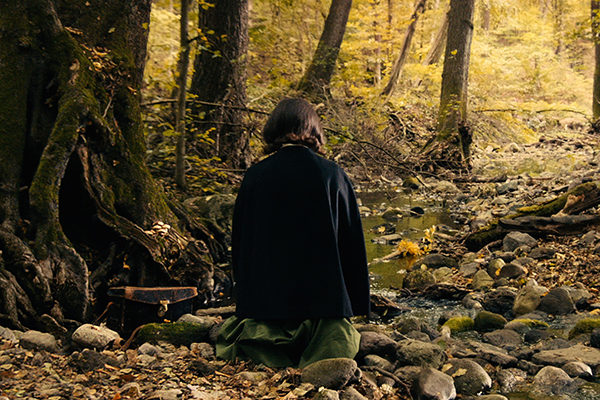
Shot by Tim Orr in gorgeous outdoor locations in New Zealand on a modest budget, Zobel’s film adds another reason to watch the career of the talented moviemaker. Matthew Munn’s production design and Ken Turner’s art direction excel in describing a real sense of place. Robbie, Ejiofor, and Pine layer their characters with subtleties sometimes missing from the inevitable conflicts that attend the final actions of the story. Zobel, however, cagily holds back one key piece of visual information at the film’s climax, and the choice renders some ambiguity in a moment that might have otherwise been heavy-handed.