The Hunting Ground

Huntingground1

Movie review by Greg Carlson

Director Kirby Dick and producer Amy Ziering follow their Oscar-nominated “The Invisible War” – a harrowing expose of the United States military’s woeful record regarding the issue of sexual assault – with another film addressing the same massive injustice done to victims of rape on college campuses. “The Hunting Ground” applies the filmmaking team’s familiar stylistic flourishes, from eye-catching graphic design disseminating grim statistics to a blend of archival and new footage seamlessly combined in a concerted effort to take a stand and make a point. The result is the gut-wrenching thesis that many colleges foster and support a culture in which rapists can repeatedly commit crimes without consequence.

While not every critic has embraced Dick’s blunt storytelling technique, which has more than once been unfavorably compared to “20/20,” “Dateline,” and other television newsmagazine shows, the director has successfully carved out a place for himself as one of the premier advocacy documentarians working in non-fiction features today. “The Hunting Ground” may not qualify as objective journalism, but given the systemic failures underlying the horrific realities of campus rape, the movie might just help bring about at least some overdue and urgent reform.  Dick and Ziering raise more questions than a single movie can hope to answer, and some viewers will yearn for a more nuanced discussion of many of the film’s topics. In the sense that the movie will start conversations on campuses and off, however, “The Hunting Ground” accomplishes its grassroots, “take action” goals.

Annie E. Clark and Andrea Pino – each assaulted while students at the University of North Carolina at Chapel Hill – emerge as key agents of change in the movie, and their presence, along with several others who were raped as students, is possibly the film’s greatest strength, especially since credible personal testimony always tops a torrent of statistical slides.  Clark and Pino have used the legal parameters of the Clery Act and Title IX, the federal law that states in part: “No person in the United States shall, on the basis of sex, be excluded from participation in, be denied the benefits of, or be subjected to discrimination under any education program or activity receiving federal financial assistance” to assist victims filing complaints against their institutions of higher learning.

In a series of explosive sequences, Dick and Ziering train their sights on America’s obsession with collegiate athletics and the fraternity “industry,” making a compelling case that universities are big businesses that exist to protect their financial interests above all else, including the safety of their own students. The story of Erica Kinsman, who was allegedly raped by Florida State quarterback Jameis Winston in 2012, sets up one of the movie’s most sickening examples of victim-blaming and shaming. Plenty of rabid football fans are quick to paint Kinsman as a false accuser, and the only thing uglier than their misguided invective is the “No Means Yes, Yes Means Anal” chant/signage that resulted in the suspension of Yale’s Delta Kappa Epsilon fraternity in 2011 and the Texas Tech chapter of Phi Delta Theta in 2014.

John Waters Interview

Johnwatersportrait

Legendary filmmaker John Waters will receive the Ted M. Larson Award from the Fargo Film Festival following his performance of “This Filthy World” on closing night, Saturday, March 7, at 7 p.m. at the Fargo Theatre. Waters will hold an audience Q & A after the show and autograph copies of his books, which Zandbroz will have available for sale at the event.

Tickets are sold separately from all festival passes and pass packages and are available now at Jadepresents.com, the Tickets 300 box office at 300 Broadway, or by calling 866-300-8300.

Waters spoke to High Plains Reader film editor Greg Carlson about his career, his hometown, and some of his favorite movies.


GBC: The Fargo Film Festival is honored to have you accept the Ted M. Larson Award.

JW: Oh good! I don’t get many awards.


GBC: Ted was my mentor and film professor and I spent a lot of time talking about your movies in his office.

JW: Is he no longer with us?


GBC: He died in 2000, just before the first Fargo Film Festival.

JW: He laid the groundwork for all the film buffs in town?


GBC: That’s right. He was the first person to teach film studies at the university level in our community.

JW: That’s great. I had someone like that at the University of Maryland. I think these people are very important.


GBC: Congratulations on the retrospective at Lincoln Center.

JW: Thanks, that was very exciting. It was like hanging around a funeral, since you got to hear everybody speak. They showed all the movies, fifty year’s worth!


GBC: I wish I could have been there. Have you ever been to North Dakota?

JW: No. I love to go places I haven’t been. And of course I will put the “Fargo” movie and the “Fargo” television show completely out of my mind so I can have a fresh canvas.


GBC: The Fargo-Moorhead Convention and Visitor’s Bureau has the prop wood chipper from the film.

JW: Well, they should! I’m curious, is the film loved or hated there, or both?


GBC: Movie-oriented people tend to love it. For the film festival a few years ago, “Fargo” was projected on the side of a building like a drive-in movie.

JW: That’s good. And now they can do it so well. I don’t know why they don’t bring drive-ins back, because now you can see the image so much better.


GBC: The only downside was that the profanity was censored because the soundtrack was broadcast on the radio.

JW: Well that’s no fun. It’s like an airline version.


GBC: Terrible.

JW: People always think I’m Steve Buscemi anyway. They’ll think that I’m there for “Fargo” again when they see me on the plane.


GBC: Steve Buscemi seems like he would be an honorary Dreamlander.

JW: Oh, he’s a good guy. Once, he went as me for Halloween. When he was doing “Homicide,” he dressed like me because people confused us. That year my Christmas card was Steve Buscemi dressed as me.


GBC: What does it take to be an honorary Dreamlander?

JW: Dreamland was when we were young, so probably LSD and shoplifting.

I’m having dinner with Mink tomorrow night. She lives in Nicaragua but I still see her. The ones that are alive, I’m still friendly with. I think it was just a gang of kids. We grew up together.

The thing was, we were from an upper middle class suburban universe and then we went downtown and wanted to be beatniks. And we met gay people and black people and we all hung around together, which made every community nervous.

Black cops used to stop us and say, “This isn’t Greenwich Village you know. You can’t hang around like this.” And so we all were like sort of refugees from our own minority that hung around together.

We bought graves together and called it Disgraceland. We personally believed you should be buried with your friends.


GBC: The Dreamlanders always seemed so willing to do anything you asked them to do on camera.

JW: Well, I wasn’t a sadist. The last scene of “Pink Flamingos” I only did one take. I didn’t say, “Let’s try that again.”

They did say no to me. I asked Mink to set her hair on fire in one movie. She said no. These were ideas I thought of on marijuana, so, you know, maybe I didn’t think them through.

Mink said, “How are we going to put the fire out?” I said, “We’ll throw a bucket of water on you.” She said no.

I asked Cookie to smash a television when it was on, with a sledgehammer. She said no. “It will explode in my face!” It might have, so I’m thankful they said no. I wasn’t asking them to do these things to be evil. I just wasn’t thinking it through.

It was all influenced by “Mondo Cane.” That’s the reason. “Mondo Cane” was one of the first shockumentaries that showed real things. In “Multiple Maniacs,” Divine ate a cow’s heart. That was training wheels compared to eating a dog turd.

And then in “Female Trouble,” he swam across a river in full drag. There were rapids and he hit his mark on the other side. And shot up eyeliner. It was real, but I had a nurse there to help. He did learn to do a flip on a trampoline.

There was one scene in “Female Trouble” I wanted him to do – I don’t know what I was thinking about – but I wanted him to vomit for real. We gave him ipecac, but he just couldn’t. The whole crew was gagging and trying to puke. Then I just sort of ended it. I think that was my “Mondo Cane” period.

I think the only person that’s ever done a movie that reminds me of my old films is Johnny Knoxville in the “Jackass” series. I love those movies. I think Johnny Knoxville is the spirit of anarchy and feels closest to what we were trying to do at the time.


GBC: I went to Sundance this year and saw “Being Evel,” with Johnny Knoxville.

JW: I can’t wait to see it. Johnny sent me pictures when he broke his penis. It was in a cast. He actually broke his penis. I never knew that was possible.


GBC: I didn’t either. He talks about it in “Being Evel.”

JW: Johnny is much hipper than Evel Knievel. He’s much better dressed than Evel Knievel.


GBC: How has Baltimore changed since you started making movies?

JW: I guess in some ways it doesn’t have an inferiority complex about itself anymore. Baltimore is really cool now. Kids from New York move here. It’s one of the last cities where you can afford to be a bohemian. It’s still cheap. It’s conveniently located to every city on the East Coast.  It’s better than it’s ever been.

Baltimore has always had a good sense of humor about itself.  It is never impressed easily by anything. At the same time, there is always local color here.  Now, like everywhere there are neighborhoods that get gentrified. And some of them, if they weren’t gentrified would just be boarded up, and that isn’t good either.


GBC: My friends Gabe DeLoach and Zach Keifer made a documentary called “If We Shout Loud Enough” about the Baltimore punk rock band Double Dagger. It’s really good. It captures some of the things you just mentioned about contemporary Baltimore.

JW: There’s a lot going on here, especially in the music scene.  Beach House. Future Islands. They all stayed here. They bought houses here, which is great.


GBC: Do you have a Baltimore restaurant recommendation?

JW: There’s a place called Peter’s Inn that I think is bohemian and foodie, which is almost impossible, but they do it very, very well.


GBC: Do you still take a Polaroid of every new visitor to your house?

JW: I do. It’s Fuji now because Polaroid, as you know, no longer makes film I can go to a drugstore and buy. I just took one two minutes ago.

When I die, the photos all go to Wesleyan University to join my film archive, but you can’t really see them until I’m dead and the people that are in them are dead.

If you take a picture of everyone who has been in your house, it’s very personal. I have pictures of some people I’d like to forget. Maybe were here once.


GBC: One thing I look forward to every year is your top ten movies list in Artforum.

JW: Thank you. Have you seen “Wild Tales”?


GBC: Not yet.

JW: So good. It’s from Argentina. It’s about revenge and is hilarious. I recommend that one highly.


GBC: I did see “Who Took Johnny.”

JW: It’s so bizarre because that one plot twist at the end when she says he came to the door. You’re like, “Uh oh. I don’t believe that.”


GBC: I love that moment.

JW: If he did visit, that means he’s a child molester and he’s still doing it.


GBC: It’s fascinating.

JW: I think it’s really a great documentary because at the end you have even more questions, but you think, “What?” The plot twists in it are really good.


GBC: Are you making notes on films throughout the year?

JW: If I really like them I do. I have a box and I throw my notes in after I see a film. I’ve rated every movie I’ve ever seen since I was sixteen.


GBC: You had “Spring Breakers” at number one for 2013.

JW: “Spring Breakers” is James Franco’s best movie. I love that there was an Oscar campaign for him: “Consider this shit.” Hilarious.


GBC: “Scarface” on repeat. Constant, y’all. Brilliant performance.

JW: Yes it was. I love the whole movie. I like Harmony a lot.


GBC: So besides Johnny Knoxville and Harmony Korine, who makes movies today that carry your torch of perversion and bad taste?

JW: I don’t know about carrying my torch. Gaspar Noe is great. Todd Solondz is great. Ulrich Seidl. There are lots of filmmakers that I really like.

I always want to see films that are startling and amazing. Not just shocking. Shocking is easy to do. But startling in the way that makes you change how you think about things. Those are the movies I like the best.


GBC: It has been a few years since George Kuchar died. A lot of younger people learned about the Kuchars thanks to you.

JW: In the 60s, he was one of the first underground filmmakers. And then later he hooked up with Curt [McDowell] and they made “Thundercrack!” in 1975.

George and Mike Kuchar were both were big influences on me because of how their films looked. Especially when I was young and saw their movies, they were the first ones that had thrift shop costumes and stolen Hollywood soundtracks and melodrama.

They were great artists. And they knew exactly what they were doing. And they never sold out. They always worked. Their movies always played. Their films are still showing all over the world.

I miss George. I did visit him in hospice. I was shocked. I knew he was sick but I didn’t think he was going to die that fast.


GBC: I watched the Oscars and was hanging on every word of the red carpet exchange between Melanie Griffith and Dakota Johnson.

JW: I saw that, yes.


GBC: I was reminded of your scene with Melanie Griffith in “Something Wild.”

JW: Melanie played parts that were very cutting edge! But I get why she didn’t want to see her daughter get spanked. I mean, my parents never saw “Pink Flamingos.” They weren’t allowed to. And Divine didn’t let his mother see it either. So I understand. Why would you torture yourself by watching your own kid do BDSM?


GBC: Another one of your memorable performances is the “no smoking in this theater” announcement.

JW: I shot that for the Landmark chain when I did a trailer thanking the viewers of the NuArt in L.A. because “Pink Flamingos” had played at least one day a week there for ten years.

And I was doing a thing saying thank you for paying my rent, for buying my cool cigarettes – it was a long time ago. And we did the whole thing and then they said, “We have four minutes of film left on the reel.”

And we just did it. It wasn’t planned.  I just made it up. There was one take of it. And they played it. There was no copyright on it and Landmark didn’t care. It was like a public service announcement.

It became a big hit at the NuArt and then it spread around the chain. Since there was no copyright, it went everywhere. I don’t know who has the negative. I’m thrilled that they did it.

They don’t make new prints so all of them really look like an old movie with all the scratches and lines and dirt, which I think only adds to it. Like a patina.

It Follows

FFF15itfollows1

Movie review by Greg Carlson

“It Follows,” writer-director David Robert Mitchell’s sophomore effort, is a chilling companion piece to debut feature “The Myth of the American Sleepover.” A retro-styled thriller that pays homage to a variety of classic horror movies like “Diabolique,” “Night of the Living Dead,” “Halloween” and “A Nightmare on Elm Street,” Mitchell’s spare, elegantly composed hallucination is at times reminiscent of Charles Burns’ “Black Hole,” and the moviemaker capitalizes on evocative Detroit locations that include both well-groomed suburbia and boarded up, decaying neighborhoods.

The story centers on Jay (Maika Monroe), whose relationship with Hugh (Jake Weary) goes from bad to worse following a consensual backseat tryst. Dosed with chloroform and tied to a chair is certainly not the pillow talk Jay expected, but Hugh drops a bombshell: he slept with Jay to “pass along” a dreadful problem. Malevolent “followers” track the last person afflicted with the mysterious curse, and as we learn in the tense prologue, the result of being caught is fatal. Mitchell is deliberately light on exposition, leaving the audience to puzzle out both the parameters of being followed and the possible solutions.

The sexual infection motif is deployed by Mitchell as both fulfillment and subversion of the genre’s sex-equals-death tradition. Only a carrier can see the approaching followers, forcing Jay’s circle of protectors, including sister Kelly (Lili Sepe) and friends Yara (Olivia Luccardi) and Paul (Keir Gilchrist), to set aside their skepticism as the threat intensifies. A fraught love triangle is introduced when attractive boy-next-door Greg (Daniel Zovatto) joins the group, catching Jay’s eye and deflating Paul’s hopes. Mitchell uses the trope to explore two facets of the ethics of sexual transmission: sleeping with someone who knows you are “sick” and sleeping with someone who does not.

Director of photography Mike Gioulakis beautifully exploits the possibilities of the widescreen image, and as pointed out by Peter Debruge, the film’s “meticulous compositions rival Gregory Crewdson’s ethereal suburban-gothic photographs.” Two of the deepest pleasures of “It Follows” reside in Mitchell’s appreciation of the long take and the traveling shot, and the filmmaker stages numerous scenes that place the viewer inside a moving car along with the weary, anxious victims. Several of those moments echo “River’s Edge,” even if Mitchell’s characters are not quite as well-defined as the dead-end kids in Tim Hunter’s brilliant film.

Our revulsion at the slightly altered familiar – perfected by George Romero in his 1968 masterpiece – manifests in the series of followers pursuing Jay. Like the flesh eaters in Romero’s apocalypse, the creatures in “It Follows” walk and don’t run. They are often seen in an unexplained state of undress. They can be young or old. They can be strangers or loved ones. They are invisible to all but the unlucky infected, and Mitchell executes several hair-raising scenes indoors and outside – nowhere is safe.

Even though the John Carpenter-esque score by Rich Vreeland’s Disasterpeace has received deserved acclaim, several critics have taken at least minor issue with the movie’s last major set piece, a confrontation set in a cavernous indoor swimming pool that ends up raising more questions than it answers. The eerie atmospherics of that aquatic setting don’t quite match up to a similar scene in “Let the Right One In,” another film that shares many of the smart sensibilities of “It Follows.” Both movies invite repeat viewings to appreciate all the details, however, and “It Follows,” like “The House of the Devil” and “You’re Next,” reminds us how much fun it can be to get scared.

“It Follows” will screen on Friday, March 6 at 7 p.m. at the Fargo Film Festival. Tickets available at the door. Producers Jeff Schlossman and Erik Rommesmo will participate in a Q & A after the screening. 

The Overnighters

Overnighters1

Movie review by Greg Carlson

Filmmaker Jesse Moss constructs one of the best documentaries of recent memory in “The Overnighters,” a complex and thoroughly gripping look at ourselves when faced with questions of charity, forgiveness, trust, and love. Set during the recent explosive population boom in Williston, North Dakota that accompanied the introduction of fracking, the film takes a hard look at community from the inside, and what Moss sees – like the best filmmaking – makes us feel a little less comfortable. Moss distills the waves of arriving migrants into astute observations that have been repeatedly and accurately compared to “The Grapes of Wrath,” emerging with a chronicle both poignant and personal.

Moss, who operated his own camera and remarkably served as the only location crewmember during principal photography, gains intimate access to his subjects through a relationship with Pastor Jay Reinke, a fascinating character whose willingness to live out his interpretation and understanding of Christian directives puts him in conflict with his parishioners, his neighbors, the city council, the local media, some of the very men he desires to help, and even his own family. Reinke runs the Overnighters program, which opens the doors of Concordia Lutheran Church to provide shelter to workers who have no other place to stay. Reinke’s radical hospitality disrupts the congregation just as much as the influx of men seeking employment in the oil fields rattles the previously quiet municipality.

Along with Reinke, Moss introduces the audience to several men, including Keegan Edwards, a young father from Wisconsin desperate to make a better life for himself, and Keith Graves, a registered sex offender whose participation in the Overnighters program poses a huge threat to its very existence. When Reinke invites Graves to move into his home – in part to counter charges in the Williston Herald that criminals are being housed in the program – Moss locates a key flash point for the drama. Is Reinke merely practicing what he preaches? Placing his children at risk? Avoiding responsibility? Taking responsibility? Demonstrating faith in the possibility of redemption? Exercising hubris and foolishness?

Moss must have had an abundance of potential story options when he amassed the footage that would become “The Overnighters,” but he and editor Jeff Gilbert also make decisive choices in shaping the narrative. The resulting urgency and immediacy fuel the movie’s churning engine and flood the viewer with emotion. Reinke, at the center of it all, is unforgettable – so much so that Moss has indicated he included some material to remind the viewer that the unfolding story was unscripted. In one gripping sequence, a youthful newspaper reporter dogs Reinke in the street, repeating his questions while Reinke, acting distracted and trying to hide his agitation, ignores him.

Moss sticks to Reinke like glue, and by the film’s final sections, the closeness yields a series of absolutely stunning onscreen revelations that simultaneously upend and validate the complexities of the content that forms the first two thirds of the movie. In several scenes, Moss’ lens bears witness to jaw-dropping intimacies that at first don’t even seem real. Once the shock wears off, the viewer is invited to reevaluate previously covered territory. This experience is otherworldly, since in at least one raw instance, Moss had no idea that he would be capturing such a private moment (in multiple interviews, Moss insists he would have turned the camera off that day had he been asked). The filmmaker’s respect for his subjects defines “The Overnighters,” an indelible snapshot of a particular place at a particular time.

Mistress America

Mistressamerica1

Movie review by Greg Carlson

Wittily written, sparklingly performed, and dazzlingly directed, “Mistress America” quickly makes for itself a strong case as Noah Baumbach’s finest film to date. If not, the movie is at least every bit as wonderful as “The Squid and the Whale,” though its tone more closely resembles an effortlessly madcap screwball comedy by Ernst Lubitsch or Gregory La Cava or Howard Hawks or George Cukor or Preston Sturges. “Mistress America” is the second writing collaboration between Baumbach and Greta Gerwig, and like “Frances Ha,” the movie blossoms under the influence and presence of the warm and winning star.

Gerwig plays Brooke, a brilliant dreamer who juggles gigs as a spin class instructor and bottom-rung interior designer with plans to open a Williamsburg restaurant where the home-style cooking will be served on deliberately mismatched china. Brooke lives in an expansive exposed brick loft – not zoned residential and reachable only by fire escape and unlocked window. The boyfriend to whom the space apparently belongs is absent. All of Brooke’s traits, and her cascade of blurted, hysterical non-sequiturs, cast a spell on Tracy (a smashing Lola Kirke), a Barnard first year and aspiring writer whose mother is engaged to marry Brooke’s father.

For the sake of future family harmony, the sisters-to-be decide to hang out, and Tracy’s trepidations evaporate in the presence of the energetic and uninhibited “adult.” Baumbach has always been a shrewd observer of human nature and desire at multiple ages, and one of the supreme pleasures of “Mistress America” is watching Tracy watch Brooke. Scott Foundas writes, “Like one of his own filmmaking idols, Eric Rohmer, [Baumbach] seems to have remained very much an adolescent at heart, and he’s one of the few American filmmakers to embrace young people in all of their amorphous identity, occasional callowness and naive optimism…” Though Brooke and Tracy are not all that far apart in age, Baumbach and Gerwig fully grasp the world of difference between them.

Without implying any disrespect to “Frances Ha,” a Sundance programmer identified “Mistress America” in his introduction to the film as a significant leap forward for Gerwig and Baumbach. The comment might have applied to a kind of collaborative confidence emerging from the pair’s onscreen and offscreen relationships, but it could just as easily footnote the filmmaker’s embrace of élan over introspection, brio over self-loathing, and joie de vivre over grim resignation. Those latter markers of melancholia describe aspects of “The Squid and the Whale,” “Margot at the Weddding,” and “Greenberg,” and are to Baumbach equally worthwhile sources of humor.

Fleet and nimble, “Mistress America,” like all great movies, leaves you wanting more and imagining additional experiences for characters you feel you got to know intimately in less than ninety minutes. There is much to recommend here: the John Hughes-esque application of Dean Wareham and Britta Phillips’ fantastic synth pop score, the incisive way Baumbach explores the boundaries between life and art (Tracy’s unauthorized use of Brooke as the basis for a short story character provides enough material for a movie of its own), and the breathless, astonishingly staged and realized set-piece that finds an odd assortment of unlikely guests committing to farce at a Connecticut home. But the greatest joys of “Mistress America” can be found in the warmth of the relationship between Tracy and Brooke.

Being Evel

Beingevel1

Movie review by Greg Carlson

Oscar-winning documentary filmmaker Daniel Junge tackles the larger-than-life personality of iconic American motorcycle stunt performer Robert Craig “Evel” Knievel in the entertaining biography “Being Evel.” As fast-paced and foul-mouthed as its subject during his 1970s heyday, Junge’s movie prominently features plenty of footage interviewing producer Johnny Knoxville, a fellow fan who had simultaneously been developing a Knievel film prior to teaming up with the documentarian. In addition to his conversation with Knoxville, Junge conducted sixty chroma key interviews for the movie, compositing the talking heads with “projected” images in a visually striking theatrical setting.

Junge intends to reconcile Knievel’s heroic status with the man’s consistently horrible behavior, and on that count, “Being Evel” is reasonably successful. As the story unfolds, two Knievels – the patriotic, action figure and helmet safety advocate and the conniving, belligerent, greedy outlaw – emerge. For millions of kids who idolized Knievel, revelations about the less savory aspects of his character are brought to life through the recollections of those involved. Promoter Shelly Saltman, for example, offers insight and perspective on his painful meeting with the business end of a baseball bat wielded by Knievel following a perceived slight published in Saltman’s memoir.

Knievel’s exploits were very well documented, and Junge uses a trove of archival material to his advantage. Sections on the wildly popular Ideal Toy Company’s wind-up Evel Knievel Stunt Cycle and the 1971 movie produced by and starring George Hamilton contribute to an understanding of the Knievel phenomenon, but the most devoted aficionado will be looking for references to other artifacts, like the Bally pinball machine, the Topps bubblegum cards, and the spectacular Aladdin Industries lunch box. It is simply not possible to squeeze in everything (the rehearsal footage from Knievel’s “Jaws”-inspired shark tank jump, included in the 2005 “Absolute Evel” documentary, is omitted here), but Junge makes strong choices to explore key highlights in depth.

No matter how many times some of the clips of Knievel’s leaps have been shown on television over the last forty plus years, audiences will react to many images with fresh amazement.  The failed 1967 Caesars Palace fountain jump, which sent Knievel skittering and tumbling across the pavement like a discarded ragdoll, receives significant attention. So too does the 1974 Snake River Canyon attempt in the steam-powered Skycycle X-2. Junge recognizes the latter event, complete with the surreal spectacle of Hells Angels mingling with high school marching band members and the general atmosphere of criminal behavior and sexual debauchery, as a critical turning point in the narrative.

Junge and Knoxville credit Knievel as a spiritual godfather to the adrenalized and inherently dangerous world of extreme sports, modern stunt riding, and the Jackass generation. Not surprisingly, the overwhelming majority of the interview subjects in “Being Evel” are men, but one of the most moving witnesses to the circus is Knievel’s first wife Linda, to whom he was married for 38 years. Suffering the indignities of her husband’s serial infidelities and the psychological stress of raising four children who had to grapple with the possibility that their dad could lose his life every time he pulled on his red, white, and blue leathers (and that he did so by choice), Linda’s candid responses are among the film’s most pointed and poignant.

World of Tomorrow

Worldoftomorrow1

Movie review by Greg Carlson

Going into the latest edition of the Sundance Film Festival, Don Hertzfeldt captured the record for most movies screened in competition by a single filmmaker in the festival’s history. And with his win for Short Film Grand Jury Prize, “World of Tomorrow” makes Hertzfeldt the only artist to have collected that honor twice. The new movie represents the next logical step in the animator’s increasingly momentous career. Longtime true believers, stunned by the conclusion of Bill’s journey in “It’s Such a Beautiful Day,” whispered to one another nervously: How could Hertzfeldt possibly create a follow-up to what is, quite simply, one of the greatest animated movies ever made?

The first hint of things to come arrived in the unexpected and delightful surprises packed into the two-minute couch gag for “Clown in the Dumps,” the 26th season premiere of “The Simpsons.” Hertzfeldt’s fabulous, phantasmagoric commentary on the durability of the show many have dismissed for years contextualizes its place in our culture, simultaneously critiquing the commercial ubiquity of its iconic characters (“Make purchase of the merchandise”) and recognizing the special place they earned in our hearts long ago (“Still love you, Homer”). Like he will do in “World of Tomorrow,” Hertzfeldt imagines a distant future that is utterly unique yet anchored in the director’s durable observations of the mundane, everyday, and quotidian.

With his signature absence of capitalization, Hertzfeldt wrote in the journal he shares on his website, “there is something strange about the simpsons that i’ve always wondered about… it’s a 26 year old show that seems to always be set in the current day, yet none of the characters ever age and they usually refer to past episodes as past events in their lives. do the children have memories of events from twenty years ago? but while they don’t age, they do evolve… they’ve changed a lot over the years from the way they were first drawn in season 1. so that was where i wanted to start… what happens when the longest running show on tv just never ends?” Hertzfeldt’s answer to that question, which applies in equal measure to the principal themes explored in “World of Tomorrow,” is assuredly one of the best moments in Simpsons history.

One of Hertzfeldt’s greatest strengths as a storyteller lies in his ability to bring apparent opposites into close proximity. Like the Bill trilogy, “World of Tomorrow” soars with happiness one moment and devastates with sadness in the next. The actions and reactions of the characters are by turns profound, uplifting, pathetic and terrifying. Expanding on several of the visual ideas introduced in his work on the “Clown in the Dumps” couch gag, Hertzfeldt contemplates the biggest questions we can ask of ourselves: What does it mean to be alive? Why are there limits to the time allotted us? How do we love?

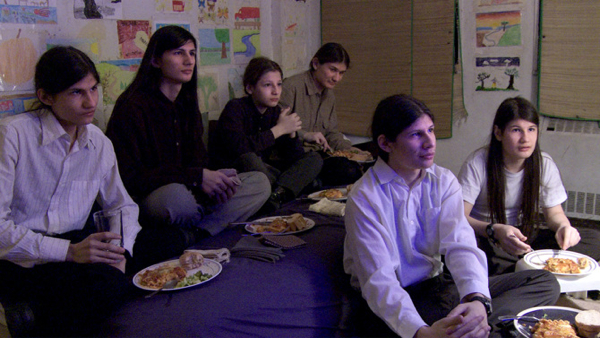
Employing digital tools – which he used on “The Simpsons” project – and, for the first time, widescreen, Hertzfeldt introduces us to Emily Prime (Winona Mae, Hertzfeldt’s niece, four years old at the time he recorded her), a little girl visited by her own future clone. The grownup Emily is voiced by Julia Pott, the accomplished British animator and illustrator whose arresting hand-drawn shorts “Belly” (2011) and “The Event” (2012) conjure fully realized worlds in which human-animal hybrids dream of love and friendship while dealing with their severed limbs. The two Emilys – one a child and one an adult but in some sense also the same person – struggle to effectively communicate with each other, but eventually manage to forge a connection.

Hertzfeldt continues to develop his capacity for jet-black comedy and brain-scrambling surrealism, and “World of Tomorrow” is crammed with jokes both visual and verbal that stare down grim, grinning death. Faulty, discount time travel machines drop passengers (and at one point, Emily Prime, like a Gashlycrumb Tiny) in barren snowscapes. Lovely shooting stars are composed of the corpses of the once hopeful. Significantly, the filmmaker’s earnest curiosity blocks out all cynicism, and viewers will take comfort in the cheerful, agreeable openness of Emily Prime. Hertzfeldt’s sensibilities radiate from both Emily Prime’s innocence and the cloned Emily’s bleaker, more wistful worldview (“Now is the envy of all of the dead”). The combination, like Hertzfeldt’s finest work, reminds us that life is short but it can also be so very sweet.

Harmontown

Harmontown1

Movie review by Greg Carlson

Fan studies scholars should salivate over Neil Berkeley’s portrait of writer/performer Dan Harmon, the self-proclaimed mayor of “Harmontown,” the popular podcast he hosts. Berkeley’s documentary bears the same name as Harmon’s loquacious, therapeutic circus, and hardcore devotees will already be familiar with the details of that freewheeling, improvisational, mental odyssey and the ways in which it thrives on audience participation. Following Harmon on the podcast’s national tour, Berkeley’s principal thematic concerns alight on the relationship between “Harmontown” and its intense and particular citizen: “a nerd full of love.”

Harmon is joined on the tour bus by his girlfriend (now wife) Erin McGathy, comptroller Jeff B. Davis, and dungeon master Spencer Crittenden, a breathing symbol of the way in which the “Harmontown” podcast experience erases barriers between audience member and performer. Crittenden, a bearded and bespectacled introvert who lives with his parents, soon emerges as the show’s unexpected star: an accomplished Dungeons & Dragons host swept up into Harmon’s new raison d’etre. Crittenden’s move from spectator to content creator inspires the Harmenian army, and Berkeley includes multiple scenes in which members of the “Harmontown” fan base take photos with and tell stories to both Crittenden and Harmon.

Podcast success aside, Harmon is probably best known as the creator of “Community,” the single-camera sitcom that premiered on NBC in 2009. Prior to “Community,” Harmon’s comic bona fides (he has been referred to as “tortured genius” enough times to make the ghost of Vincent van Gogh snip his other ear) were well established. The what-might-have-been, too-good-to-be-true promise of “Heat Vision and Jack,” a much discussed and costly pilot that starred Jack Black and Owen Wilson in a loopy metafiction with nods to “Knight Rider,” became a crazy calling card for Harmon and collaborator Rob Schrab, even though no additional episodes were made.

“Heat Vision and Jack” is covered in “Harmontown,” as is Harmon’s doomed relationship with “The Sarah Silverman Program,” which he co-created with Silverman and Schrab. Silverman appears in “Harmontown” (along with a number of other comedians and once and future Harmon collaborators like Black, Schrab, Ben Stiller, and many “Community” cast members) and describes the events leading to Harmon’s eventual ouster from “The Sarah Silverman Program.” Harmon’s deficiencies, vaguely described here as a kind of controlling perfectionism, foreshadow the firing of Harmon from “Community.”

At a certain point along the way, Dan has an epiphany that Spencer is in fact the hero of this narrative, and in another movie, Berkeley might have run with the idea. The filmmaker attempts a few times to temper the constant adulation from “Harmontown” ticket buyers with Harmon’s capacity for cruelty, but some will be left with the feeling that the documentary does not go far enough in trying to grapple with Harmon’s demons and dark side. Harmon’s alcohol consumption, for example, is a big elephant in a small room, but Berkeley keeps his distance, playing a night when Harmon gets fall-down drunk on moonshine strictly for laughs. I would also have appreciated an opportunity to get to know McGathy better. She seems to suffer more than anyone’s fair share of abuse, but remains pretty tight-lipped when it comes to criticizing her partner.

Inherent Vice

Inherentvice1

Movie review by Greg Carlson

Paul Thomas Anderson’s future cult film “Inherent Vice” is soft-boiled detective fiction. Bleary-eyed and hair-tousled, the movie is a pungent, shambling, meandering, and thoroughly hilarious shaggy dog story with a non-agenda traceable directly to the likes of Howard Hawks’ adaptation of “The Big Sleep” and its famous anecdote in which Raymond Chandler received a telegram from the director demanding to know who committed one of the murders. Chandler, of course, claimed he had no idea, and the legend has evolved into one of the most glorious arguments summarizing the value of the journey rather than the destination.

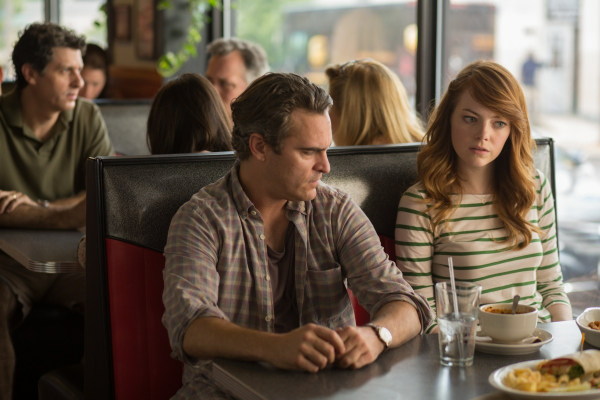
As the pot-addled private investigator Larry “Doc” Sportello, Joaquin Phoenix is about as far as he can get from the tightly coiled Freddie Quell, and the one-eighty feels like Anderson’s gift to his star. A mellow cat in a dog-eat-dog, post-Manson horror show, Doc may or may not be smarter than he lets on. A visit from his ex “old lady,” Shasta Fay Hepworth (Katherine Waterston), propels Doc, more or less, in the direction of a knotty/naughty missing person case, and the leads only lead to what might be described as more rabbit warren than rabbit hole.

“Inherent Vice” is the first big screen adaptation of Thomas Pynchon to be produced, and Anderson’s script preserves much of the novel’s tone and language, especially evident via the narration provided by Joanna Newsom’s Sortilege. The story goes that Anderson transcribed the novel’s dialogue line for line and the action scene for scene before deciding what had to be cut, and the result should delight devotees of Pynchon’s gift for Heller-esque monikers, spider-webbed pop culture allusions, brain-melting argot and the warped antinomies of L.A. law enforcement, the last perfectly captured by Josh Brolin’s Lt. Detective Christian F. “Bigfoot” Bjornsen.

The flat-topped civil rights violator is a perfect foil and nemesis to Doc’s filthy-footed hippie, and the symbiosis between the two unlikely bedfellows provides many of the movie’s biggest laughs and most satisfying exchanges. Bjornsen’s square jaw and square attitude clash with Doc’s permissive anti-establishment vibe, but “renaissance cop” and gumsandal are more unified than either cares to admit. Theirs is the movie’s most thoroughly understood and fully realized relationship.

Anderson’s deliberately slack pacing will alienate many viewers, but the relaxed running time allows the filmmaker to indulge in one of his greatest strengths: the non-stop introduction of fabulous faces in meaty roles, some of which turn out to be single scene appearances so delicious you keep your fingers crossed that Doc will reacquaint himself with these creatures later. Not unlike the gallery of misfits in Anderson’s other 70s Southern California period trip “Boogie Nights,” “Inherent Vice” showcases the auteur’s affection for actors, and the giddy exuberance shows.

In his entertaining video essay, Chris Wade makes a case for the “Slacker Noir,” a “mystery in which the protagonist’s primary goal is to extricate himself from the main storyline rather than somehow solve or resolve the conflict.” Naturally, the subgenre mash-up of tough, pulpy crime writing perfected by Hammett, Cain, and Chandler (dependent on procedure) and stoner comedy (dependent on inability to function procedurally) relies on parody, and in this respect “Inherent Vice” can be aligned with hallmarks including Anderson-hero Robert Altman’s “The Long Goodbye” and Joel and Ethan Coen’s “The Big Lebowski.”

Happy Valley

Happyvalley

Movie review by Greg Carlson

While there is an abundance of hero worship on display in Amir Bar-Lev’s raw and riveting documentary “Happy Valley,” the most courageous figure to emerge from the wreckage and devastation caused by the Jerry Sandusky case at Penn State is Sandusky’s adopted son Matt. For any number of possible reasons, Matt is the only person victimized by Jerry Sandusky to appear in the movie, and each time he speaks, Bar-Lev refocuses attention on the grim truth: the lives of many children and families were shattered by the monstrous actions of a serial child molester. In 2012, Sandusky was found guilty of 45 counts of sexual abuse of young boys and was subsequently sentenced to 30 to 60 years in prison for his crimes.

“Happy Valley,” however, is not a movie that digs into the specifics of the criminal proceedings leveled at Sandusky. Instead, Bar-Lev uses the case as an inciting incident to examine the ways in which a variety of communities with competing interests and investments come together and are torn apart. The movie does make an argument that the passionate football fans of the Nittany Lions showed in their desire to exonerate venerated football coach Joe Paterno a stunning lack of perspective regarding Sandusky’s victims, but that viewpoint may not be emphatic enough.

Bar-Lev recognizes the challenges of addressing the relationship between Paterno and retired assistant coach Sandusky, and while the filmmaker shows old footage of an interview in which both men appear, the suggestion that Paterno was indifferent to — or even disliked — Sandusky precedes the questions of how much Paterno knew and for how long. “Happy Valley” spends significant time with Paterno’s wife Suzanne and two of their children, sons Jay and Scott, and while the film aspires to a kind of journalistic objectivity, Paterno is treated with respect, if not kid gloves, by the filmmaker.

While Paterno’s legacy emerges as one of the movie’s central themes, Bar-Lev juggles a head-spinning number of fascinating subplots and side trips, each of which could sustain a film. These topics are naturally interrelated, from the perceived severity/lack of severity of the NCAA sanctions to the unruly crowds that blame the media for hastening Paterno’s exit and physical decline. Only brief mention is made of the ouster of Penn State president Graham Spanier, senior vice president for finance and business Gary Schultz, and athletic director Tim Curley, possibly due to the ongoing and still unfolding events (something that prevents the document from achieving a full sense of closure).

One of the film’s most intense sequences takes place outside Beaver Stadium at the site of Angelo Di Maria’s bronze statue of Joe Paterno, where a man holding a small hand-written sign that reads “Paterno, the Cover-Up Artist! Paterno, the Liar! Paterno, the Pedophile Enabler!” verbally and physically clashes with several angry people. During the intensely uncomfortable confrontations, Bar-Lev cuts to the sky, where a plane pulls a banner stating “Take the statue down or we will.” The chaotic scene, complete with finger pointing and heated arguments, captures the bizarre culture that develops when something as sacred as big-budget collegiate football is challenged. The statue, of course, was removed and placed into storage, but plans by alumni acting independently from the university are underway to unveil a new statue of Paterno, a few miles from the stadium, in November of 2015.