Movie review by Greg Carlson
The feature directorial debut of established internet phenomenon and entertainment hyphenate Hayley Kiyoko – known unironically to her fans as “Lesbian Jesus” – carries with it a curious backstory becoming more and more common in the era of DIY media makers who came of age producing content for online platforms. The movie version of “Girls Like Girls” is based on the bestselling 2023 novel of the same title, itself an adaptation of Kiyoko’s 2015 single and music video. The lightspeed transformations of pop culture in our protean digital age partially imbue Kiyoko’s work with an almost quaint sense of queer teen romance as it might have been (re)presented years ago. Perhaps it is no coincidence the events of the movie are set in 2006.
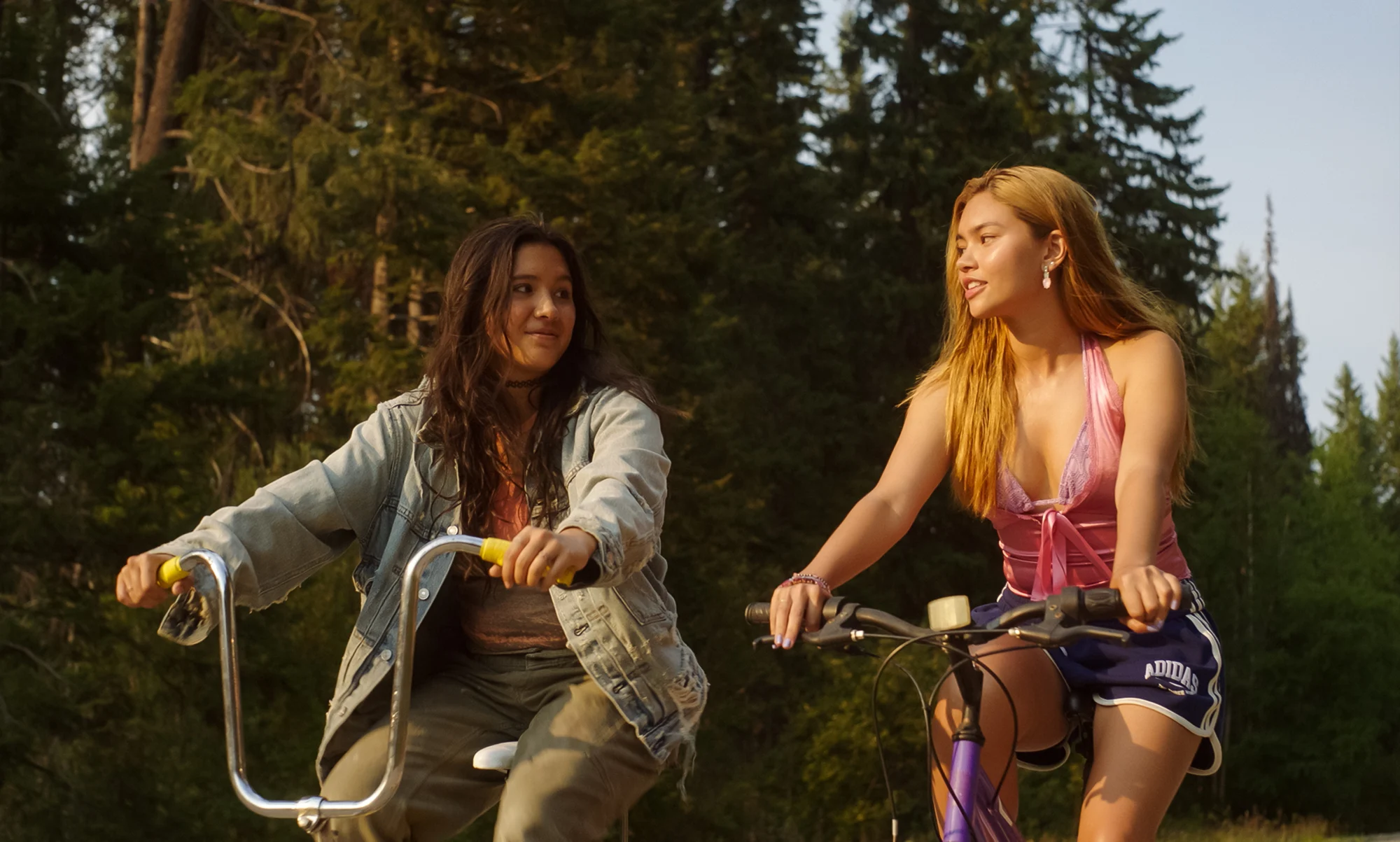
Some viewers will surely take comfort in Kiyoko’s girl-meets-girl tale of Coley (Maya da Costa), a teenager reeling from the death of her mother as she seeks a sense of equilibrium with long-estranged father Curtis (Zach Braff). Relocating to the magic hours of a sun-dappled Oregon, “new girl” Coley falls hard for the mercurial Sonya (Myra Molloy), whose own nascent lesbian awakening remains carefully hidden from her boyfriend Trenton (Levon Hawke) and their group of pals. For older watchers already grown when the iconic AOL Instant Messenger chat ruled online communication, the presence of period details may not seem too far away or foreign.
Kiyoko’s infusion of post-Y2K nostalgia may cast a glow over the familiar terrain of a romance complicated by the “forbidden” nature of the submerged/hidden/unspoken, but a number of contemporary queer critics and audience members have questioned the extent to which “Girls Like Girls” successfully operates within the framework of LGBTQ+ screen stories more typical of the 1980s and 1990s. In other words, while mileage always varies for the individual consumer, there is a legitimate argument that Kiyoko fails to locate the necessary edges regardless of the chosen period. In any case, this is Coley’s narrative and she is the undisputed protagonist; Sonya, in a supporting spot, is the person coming out.
Given the director’s earnest tone, it is impossible to say whether “Girls Like Girls” will eventually be enshrined as essential cult lesbian cinema. Kiyoko’s built-in fandom will have some impact on that question. The movie frequently struggles to communicate the depth of characterization necessary to elevate both Coley and Sonya to a level allowing close viewer identification. As the obscure object of Coley’s desire, Sonya is surely meant to frustrate the course of true love via some degree of internal conflict in the antiquated “But-what-will-people-say?” movie tradition that equates homosexuality with wrongness.
Despite the R-rating, “Girls Like Girls” sticks to a modest sensuality that emphasizes Coley’s erotic longing for Sonya, who is always framed and shot and gazed-upon in a way that underlines her physical desirability to Coley and the rest of Sonya’s peers. The choice aligns the viewer with Coley’s intense emotions, which run from giddy, pulse-quickening excitement to frustration and heartbreak. The saving grace of “Girls Like Girls” emanates from Kiyoko’s conviction and personal connection to this world and material. Even viewers with little or no knowledge of the decade-long journey from song to movie will instantly clock the filmmaker’s authenticity.