Movie review by Greg Carlson
David Robert Mitchell’s energizing dino-danger adventure “The End of Oak Street” descends upon us like a late-summer gift from the Hollywood heavens. If possible, go see it knowing nothing ahead of time and then come back to read the rest of this review. Mitchell’s fourth film as writer-director continues the moviemaker’s preoccupation with the subtleties and nuances of familiar suburban experiences charged through with a heightened sense of the uncanny. In “Oak Street,” an inexplicable cross-time event drops a family struggling with internal domestic peril into a prehistoric bubble of run-for-your-life peril. Both the early 1980s setting and the central presence of thundering theropods draw a straight line to principal inspiration Steven Spielberg.
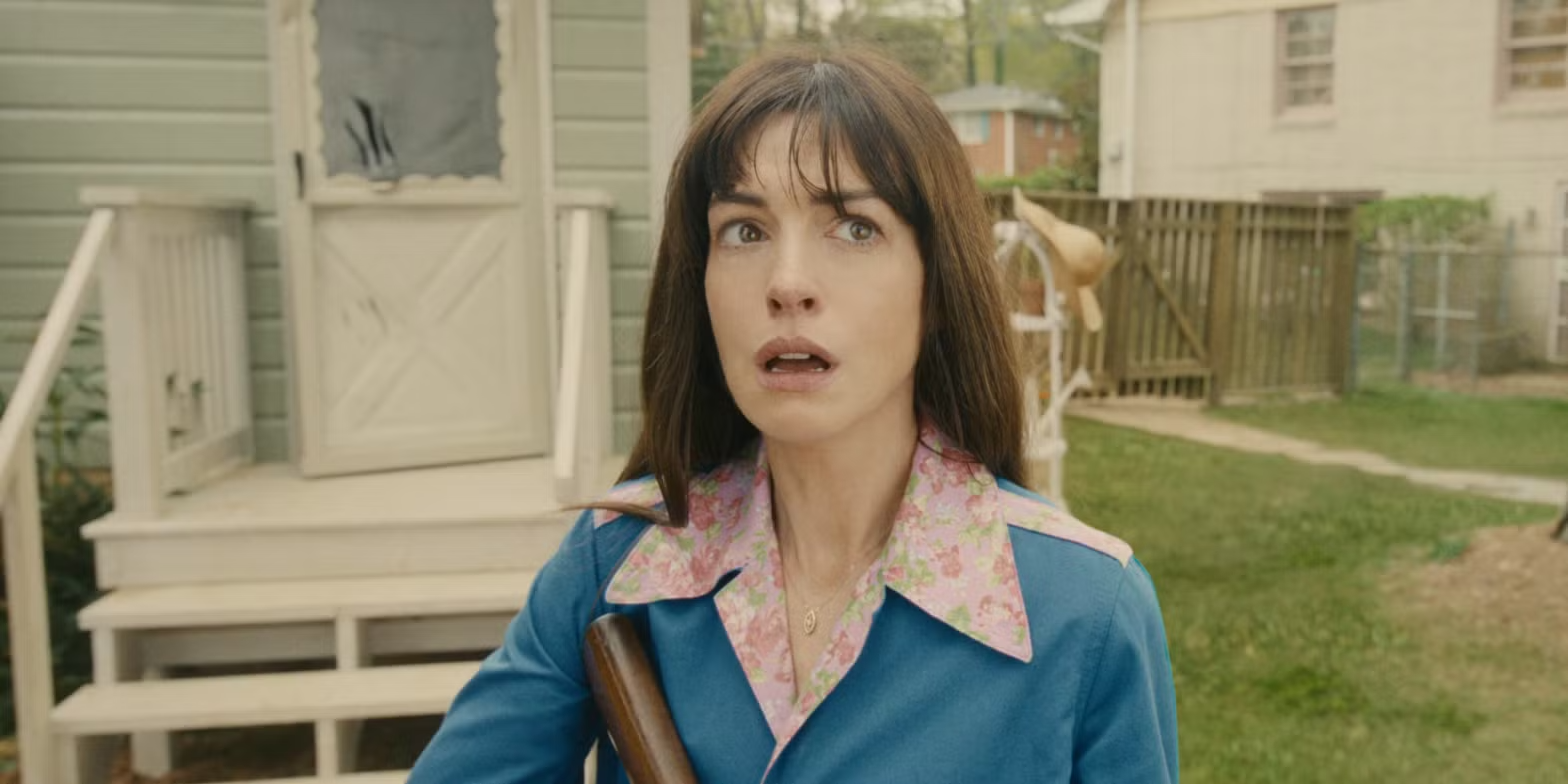
But Mitchell’s critters, which include a massive, snake-like, Titanoboa-inspired scene-stealer, a fantastically-feathered Allosaurus, and a full complement of threats large and small, are integrated into a dynamic drama that stands apart from the Jurassic World-era of Universal’s franchise. By jettisoning Jurassic Park/World’s preoccupation with the hubristic fallout of unethical science beholden to investor greed, Mitchell invigorates the viewer by deliberately aligning our own confusion and disorientation with the stunned reactions of the Platts, a Michigan quartet made up of aspiring novelist Denise (Anne Hathaway), alcohol-dependent Greg (Ewan McGregor), and their kids Audrey (Maisy Stella) and Brian (Christian Convery).
The central family unit, threatened initially by the grim possibility of dissolution by divorce, must work together once the gnarly claws and jaws start stampeding across lawns. McGregor is as dependable as ever, but Hathaway, whose 2026 is turning out to be her annus mirabilis, takes over “Oak Street” with a ferocious conviction. Mitchell’s movie marks the fourth of Hathaway’s five releases this calendar year – the highest tally of her career. The Oscar-winning star’s chops are as impressive as her instincts; devoted fans might recall her terrific turn as another writer tangled up with a giant monster in Nacho Vigalondo’s darkly comic kaiju homage “Colossal.”
Grouches might argue that Mitchell skimps on richer and deeper characterizations in favor of the constant escalation of theme park thrills. To my mind, however, the filmmaker’s all gas-no brakes method here is as deliberate and methodical as many of Hitchcock’s prime chases. “The Myth of the American Sleepover,” “It Follows” and “Under the Silver Lake” all explored, to one degree or another, the illusion of safety and comfort falsely provided by our neighborhoods (a theme that David Lynch carried to its apotheosis in “Blue Velvet” and “Twin Peaks”). In this regard, “Oak Street” comfortably harmonizes with the director’s impressive filmography.
It’s difficult to say whether “The End of Oak Street” would have worked better without the limitations of the PG-13 rating, but Mitchell, like Spielberg before him, appears to take genuine pleasure in walking right up to the line without crossing it. What we don’t see, enhanced by sound designer Paula Fairfield and her team, is as unsettling as what we do witness. A few critics have detected a mean-spiritedness in the delivery of the carnage and mayhem while others (myself included) would like to imagine that the director is sending a clear message to the next generation of moviemakers: being scared is OK. The film’s dedication, made by Mitchell to his late father, speaks volumes.